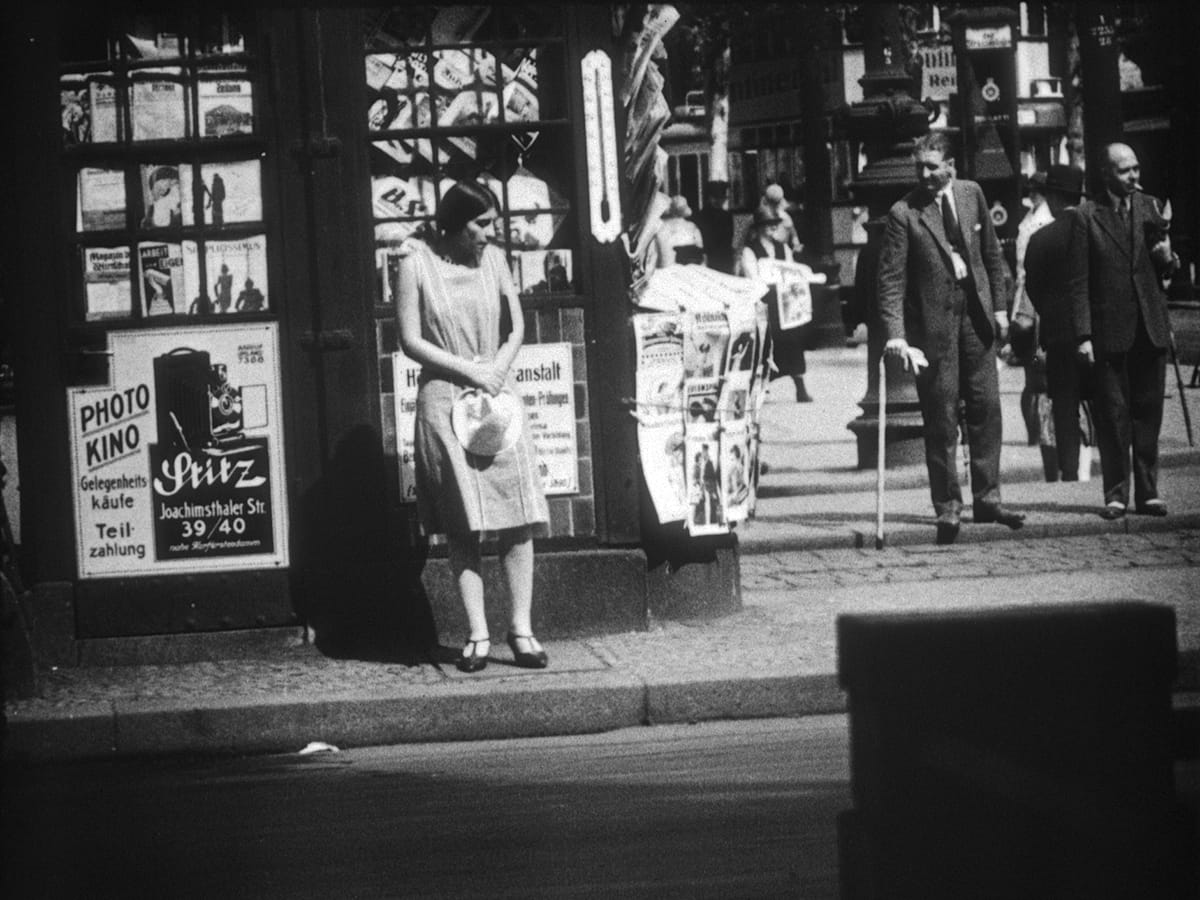
Near the middle of People on Sunday, Berliners at the lakeside turn toward a beach photographer. Their faces first arrive in motion: squinting in the sun, finding an expression, failing to hold it. Then the film arrests them. Freeze frames briefly convert a moving crowd into a stack of portraits, only for a run of idealized, retouched romantic stills—smooth couples in prepared poses—to make stillness look suspiciously perfect.[3]
The sequence seems to offer an easy contest. Moving pictures catch life; formal photographs manufacture it. Yet Robert Siodmak and Edgar G. Ulmer's 1930 silent film is too alert to performance for that verdict to hold. Its supposedly candid faces have been selected, framed, and edited. Its five principal players use their real names and everyday occupations, but they are also following a scenario in front of Eugen Schüfftan's camera. Even a day off has conventions: how to flirt, how to picnic, how to look carefree, how to behave when someone is looking.
That is why the portrait interlude is not a documentary ornament. It is the film in miniature. People on Sunday does not discover a pure self behind the pose. It catches the more interesting instant in which ordinary people try a pose on—and lets motion show the effort.
Spoiler note: this essay discusses the full film, including its return to the working week.
The camera catches composure being made
The lakeside montage begins with the social ritual of having one's picture taken, but the movie camera refuses to wait for the ritual to finish. We see faces organizing themselves for the promised photograph. A grin spreads, a mouth tightens, eyes search for the lens. These transitional expressions would be mistakes in a paid portrait; here they are the event.
Imogen Sara Smith notes that the sequence sets unvarnished moving faces against retouched romantic stills, apparently claiming honesty for cinema over photography.[3] But the film complicates its own claim by using freeze frames. The moving image proves its vitality by stopping. The candid face becomes memorable only after editing extracts it from the flow. Cinema does not defeat the portrait; it reveals that a portrait is made from time, then borrows the same power to preserve one.
The people looking back also prevent the sequence from becoming invisible observation. They know an image is being taken. Some cooperate, some mug, some look wary. Their direct gazes turn documentary evidence into an encounter. Schüfftan's camera may catch the seconds around the official pose, but it cannot pretend to be absent from them.
This matters because the film's famous naturalness is often treated as if it simply happened. The light flickers, crowds cross the frame, trains and traffic keep moving, and the performers do not carry themselves like studio stars. Yet naturalness here is an achievement of timing and selection. The film gives us the seams between expressions, and those seams feel true precisely because a more conventional picture would cut them away.
“A film without actors” still contains performance
An opening title announces People on Sunday as “a film without actors.” It then introduces five first-time performers through the jobs to which they have already returned: taxi driver Erwin Splettstößer, record seller Brigitte Borchert, wine merchant Wolfgang von Waltershausen, film extra Christl Ehlers, and model Annie Schreyer.[1][2] The joke is gentle but exact. Two of these supposedly untouched amateurs already work close to the manufacture of images; all five live in a city where selling, driving, modeling, and flirting require public selves.
Their screen characters overlap with their lives without becoming identical to them. The film builds a slight fiction around a Saturday encounter, a Sunday excursion, shifting attraction, jealousy, and a missed appointment. The cast are not secretly unaware of the production. They are nonprofessionals collaborating in a story that uses their names, clothes, gestures, occupations, and city as material.[2][5]
That overlap changes what counts as good acting. A studio performance tends to hide the work required to turn direction into behavior. Here, a pause can remain slightly too long; a smile can seem directed both toward another person and toward the crew. The uncertainty is not evidence that fiction has failed. It is the film's texture. We watch people learning how much of themselves a camera will accept.
The phrase “without actors,” then, is less a factual category than a production challenge. Can a movie preserve the social density of real people while asking them to play? People on Sunday answers by keeping both layers visible. Its performers are neither transparent documents nor polished stars. They are people noticing what the lens makes possible.
Sunday is a borrowed studio
The production replaces sets with Berlin. A meeting near Bahnhof Zoo emerges from moving traffic and commerce; the excursion unfolds across trains, platforms, paths, water, beach, and scrubby woodland. The film's makers developed the project with little money, outside a major studio, and folded documentary city views into a fictional outing.[2][4][6] Location is not just a backdrop. It supplies interruptions and strangers that no controlled set could fully arrange.
But the trip does not escape modern urban life. It condenses it. Records come along on the gramophone. Frankfurters, boat rides, and the beach photographer's trade turn leisure into a small chain of purchases. The four friends join a mass exodus to the water, then the editing repeatedly pulls particular gestures and faces back out of the crowd.[2][6] Sunday offers individuality, but through shared routes and recognizable commodities.
The portrait photographer belongs exactly here. He sells a durable version of the day people are already paying to enjoy. His customers do not need the photograph to prove they visited the lake; they want an image in which the visit becomes possessable. The film is making a related promise on a larger scale. It will retain sunlight, bodies, transport, fashion, and play after the Sunday itself has disappeared.
That parallel keeps the movie from congratulating itself too easily. The retouched romantic stills smooth ordinary life into an ideal, but People on Sunday also turns an outing into a beautifully paced object. Its achievement lies in admitting the conversion. By showing people preparing their faces, it keeps the act of image-making inside the image.
Carefree is not the same as equal
The film's lightness has an edge. Wolfgang invites Christl on the outing, then redirects his attention toward Brigitte. Male friendship survives the shifting pairings more easily than female feeling does. Annie, after quarreling with Erwin and oversleeping, misses the day altogether. The film treats these turns with comedy and speed, while Christl's watchfulness and withdrawal register the cost of the men's freedom.[2][5]
Noah Isenberg describes the viewpoint as marked by voyeurism and boyish bravado, even as the women challenge the men and retain individual force.[2] That boundary is essential to the film's realism. Amateur casting does not abolish the power behind a camera, and candid photography does not guarantee an equal gaze. The same loose form that catches unscripted-looking expressions can still organize attention around who gets to look, pursue, choose, and move on.
The lakeside portraits sharpen the contradiction. A direct gaze can feel like self-possession, but the editor still determines its duration and neighbors. What makes the sequence valuable is not innocence. It is friction: the subjects meet the camera's demand with expressions that never become completely obedient.
Monday develops the picture
The ending returns from the lake to Berlin's streets and the working week. Crowds, vehicles, and buildings resume their weekday rhythm; the closing thought is that millions wait for the next Sunday. The excursion has not transformed the characters' material lives or settled their attachments. It has given them an interval.[7]
The structure makes that interval poignant without pretending it is liberation. At the beginning, the film has already told us the players are back at their jobs. Sunday therefore arrives as a memory before its story starts. At the end, it becomes a future appointment again. The day off is always being approached or left behind.
This weekly loop explains the force of the frozen faces. A photograph cannot stop Monday, but it can oppose Monday's claim to be the only consequential time. The image says that leisure, flirtation, boredom, disappointment, and sunburn also compose a life. The movie preserves not heroic action but the brief freedom to be unproductive—and the visible work of looking that way.
The film itself survived through similar acts of preservation. Deutsche Kinemathek and EYE Film Institute Netherlands restored it in 2014, carrying Schüfftan's unstable sunlight and the performers' tentative glances into another century.[4] Restoration does not make the Sunday permanent; it lets its temporariness remain visible.
People on Sunday is often introduced through the astonishing later careers of its young crew. The portrait sequence asks for a less retrospective way of seeing. Before these collaborators became famous names, and before the ordinary Berliners became historical faces, the camera met people in the process of composing a present. It caught the pose before it hardened into identity. Then Monday came, and the film kept moving.
Sources
- The Criterion Collection, “People on Sunday” — film record, cast and crew, format, restoration information, and official film stills.
- Noah Isenberg, “People on Sunday: Young People Like Us,” The Criterion Collection (2011) — production context, amateur performers, city-symphony form, leisure culture, gendered viewpoint, and contemporary reception.
- Imogen Sara Smith, “The Sun on Their Faces: One Scene from People on Sunday,” The Criterion Collection (2018) — close reading of the beach-photographer sequence, moving faces, freeze frames, and idealized studio portraits.
- Deutsche Kinemathek, “Menschen am Sonntag” — the 1929 location production, improvised development, amateur cast, later careers, and 2014 restoration with EYE Film Institute Netherlands.
- filmportal.de, “Menschen am Sonntag” — production dates, credits, cast occupations, synopsis, premiere record, archive holdings, and institutional still gallery.
- Deutsches Historisches Museum, Zeughauskino, “Menschen am Sonntag” — Romanisches Café origins, low-budget collective production, Wannsee outing, and Erich Kästner's contemporary response.
- EYE Filmmuseum, “Menschen am Sonntag” — Saturday-to-Sunday structure, Nikolassee excursion, Monday return to work, nonprofessional cast, and low-budget location production.