Abel Gance's Napoleon is usually praised as a silent-era monument, but its most useful lesson is industrial: a movie format is never just an image shape. Gance's famous Polyvision finale required cameras, projectors, screens, orchestral presentation, archival reconstruction, and theater willpower to align before the audience could see what the director had imagined.[1][4] The film did not merely widen cinema. It made widescreen into a live engineering problem.
That is why Napoleon still feels contemporary inside a format culture full of premium large screens, restorations, roadshow revivals, and technical badges. The question around Gance's film was not "can a frame be wider?" It was "can a whole exhibition chain support the wider idea?" In 1927, the answer was only partly yes. Nearly a century later, the answer still depends on institutions willing to rebuild the conditions of showing, not only the pixels of an image.
The format was an event, not a ratio
Polyvision is easiest to describe as three screens placed side by side. That description is accurate and inadequate. Britannica notes that the finale used a triptych process requiring three synchronized cameras, with the side panels sometimes carrying different images from the center and sometimes blending into one panoramic field.[4] The technical audacity was not simply that three pictures sat next to one another. The audacity was that Gance treated those three pictures as a form of montage.
In ordinary widescreen, expansion often promises continuity: more landscape, more bodies, more spectacle held in one view. Gance wanted something less settled. The three panels could become a single battlefield, a patriotic emblem, or a set of simultaneous visual arguments. The screen was not only wider; it could disagree with itself. That made Polyvision closer to orchestration than enlargement. The center panel could anchor Napoleon, while the lateral panels could carry crowds, flags, movement, memory, or historical force around him.
This is why the format belongs in film-industry history rather than in a novelty drawer. Gance was testing whether cinema could make scale perform structurally. A bigger picture was not enough. The exhibition had to produce a feeling that the story had exceeded the normal container.
The 1927 release already exposed the bottleneck
The restoration history shows how unstable the original object was from the start. La Cinematheque francaise summarizes two major 1927 presentations: an Opera version shown on April 7, 1927, running 3 hours 47 minutes with triptychs, and an Apollo version shown in May 1927, running 9 hours 40 minutes without the triptychs.[2] A separate Cinematheque note explains that later restorations had long mixed elements from two original negatives with different artistic choices, making the film not just incomplete but internally tangled.[3]
Those facts matter because they puncture the fantasy of one lost original waiting patiently in a vault. Napoleon was a production, a roadshow idea, a set of version decisions, and an exhibition problem almost immediately. The same film that imagined three-screen immersion also entered a marketplace that could not reliably sustain its technical demands. Britannica puts the theatrical constraint bluntly: few theaters were willing to invest in the equipment needed to project the film properly.[4]
That is the first industry lesson. A format can be artistically ahead of its time and commercially stranded at the same moment. Polyvision needed not only invention but adoption. It needed projection booths with three-machine coordination, screens wide enough to justify the effect, trained staff, and booking economics that made the whole thing worth attempting. Without that chain, the finale could be reduced, altered, or remembered more than experienced.
Gance used hardware as visual syntax
The triptych was only one part of the film's technical appetite. BFI's guide to the film emphasizes how Gance pushed silent cinema through rapid cutting, split-screen work, superimpositions, rigged cameras, and physically adventurous camera placement.[5] In the schoolboy snowball sequence, for example, camera movement and montage turn a child's game into tactical destiny; in the pillow fight, multiple compartments and overlapping images make the frame burst into pieces before the adult epic has even fully begun.[5]
That matters because Polyvision was not a late gimmick pasted onto a conventional film. It was the largest expression of a habit already present throughout the work: Gance kept asking the apparatus to think. If one camera position could not produce the sensation he wanted, the camera could be strapped, swung, masked, rewound, or multiplied. If one frame could not contain enough simultaneous pressure, the frame could be divided. If division was not enough, the entire screen could become three related screens.
Seen this way, Napoleon is less a prophecy of one later format than a warning against narrow format history. It does prefigure later large-screen attractions in spirit, but the specific achievement is stranger. Gance's format was not standardized, industrialized, and rolled out as a stable product. It was a bespoke attempt to make the theater behave like part of the editing bench.
Restoration became the second technology
Because Napoleon survived as versions, fragments, restorations, and contested presentations, its modern life is also a technology story. Cannes' 2024 announcement says the new reconstruction took more than sixteen years, used reels from French and international archives, reviewed nearly 100 kilometers of film, and relied on Gance's editing notes and correspondence to rebuild the seven-hour "Grande Version."[1] The Cinematheque's earlier restoration account is even more granular: the first phase analyzed 930 boxes, nearly 100,000 meters of film, and corrected or completed a large share of existing catalogue notices.[2]
That archival work is not a neutral service performed after the real art. It is the condition under which the art can reappear. A three-screen finale is especially vulnerable to archival disorder because the meaning sits in relations: left to center, center to right, sequence to sequence, tinting to music, and projection to room. Recovering the film is therefore not just a matter of locating more footage. It is a matter of recovering synchronization, sequence logic, rhythm, and exhibition intent.
The 2024 Cannes presentation made that institutional chain visible. The first part opened Cannes Classics, and the full work was scheduled for exceptional live performances with Radio France forces before Cinematheque and wider French presentations.[1] In other words, a film famous for making projection a problem had to be revived through another coordinated apparatus: archive, lab, festival, orchestra, distributor, and screening venue.
The format still argues with modern cinema
Modern premium formats often sell certainty: bigger, brighter, sharper, more immersive. Napoleon offers a more unstable model. Its scale is not only optical; it is procedural. The film asks what happens when the moving image becomes too ambitious for ordinary handling, then leaves later generations to rebuild the handling.
That is the difference between treating Polyvision as a trivia answer and treating it as an industry signal. The trivia answer says Gance used three screens. The industry signal says cinema changes when a director's desired image forces changes in production, projection, restoration, music, and spectatorship at once. The result can be magnificent, but it can also be fragile. The larger the apparatus, the more ways there are for the work to be compromised.
The paradox is that fragility is part of the film's power. A standard format can circulate easily and disappear into habit. Polyvision never disappeared into habit. It remained visible because it was difficult: difficult to shoot, difficult to project, difficult to preserve, difficult to restore, difficult to present. Napoleon became legendary partly because its technical ambition was never fully domesticated by the market.
That is why the film still matters for cinema technology. It reminds us that formats are promises made to audiences, and promises require infrastructure. Gance promised a historical epic that could exceed the single frame. The industry could not fully keep that promise in 1927. Archives and festivals are still trying to keep it now.
Sources
- Festival de Cannes, "Napoleon by Abel Gance (1st period) opening Cannes Classics at the 77th Festival de Cannes" (2024 restoration announcement, reconstruction scope, triptych note, and performance plan).
- Georges Mourier, La Cinematheque francaise, "La comete 'Napoleon': restauration du film d'Abel Gance" (versions, restoration history, archive inventory, and film-element analysis).
- La Cinematheque francaise, "Restaurer le 'Napoleon' d'Abel Gance: necessite, ambition et methode d'un vaste chantier" (Opera/Apollo distinction, original-negative problem, and triptych reintegration).
- Encyclopaedia Britannica, "Napoleon" (film overview, triptych process, three synchronized cameras, theater-equipment barrier, and restoration history).
- BFI, "Napoleon: 10 unmissable highlights from Abel Gance's five-and-a-half-hour masterpiece" (technical innovations, rapid cutting, split-screen work, camera rigs, and restoration context).
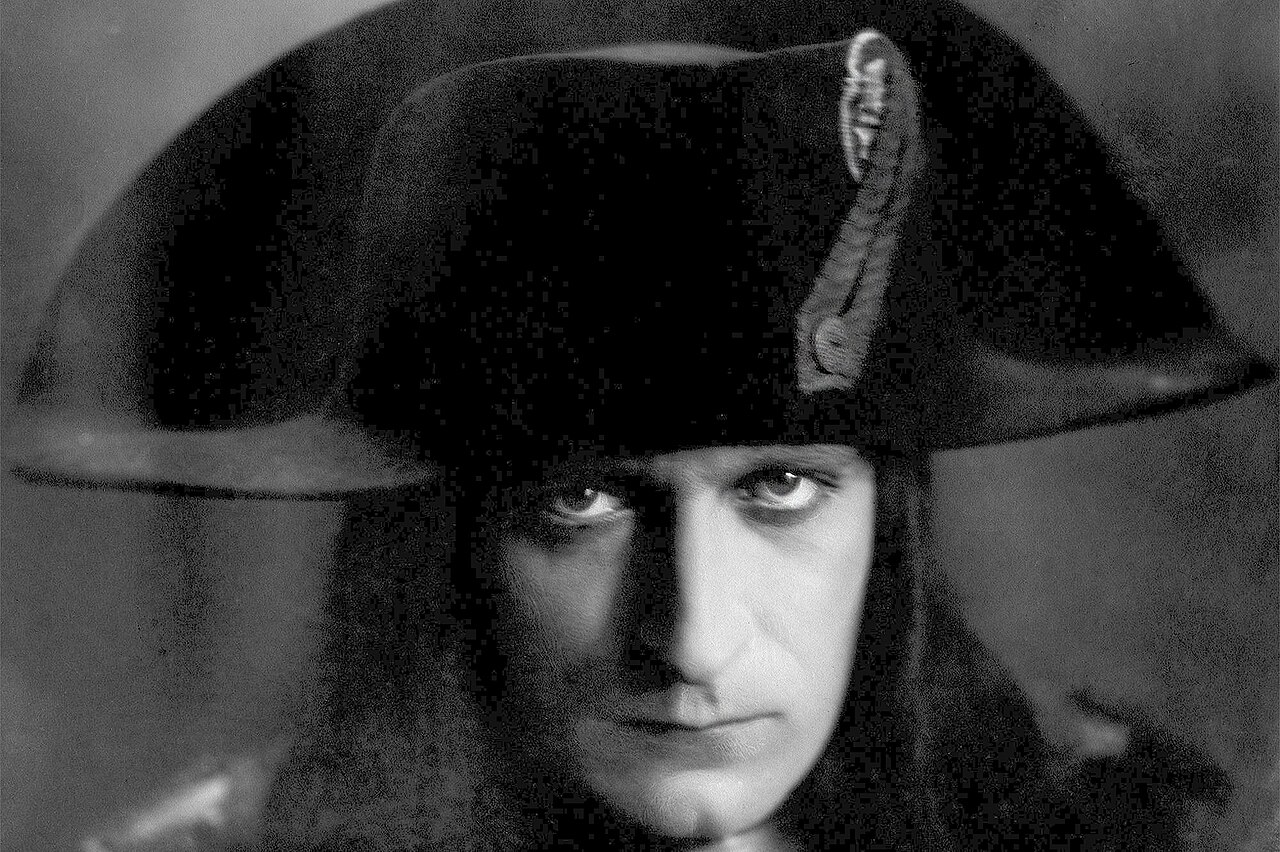
- Wikimedia Commons, "File:Choumoff - Albert Dieudonne Napoleon.jpg" (1927 Pierre Choumoff vintage still of Albert Dieudonne as Napoleon for Abel Gance's film).