Spoiler warning: this close reading discusses the film's repeated dream structure and final image.
Maya Deren and Alexandr Hammid's Meshes of the Afternoon is only about fourteen minutes long, but it does not behave like a miniature. The Library of Congress describes the 1943 film as a classic of avant-garde cinema, built from fragmented everyday images: a flower, a key, walking upstairs, looking out a window, dreams crossing into reality.[1] That list sounds almost modest. In the film, those objects do not sit still long enough to become symbols in the easy classroom sense. They act like mechanisms.
The best way into Meshes is not to ask what the key "means" and then decode the knife, the mirror-faced figure, the phone, or the stairs one by one. The film is stranger and more disciplined than that. It turns ordinary domestic material into a system of recurrences. A woman returns home, sleeps, dreams, re-enters the house, sees herself multiplied, and keeps finding the same objects under new pressure. The result is not a puzzle with a hidden answer. It is a machine for showing how perception can loop, split, and turn against the person doing the perceiving.
A house with editing built into it
The film's house is ordinary enough to be frightening. BAMPFA's collection record fixes the material basis: a 16 mm black-and-white print, roughly fourteen minutes, made in Hollywood in 1943 by Deren and Hammid, with Teiji Ito's music added later.[3] Those facts matter because the film's scale is part of its force. It does not need a studio set or elaborate fantasy world. It needs a stairway, a bedroom, a chair, a window, a door, a road, and a few objects that can be filmed until they stop feeling neutral.
The first entrance into the house feels like a practical action. The key opens the door. The room waits. The phone is off the hook. The knife sits inside the loaf. But as the dream repeats, function becomes unstable. A key can fall. A key can be held. A key can appear in the mouth. A key can open the same space again with a different charge. The object remains recognizable, yet its relation to the world changes every time the edit brings it back.
That is why the film still feels so radical. It does not abandon reality for dream; it makes reality vulnerable to cinematic repetition. LUX's page emphasizes the film's eyeline matches and mismatches, extreme angles, fluid movement, and dreamlike mise-en-scene.[2] Those are technical observations, but they point to the deeper construction. A look does not reliably connect viewer and object. A staircase does not simply lead upward. A doorway does not simply divide outside from inside. Space has become a pattern that can be rearranged by attention.
The key is an edit before it is a symbol
Many films use recurring objects as motifs. Meshes does something more severe. It makes objects change their grammatical role. The key is first a tool, then evidence, then lure, then threat, then almost a bodily object. To call it a symbol is not wrong, but it is too slow. A symbol waits to be interpreted. The key acts. It moves the film from one state of mind to another.
Sarah Keller's teaching essay for The Cine-Files is useful here because it warns against treating the film as a locked cabinet with one correct meaning. She frames Meshes as a film that teaches viewers how to engage with non-linear, non-causal, and non-narrative form rather than how to solve a single riddle.[4] That is exactly what the key does inside the film. It invites the viewer to follow process, not extract a password.
The knife works the same way, but with a different temperature. It begins as a household object, a utensil folded into ordinary bread. Once the film repeats it, the knife becomes concentrated possibility. It can be hidden under a pillow, grasped, raised, redirected toward the self, or thrown toward the man whose face turns into mirror. The film does not need to explain whether the knife stands for violence, desire, fear, or self-destruction. It lets the knife become available to all of them because repetition has stripped domestic life of innocence.
The mirror-faced figure changes what looking means
The hooded figure with a mirror for a face is the film's most famous image because it gives the dream a body without giving it a stable identity. A normal face would answer too much. The mirror refuses the answer and sends vision back outward. The woman pursues a figure and finds not a person but a reflecting surface, a blankness that turns looking into confrontation.
MoMA's teaching material on Deren's legacy notes that Meshes was often read as Surrealist or psychological, while Deren resisted interpretations that ignored formal construction. The same material quotes her insistence on "the censorship of form," the idea that fantasy had to be controlled by cinematic inevitability rather than released as loose dream imagery.[5] That matters for the mirror figure. The image is uncanny, but it is not casual. It is placed inside an exact relay of pursuit, return, object, and repetition.
The mirror also gives the film a brutal answer to spectatorship. The viewer wants to see the face because faces stabilize movies. Faces tell us who is responsible, who is afraid, who desires, who threatens. Meshes removes that contract. When the male figure's face later becomes a mirror and shatters into ocean, the film makes the domestic interior touch an impossible exterior. The house, the body, the lover, the dream, and the sea are no longer separate containers. The mirror has broken the categories that made looking feel safe.
Repetition creates new selves
The multiplied women around the table are among the film's sharpest inventions. They are not clones in a science-fiction sense. They are temporal positions made visible: earlier self, watching self, acting self, endangered self. Each version seems to carry a different relation to the objects on the table. The film turns internal division into staging.
Keller's essay stresses the film's collaborative and do-it-yourself provenance: Deren and Hammid made it outside commercial and studio systems, with a small working process that opened space for an experimental cinema of control and immediacy.[4] That independence shows up in the table sequence. A studio psychological drama might have explained the woman's divided mind through dialogue, flashback, or diagnosis. Meshes simply places the divisions in the room and lets editing do the thinking.
This is also why the film's feminism is formal before it is declarative. The domestic space is not presented as a neutral setting that happens to contain a distressed woman. It is a structure that keeps generating versions of her. The house produces repetitions; the repetitions produce selves; the selves gather around objects that refuse to remain harmless. The film's argument about interior life is made through cinematic arrangement, not through speech.
The score arrives after the dream
It is easy to forget that Meshes was originally silent. BAMPFA records Teiji Ito's music in its print notes, and LUX lists the work with sound while also identifying it as an Anthology Film Archives preservation print.[2][3] That later soundtrack changes the viewing experience without replacing the film's visual logic. The image track already has rhythm: footfalls, glances, returns, drops, cuts, and impossible continuities. Ito's music intensifies the loop, but the loop is already built into the editing.
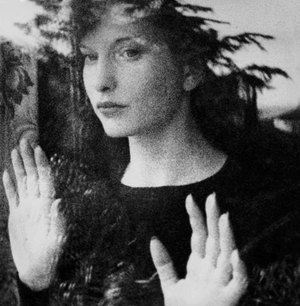
That history is important because it keeps the film from becoming a fixed artifact too quickly. Meshes has always had a slightly unstable archival life: silent origin, later sound, preservation prints, museum records, teaching contexts, online stills. The Commons image used here is a real portrait photograph of Deren rather than a film-frame screenshot, poster, diagram, or abstract concept graphic.[6] It is the right QA-safe image for this article because it keeps the visual grounded in the maker whose formal discipline turns hand, key, room, black-and-white texture, and domestic pressure into film evidence.
The ending does not close the loop
The final discovery of the woman's body can be described as a twist, but that makes it sound too neat. The ending is better understood as the point where the loop stops protecting itself. The dream has repeated enough times that object, self, and threat can no longer be kept apart. The man enters the house and finds the consequence already waiting.
The Library of Congress says the film intersperses dreams and reality and asks the audience for curiosity and patience.[1] That patience is rewarded not with clarity in the detective-story sense but with formal recognition. We begin to understand how the film thinks. It thinks through return. It thinks through objects. It thinks through the cut from one impossible continuity to another. It thinks by making the house remember what the woman cannot master.
So Meshes of the Afternoon lasts because it is not merely an influential avant-garde short. It is a close reading of cinema by cinema itself. A key opens a door, then opens a loop. A knife cuts bread, then cuts through domestic calm. A mirror reflects a face, then refuses the face. A stairway connects floors, then bends space into dread. The film's ordinary objects are not decorations around a dream. They are the dream's working parts.
By the end, the house has become a camera, the camera has become a mind, and the mind has become a room where every familiar thing can return with altered force. That is the trapdoor Deren and Hammid build: not beneath the floor, but inside the act of looking.[1][2][5]
Sources
- Library of Congress, "Meshes of the Afternoon (1943)," in Brief Descriptions and Expanded Essays of National Film Registry Titles, for registry context, creators, runtime, and description of fragmented imagery.
- LUX, "Meshes of the Afternoon" work page, for format details, preservation-print note, and comments on dreamlike mise-en-scene, eyeline mismatches, and extreme angles.
- Berkeley Art Museum and Pacific Film Archive, "Meshes of the afternoon" collection record, for 16 mm print details, 1943 date, credits, runtime, and Teiji Ito music note.
- Sarah Keller, "Teaching Meshes of the Afternoon," The Cine-Files, issue 9, fall 2015, for classroom framing, production context, collaboration, and non-linear form.
- The Museum of Modern Art, "Maya Deren's Legacy" teaching PDF, for discussion of Deren's formal method, reception, and resistance to loose Surrealist readings.
- Wikimedia Commons, "File:Maya Deren.jpg," source page for the real portrait photograph used as the article image.