Spoiler note: this essay discusses the film's final movement toward the hospital and the emotional turn that precedes it.
Agnes Varda's Cleo from 5 to 7 is often introduced through its clean formal hook: a singer walks through Paris while waiting for medical test results. Criterion's edition page calls it a real-time portrait of a woman set adrift in the city as she awaits biopsy news, and the BFI stresses how the film moves from the first surge of the French New Wave into something more introspective.[1][4] That is accurate, but it can make the film sound more schematic than it feels. Varda does not merely attach suspense to a clock. She makes waiting visible as a series of changing relations: to mirrors, strangers, traffic, music, money, superstition, war, and finally another person who is also living under a death sentence.
The title is already a small deception. The film does not actually cover two full hours; it runs closer to ninety minutes and ends before seven.[2] That gap matters. It keeps the title from being a stopwatch promise and turns it into a social phrase: "from five to seven" is a stretch of time associated with assignations, leisure, and illicit possibility. Varda takes that elegant interval and loads it with diagnosis. Cleo's afternoon is not a romantic interlude. It is an audition for whether she can become more than the image everyone, including herself, has learned to consume.
The clock is psychological before it is mechanical
Adrian Martin's Criterion essay is useful because it separates two kinds of time in the film: real clock time and the "passionate time" of suspense, where duration expands or contracts according to feeling.[2] Varda's achievement is to keep both alive. The chapter titles and minute markings tell us that time is passing. Cleo's behavior tells us that time is not passing evenly.
At the fortune teller's apartment, the clock is prophetic. Every card looks like information arriving too soon. Death appears not as an abstract symbol but as an image Cleo cannot metabolize. The scene begins in color, then drops into black and white after Cleo leaves, as if the ordinary world has suddenly become the medium in which a sentence must be served.[4] From that point on, the city keeps offering clocks without always showing clock faces. There are schedules, taxi rides, cafe intervals, rehearsal time, waiting-room time, the doctor's absence, and the soldier's remaining leave.
The film's real-time structure would be a gimmick if it only proved that Varda could choreograph movement. Instead, it lets anxiety keep changing shape. Early on, waiting means panic in costume. Later, it becomes attention. By the time Cleo reaches the park, the minutes have not disappeared, but they have stopped belonging only to her.
Mirrors teach Cleo the wrong kind of evidence
The early Cleo is not simply vain. She is epistemologically trapped: she uses appearance as evidence that she exists. Molly Haskell's Criterion essay describes Varda's Paris as a hall of mirrors, full of windows and faces that reflect the heroine back to herself.[3] The phrase gets at the film's visual logic. Cleo looks at herself because the world has trained her to believe that looking beautiful is a form of security.
That security fails quickly. A mirror can confirm that her face is still intact, but it cannot answer the medical question. A hat can change the surface, but not the diagnosis. A lover can admire her, but his visit lasts barely long enough to count as comfort. Her apartment, with its white surfaces and theatrical objects, feels less like a home than a display case built around a singer who has learned to perform being cherished.
Varda is sharp here because she does not punish Cleo for wanting to be beautiful. The camera understands the force of beauty. It also understands the cruelty of making beauty a woman's proof of life. When Cleo removes the wig later, the gesture works because it is not a moral lesson about naturalness. It is a formal shift. She stops using herself as a finished image and begins to move through the city as someone unfinished.
Paris is not background
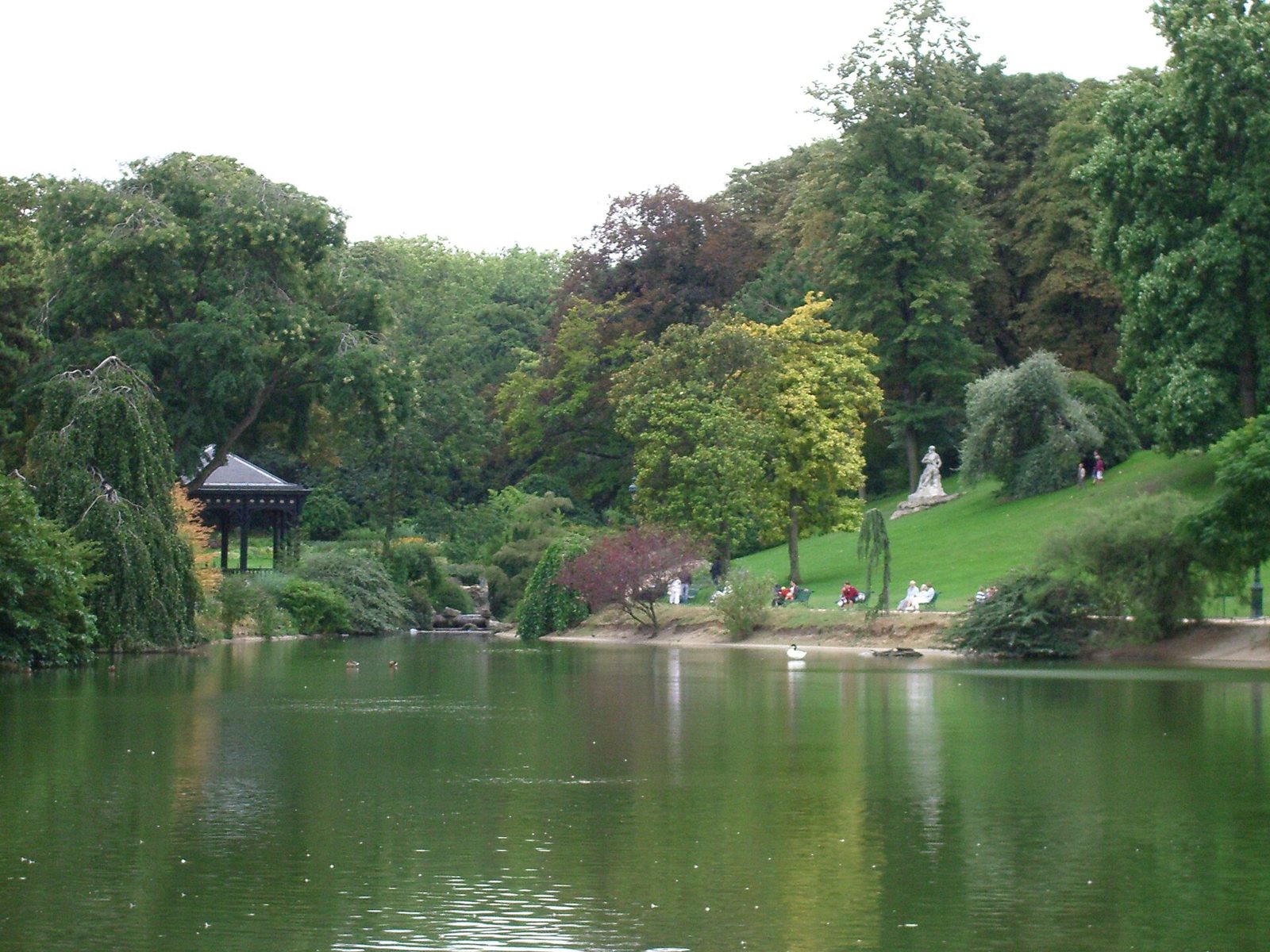
Varda's own famous formulation, cited by Martin, is that the film is a portrait of a woman painted onto a documentary about Paris.[2] The BFI locations feature makes the phrase concrete by tracing the film's route through Rue de Rivoli, Rue Huyghens, Boulevard Montparnasse, Le Dome, Parc Montsouris, and the Salpetriere hospital area.[5] Those locations are not scenic confirmations that the movie was shot outside. They are part of the film's moral design.
Early Paris reflects Cleo back to herself: shop windows, cafe interiors, taxi glass, street gazes. Midway through, the city begins to interrupt her self-enclosure. News of the Algerian War travels through the soundtrack and social atmosphere. Performers, workers, students, friends, and strangers pass through her afternoon. The film keeps letting ordinary Paris push against melodrama, not to minimize her fear but to place it inside a larger field of life.
That field is why Cleo from 5 to 7 still feels modern. It refuses the false choice between subjectivity and documentary texture. Cleo's dread is private, but the city will not allow it to remain sealed. The more precisely Varda maps the walk, the less the film feels like a private illness drama. Illness becomes one way of discovering that the world has been there all along.
The song breaks the performance contract
The rehearsal-room sequence is the film's hinge. Michel Legrand, who wrote the score, appears in the film as one of Cleo's musicians, and Criterion lists the film's music and cameos as part of its mix of verite, melodrama, and New Wave play.[1] At first, the scene looks loose and charming. Cleo jokes, the men orbit her, and performance seems to restore the old contract: she is the beautiful center, and others arrange themselves around her.
Then "Sans toi" changes the room. The stylization tightens. The playful rehearsal darkens into a full emotional exposure. Cleo hears herself being turned into the image of abandonment, pallor, and death, and suddenly the role no longer protects her. She is not simply singing a sad song. She is watching the entertainment machine convert her fear into marketable feeling.
That is why she has to leave. The apartment cannot contain what the song has revealed. The film's movement into the street after this sequence is not just a plot transition. It is a refusal of the old arrangement in which Cleo's beauty, voice, clothes, and pain are all materials for other people's use.
Antoine changes the scale of fear
The park sequence can look deceptively gentle. Cleo meets Antoine, a soldier on leave, and the film seems to soften into conversation. But the scene matters because Antoine does not look at her in the old way. He recognizes beauty, but he is not organized by her celebrity. Hammer Museum's program note describes the film as following Cleo through fortunes, omens, superstition, and Paris streets while she awaits potentially dire medical news; it also names Antoine as part of the cast and places the film in a 35mm archival screening context.[7] In the drama itself, Antoine becomes important because he brings another mortal clock into the frame.
He is about to return to the Algerian War. Cleo fears cancer. Neither fear cancels the other. Instead, they make a conversation possible in which death is no longer an isolating spectacle. For much of the film, Cleo's fear makes her feel exceptional and trapped. With Antoine, fear becomes shareable. She can speak, listen, walk, ride, and arrive at the hospital with someone who is not trying to turn her into an image or a diagnosis.
That is why the final movement feels so startlingly light. The medical news is not magically erased. The future remains uncertain. But Cleo's relation to the future has changed. She has moved from being watched to being with.
Canonization should not flatten the film
The film's reputation is now secure. In the 2022 Sight and Sound critics' poll, the BFI listed Cleo from 5 to 7 at number 14, one of several films by women directors whose rise changed the visible shape of the canon.[6] That recognition is deserved, but canon status can make Varda's film sound monumental in the wrong way. It is not great because it announces greatness. It is great because it keeps small movements exact: a glance into glass, a hat purchase, a taxi interruption, a song that turns too real, a park conversation, a bus ride toward results.
The close-reading lesson is therefore simple but demanding. Varda makes form answer feeling without reducing either. Real time becomes suspense, but not only suspense. Paris becomes documentary, but not only documentary. Beauty becomes a trap, but not only a trap. The film's deepest transformation is not that Cleo stops fearing death. It is that she stops living as if fear can only be managed by controlling her reflection.
By the end, waiting has become a different art. At five o'clock, Cleo waits as an image terrified of damage. Near six-thirty, she waits as a person in the world, still frightened, but newly capable of relation. That is the miracle of Varda's construction: the clock keeps moving forward, while Cleo learns how to stop being imprisoned by the ways she has been seen.
Sources
- The Criterion Collection, "Cleo from 5 to 7 (1962)" edition page, including restoration notes, film information, cast, credits, music, cameos, and summary.
- Adrian Martin, "Cleo from 5 to 7: Passionate Time," The Criterion Collection, January 21, 2008, on real time, passionate time, Varda's city route, and the Paris documentary frame.
- Molly Haskell, "Cleo from 5 to 7," The Criterion Collection, May 15, 2000, on female identity, mirrors, Paris, self-image, and the movement from blindness to awareness.
- BFI, "Cleo from 5 to 7 (1962)" film page, including New Wave context, real-time framing, tarot opening, city portrait, and transformation notes.
- BFI, "60 years of Agnes Varda's Cleo from 5 to 7: how the Paris locations look today," source for location detail including Parc Montsouris in the film route.
- BFI, "Revealed: the results of the 2022 Sight and Sound Greatest Films of All Time poll," December 1, 2022, listing Cleo from 5 to 7 at number 14.
- Hammer Museum, "Cleo from 5 to 7" program page, presented by the UCLA Film & Television Archive, including synopsis, archival screening context, cast, format, and runtime.
- Wikimedia Commons, "Parc Montsouris - Paris.JPG," real-world photograph of Parc Montsouris used as the replacement article image.