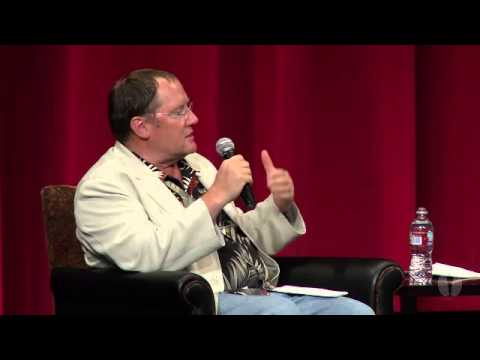

Hayao Miyazaki is often praised through big nouns: imagination, wonder, nature, flight, childhood. Those words are true enough, but they can make his films sound softer and less engineered than they are. The two Academy clips below are useful because they compress his method into two practical problems: how an animated environment should behave, and how a character should become legible before the story explains them.[1][2]
Taken together, the clips argue against the lazy version of "world-building." In Miyazaki, a world is not a decorative inventory of houses, trees, skies, spirits, and machines. It is a field of pressure. A child crosses it, waits inside it, misreads it, fears it, trusts it, and changes because of it. That is why My Neighbor Totoro can feel almost plotless while remaining dramatically alert, and why films like Nausicaa of the Valley of the Wind, Princess Mononoke, Spirited Away, and Ponyo keep turning weather, thresholds, animals, engines, and bodies of water into active dramatic forces.[3][4][5]
The Academy Museum's Miyazaki exhibition helps explain why these short videos are more than fan-service fragments. The museum framed his work through original imageboards, character designs, storyboards, layouts, backgrounds, posters, and cels from Studio Ghibli's archive, which is exactly the chain these clips make visible in miniature.[3] Environment and character are not separate departments in the viewer's experience. They are two ways of asking the same question: what kind of life can this animated world sustain?
The environment is a character test
The first clip, "Depicting the Environment," should be watched for how little it treats landscape as scenery.[1] Miyazaki's strongest places are full of pleasures, but they are not neutral. A forest path invites exploration and also hides what adults cannot fully manage. A bathhouse dazzles, but it also runs on labor, hierarchy, appetite, and rules. A valley, sea, castle, town, train platform, or family house becomes meaningful because characters must learn what kind of attention the place demands.
That is why the environment in a Miyazaki film rarely feels like a background painting pasted behind action. It has tempo. Grass moves, smoke hangs, insects swarm, water lifts, dust gathers, machinery breathes, and small domestic objects seem to carry memory. The Academy Museum's exhibition emphasis on backgrounds and layouts matters here because those are not merely beautiful production artifacts; they are where the film decides how a body can move through a world.[3] A layout can make a corridor feel safe, a threshold feel uncertain, or a tree feel less like a symbol than a neighbor with mass and patience.
The Studio Ghibli works pages provide a useful factual anchor for this viewing habit. My Neighbor Totoro is listed as a 1988 film with Miyazaki as original creator, screenwriter, and director; Nausicaa, Princess Mononoke, Spirited Away, and Ponyo likewise sit in the official filmography as projects where his authorship is tied to story, direction, and a larger design culture.[4] That continuity matters because the environmental intelligence is not a one-film theme. It is a recurring cinematic grammar.
The Academy Museum's 2026 Studio Ghibli screening-series notes are helpful precisely because they keep these films from flattening into one poster slogan.[5] The page describes Princess Mononoke through a bitter conflict among Iron Town, San, forest spirits, and animal gods, then stresses that the film resists an easy good-versus-evil split.[5] It also frames Spirited Away through Chihiro's work inside a bathhouse for spirits and Ponyo through a friendship that blooms in a hand-drawn oceanic world.[5] My inference from those notes is that Miyazaki's landscapes work because they refuse to be either Eden or apocalypse. They are living systems with obligations. Characters do not solve them by admiring them. They must learn how to behave inside them.
That is the key annotation for the first clip: watch for environment as instruction. Miyazaki's animated worlds teach the viewer where attention should go before a line of dialogue confirms it. A breeze, a soot sprite, a river spirit, a flooded road, or a roaring engine can make the moral shape of a scene visible. This is not a retreat from story into atmosphere. It is storytelling through atmosphere.
Character begins before psychology
The second clip, "Developing a Character," narrows the same logic to My Neighbor Totoro.[2] It is tempting to begin with Totoro himself, because the creature became one of the most recognizable figures in animation. But the better way into the clip is through the children. Satsuki and Mei do not become convincing because the film gives them elaborate explanatory speeches. They become convincing because of timing, movement, curiosity, impatience, fear, posture, and the way each responds to a house and countryside that are both ordinary and enchanted.
That is why the first and second videos belong together. The environment clip describes the field; the character clip describes the body learning that field.[1][2] In a lesser film, a rural house might be a charming container and a magical creature might be a toyetic invention. In Totoro, the house creaks, the girls inspect it, the soot sprites retreat, the trees loom and shelter, and the creature's scale keeps changing according to a child's courage. Character is not added on top of the place. Character is revealed by how a person tests the place and how the place answers.
Miyazaki's child characters often work this way. They are vivid without being overexplained. The article should not pretend they are simple vessels of innocence. They can be bossy, stubborn, brave, careless, generous, jealous, lonely, and intensely observant. What makes them memorable is that the films trust physical attention before psychological labeling. A child running, sulking, listening, hiding, carrying a package, feeding a fish, or staring at a parent tells us what kind of mind is in motion.
The official Ghibli listing for My Neighbor Totoro gives the bare production facts: released in 1988, directed and written by Miyazaki, with Joe Hisaishi's music and an 86-minute running time.[4] Those details are modest, but they underline the film's discipline. It is not long, overplotted, or aggressively explanatory. It builds emotional force from calibration. When the girls arrive at the house, when Mei follows what she thinks she sees, when Satsuki tries to act older than she is, and when the forest becomes a place of appeal rather than escape, the film is developing character through repeated contact with environment.
The second clip therefore teaches a useful rewatching habit: do not ask first what a Miyazaki character "represents." Ask what the character notices, how quickly they move toward or away from uncertainty, and which parts of the world answer them. Totoro's greatness as a figure depends on that exchange. He is not only a design object with ears, teeth, belly, and silhouette. He is a pressure test for attention. If the children were drawn less specifically, the creature would become plush iconography. Because the children feel alive, the creature can remain mysterious without becoming empty.
What the pair reveals
Viewed together, these two Academy videos show why Miyazaki's animation keeps surviving beyond nostalgia.[1][2] The films do not ask viewers to choose between immersive beauty and disciplined craft. They make beauty the result of discipline. A forest is drawn with care because a child's trust depends on it. A child is animated with precision because the world's mystery depends on the child being able to register it. Environment and character complete each other.
This also explains why Miyazaki's work can be comforting without becoming frictionless. His worlds are inviting, but they often contain illness, labor, war, waste, loneliness, grief, dangerous machines, and fragile households.[5] The comfort comes from attention, not denial. The films notice the world carefully enough that fear has somewhere to go. A child can cross a field, enter a bathhouse, speak to a spirit, feed a creature, ride with a stranger, or wait for a parent, and the film will honor the scale of that act.
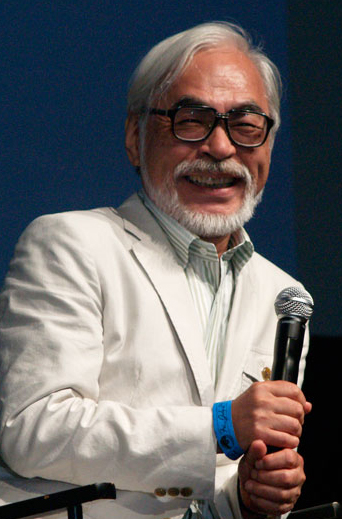
The cover photograph of Miyazaki at San Diego Comic-Con in 2009 is useful for the same reason.[6] It is not a still from one film, and it does not try to summarize Ghibli as a brand. It shows a filmmaker in public, speaking into a microphone after decades of work in which speaking is rarely the first tool. The two videos make that contrast productive. Miyazaki explains, but what he explains is a cinema that usually lets places, gestures, weather, and attention do the talking.
The collection's practical lesson is simple: in Miyazaki, do not separate wonder from construction. Wonder arrives because the construction is patient enough to let a viewer believe that a character and a world are discovering each other in real time. That is why his films can be watched by children, rewatched by adults, and still feel unfinished in the best sense. The world keeps offering tests, and the characters keep teaching us how to look.
Sources
- Academy Originals, "Hayao Miyazaki: Depicting the Environment," YouTube video.
- Academy Originals, "Hayao Miyazaki: Developing a Character," YouTube video.
- Academy Museum of Motion Pictures, "Hayao Miyazaki" - exhibition page on the Studio Ghibli archive materials and exhibition scope.
- Studio Ghibli, "Studio Ghibli works" - official filmography pages for Miyazaki-directed films including My Neighbor Totoro.
- Academy Museum of Motion Pictures, "The World of Studio Ghibli" - screening-series notes on Ghibli's hand-drawn animation, storytelling, and film contexts.
- Wikimedia Commons, "File:HayaoMiyazakiCCJuly09.jpg" - Natasha Baucas photograph of Miyazaki at San Diego Comic-Con used as the article image.