Kinuyo Tanaka's directorial career is often introduced as a correction: one of Japanese cinema's great actresses was also a filmmaker, and the filmmaking has been too long overshadowed. That correction is necessary, but it is too small. The sharper profile starts with craft. Tanaka came to directing with decades of bodily knowledge about how Japanese cinema placed women in rooms: how a pause could be made dutiful, how a lowered gaze could be praised as virtue, how a doorway could turn a private wound into public evidence.[1][3]
Harvard Film Archive frames the scale of the acting career clearly. Tanaka worked with Heinosuke Gosho, Keisuke Kinoshita, Kenji Mizoguchi, Mikio Naruse, Yasujiro Ozu, and others, becoming closely associated with women who find courage and dignity under severe pressure.[1] That history did not disappear when she moved behind the camera. Her six directed features, released from Love Letter in 1953 through Love Under the Crucifix in 1962, read like an argument with the roles she had known from inside.[2][3]
Stardom Was Not Baggage
The usual danger in writing about actor-directors is to treat performance history as a prelude to the real work. Tanaka resists that split. By the 1930s she was already a major star, and after World War II her presence deepened through Mizoguchi's The Life of Oharu, Ugetsu, and Sansho the Bailiff.[1] Those films helped fix her international image around endurance, sacrifice, and historical suffering, but they also gave her an unusual education in how cinema manufactures sympathy.
That education becomes visible in the directed films. Tanaka does not simply point the camera at mistreated women and ask the viewer to pity them. She keeps returning to the social machinery that makes pity necessary: families that need women's wages, men who imagine forgiveness as their privilege, postwar institutions that promise reform while policing bodies, and historical orders that translate desire into punishment.[2][3] The emotional force is strong, but the profile is not sentimental. Her women are watched, judged, traded, remembered, medicalized, and instructed. The camera understands the pressure because the actor had spent a career making such pressure legible.
This is why the directorial shift is more than a career novelty. Tanaka knew the difference between suffering as spectacle and suffering as structure. Her films are strongest when they ask what arrangement of rooms, laws, family duties, and public stories has made a woman's pain appear normal.
The Breakthrough Was Institutional As Well As Personal
The gender history around Tanaka is complicated enough to state carefully. Harvard and BFI describe her as the second woman to direct within the Japanese studio system, after Tazuko Sakane, whose 1936 feature New Clothing is lost.[1][3] BAMPFA sharpens the distinction by calling Tanaka the first Japanese woman to direct and release a feature film, because Sakane's work did not survive as a released public precedent in the same way.[4] Either formulation points to the same fact: when Tanaka began directing, the path was barely a path at all.
The 1952 turn shows both support and resistance. Naruse encouraged Tanaka by taking her on as an assistant; Kinoshita wrote Love Letter; Ozu supplied an unproduced screenplay for The Moon Has Risen.[1][3] Mizoguchi, by contrast, tried to keep his star from directing through the authority of the Director's Guild.[1][3] That opposition should not be reduced to colorful biography. It names the institutional stakes. Tanaka was not only changing jobs. She was crossing from being a face shaped by directors into a person authorized to shape the screen.
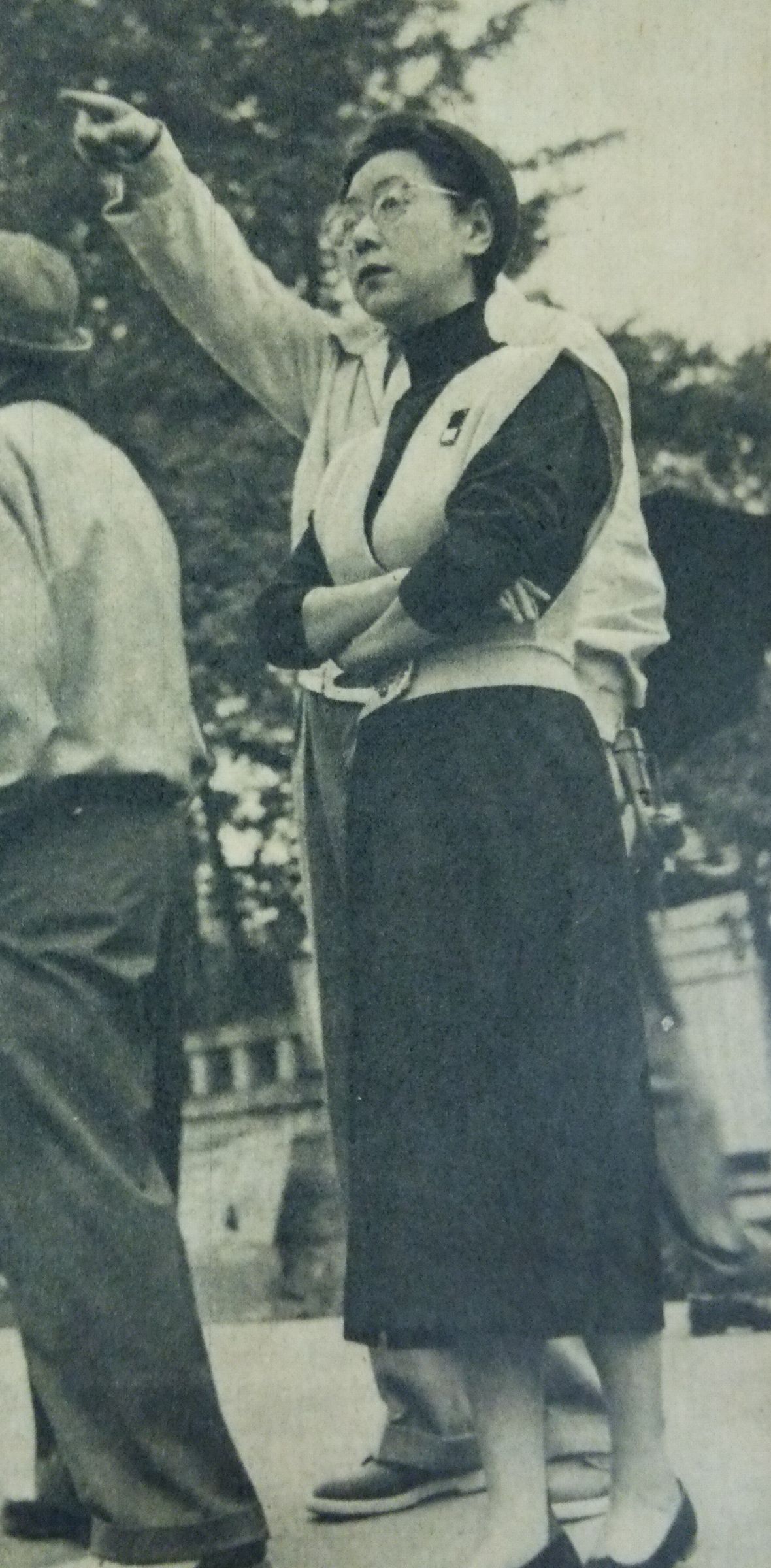
The image from Love Letter captures that crossing without ceremony. Wikimedia Commons identifies it as a November 1953 Asahi Graph photograph of Tanaka directing Koibumi, the Japanese title of Love Letter.[5] It is not glamorous. It is better than glamorous: she is outdoors, mid-command, one arm extended, body angled toward the work. The photograph gives the profile its physical evidence. Directing, here, is not an honorific attached to a star. It is labor in public view.
Her Films Keep Testing Male Conversion
Love Letter is a useful first film because its drama is not simply whether a woman can be forgiven. BFI describes it as a postwar melodrama in which an embittered veteran re-encounters a former love and judges her relationship with an American serviceman, while the film's novelty lies in insisting that the man must change for a better society to become possible.[3] That shift matters. Tanaka does not stage the woman as a moral problem awaiting judgment. She makes male judgment itself the problem.
The same logic carries into the lighter The Moon Has Risen. BAMPFA's program note centers the film on a widower, three sisters, and a matchmaking campaign in Nara, while BFI argues that the film carries Ozu-like material with a different sensuality.[2][3] Tanaka's direction is not a rejection of her mentors. It is a rebalancing. The inherited script becomes a room where younger women's movement, timing, and desire can loosen paternal stillness without simply destroying family comedy.
Then Forever a Woman changes the temperature. BFI calls it the first film Tanaka began entirely independently, built around a female poet, divorce, motherhood, terminal breast cancer, and sexual desire.[3] Harvard similarly singles it out as a taboo-breaking portrait of a poet facing breast cancer and asserting life against constricting expectations.[1] The crucial point is not only the subject matter. It is that Tanaka lets the body remain a thinking body. Illness does not erase erotic life. Maternity does not exhaust womanhood. Poetry is not decoration; it is a form of self-claiming when the social world keeps assigning the heroine a smaller role.
Range Was Her Argument
The six-film shape matters because Tanaka did not keep remaking one feminist thesis in one register. The Wandering Princess moves into color, widescreen, aristocratic displacement, and wartime history. Girls of the Night returns to postwar institutions through women sent to reform centers after Japan's Prostitution Prevention Law. Love Under the Crucifix sets religious prejudice, class hierarchy, and sexual transgression inside the late sixteenth century.[2][3] The range is not decorative. It argues that women's constraint is not a single plot but a recurring social technology, able to change costume from occupation Tokyo to historical pageant.
That range also protects Tanaka from being treated only as a rediscovered woman pioneer. Pioneer status matters, but it can flatten the work into evidence of absence elsewhere. The better claim is aesthetic: Tanaka had a director's problem and kept attacking it from different angles. How does a film show a woman thinking when the room wants her to perform obedience? How does it show desire without letting desire become a charge against her? How does it make reform, family, medicine, religion, or romance visible as a system rather than a backdrop?
BAMPFA's retrospective note is helpful because it places Tanaka amid fan magazines, publicity culture, and an industry that often valued actresses for managed images.[4] Tanaka's directing career pushes against that management. She knew screen image intimately, and she used that knowledge to unsettle the terms under which women were made visible. Her films do not escape melodrama, comedy, or historical spectacle; they work through those forms until the audience can feel their rules.
Why The Profile Still Matters
The recent restoration and retrospective cycle around Tanaka has made her directorial work easier to see as a body rather than as a rumor; BAMPFA's series page notes new 4K restorations of all six directed films and places them alongside works from the scope of her acting career.[2] That visibility changes more than a canon checklist. It asks viewers to rewatch postwar Japanese cinema with the traffic moving both ways. Tanaka was not merely shaped by Ozu, Mizoguchi, Naruse, and Kinoshita. She carried knowledge from those collaborations into films that questioned what their worlds often asked women to bear.
Her best profile, then, is not "great actress became director." It is "great actress understood the camera from the inside and then used it from the other side." Acting memory became directing grammar. A glance, a blocked doorway, a sickroom, a letter, a reform institution, a father's house, a historical costume, a poem: these are not just plot objects in her films. They are pressure points where a woman tests the shape of the life being assigned to her.
That is why the photograph of Tanaka pointing on the Love Letter location has such force. It shows the grammar beginning to move outward. The woman long watched by Japanese cinema is now arranging what the camera will watch, and the gesture is not symbolic. It is practical. Someone has to decide where the bodies go, what the room means, and whose change the scene will require.
Sources
- Harvard Film Archive, "Kinuyo Tanaka - Actress, Director, Pioneer" - retrospective essay on Tanaka's acting career, six directed features, collaborator network, opposition from Mizoguchi, and feminist perspective.
- BAMPFA, "Forever Kinuyo Tanaka" - retrospective page on new restorations of all six directed films, acting-career context, and program notes for Love Letter, The Moon Has Risen, Forever a Woman, Girls of the Night, The Wandering Princess, and Love Under the Crucifix.
- BFI, "Where to begin with Kinuyo Tanaka" - viewing guide covering Tanaka's status in Japanese film history and readings of Love Letter, The Moon Has Risen, Forever a Woman, Girls of the Night, and Love Under the Crucifix.
- BAMPFA, "Off the Shelves: Kinuyo Tanaka" - film-library note on Tanaka's fan-magazine image, move behind the camera, and place in Japanese cinema's gender history.
- Wikimedia Commons, "File:Tanaka Kinuyo directs the film Koibumi.JPG" - November 1953 Asahi Graph photograph of Tanaka directing Love Letter, used as the article image.