
HBO's 2012 Directors Dialogues interview with Ang Lee is valuable because it catches him at a point when his career already looked impossible to summarize neatly.[1] By then, Lee had moved from Taiwanese family comedies and dramas into Jane Austen adaptation, American suburbia, wuxia, Civil War drama, superhero myth, queer western romance, erotic espionage, and the digital survival spectacle of Life of Pi.[2][3][4] That range can be mistaken for restlessness. The interview makes a better case: Lee keeps changing genres because each genre gives him a new container for pressure.
That is the viewing lens here. Lee is not interesting simply because he crossed from Mandarin-language cinema into Hollywood, or because he won major prizes in more than one register. The Directors Guild of America framed him in 2010 as a filmmaker who had crossed borders through stories that remained legible across cultures, and its later lifetime-achievement announcement stressed the unusual breadth of his body of work.[2][5] Those institutional summaries are accurate, but the interview lets you watch the temperament underneath them. Lee often sounds less like a brand-name auteur defending a fixed style than like a craftsman asking what kind of discipline a film needs before it can become emotional.
That distinction matters for Crouching Tiger, Hidden Dragon. Britannica's career overview treats the film as the point where Lee's repertoire expanded into internationally legible martial-arts spectacle, while Sony Pictures Classics' film page keeps the film's action identity tied to romance, landscape, and performance rather than separating them.[3][4] My inference from the video and the written record is that Lee's signature is not a visual motif in the narrow sense. It is a habit of converting genre rules into emotional architecture: repression becomes blocking, combat becomes longing, decorum becomes suspense, technology becomes a test of belief.
Watch the way Lee talks about scale as responsibility, not size
The first useful thing to notice in the interview is how rarely Lee treats spectacle as self-justifying.[1] This is especially helpful because his career includes films that could be sold by surface alone: airborne swordplay, computer-generated animals, split-screen comic-book psychology, period settings, star actors, and awards prestige. Yet the thread that makes those films recognizably his is not scale. It is the burden that scale places on feeling.
In Crouching Tiger, Hidden Dragon, the fights are beautiful, but the beauty is not just decoration.[3][4] The leaps and wire-assisted movements work because the characters are already constrained by duty, rank, age, desire, and self-command. Gravity matters because they seem briefly able to disobey it; social gravity matters because they cannot disobey it for long. The Sony Pictures Classics page is useful here because it presents the film as action-packed without reducing it to action mechanics; Lee's martial-arts film is also a romance of delayed speech and disciplined bodies.[4] The HBO conversation reinforces that point by making Lee's genre shifts sound like fresh obligations. Each format asks him to solve a different kind of restraint.
That is why the interview works as more than career overview. Around the middle of the conversation, the pattern becomes clear: Lee is drawn to forms that impose rules before they offer release.[1] Austen manners, wuxia honor, western landscape, family ritual, comic-book transformation, and survival adventure all give him surfaces that audiences recognize. He then uses those surfaces to ask where feeling can hide. The result is not genre-hopping for novelty. It is genre as a series of pressure chambers.
The cross-cultural story is real, but the craft story is sharper
It is tempting to make Lee's career mainly about cultural translation. That would not be wrong. He was born in Taiwan, studied film in the United States, and built a career that repeatedly moves between Chinese-language and English-language production contexts.[2][3] The DGA interview foregrounds that border-crossing biography, while Britannica's overview tracks the same movement from early Taiwanese features to major English-language productions.[2][3]
But the HBO interview suggests that the more precise craft question is not simply how Lee translates culture. It is how he translates emotional codes from one formal system into another.[1] Sense and Sensibility is not successful because Lee merely behaved respectfully toward English literary heritage. It is successful because he understood that Austen's social rituals are action scenes of hesitation, timing, and withheld information. Brokeback Mountain is not powerful only because it carries a forbidden romance into western iconography. It is powerful because the western's open spaces intensify the characters' inability to speak freely. Life of Pi is not only a technical problem of digital animals and 3D space. It asks whether artificial images can carry spiritual and emotional uncertainty without becoming weightless spectacle.[1][4]
That is the useful viewing move: listen for Lee describing difficulty as part of the job, not as a detour from it.[1] His films often seem calm on the surface, but their calm is manufactured under pressure. The interview's modest format helps reveal that. A flashier retrospective might cut the career into highlights. This one leaves room to hear a director measuring the cost of each form.
The late-career technology question was already inside the older films
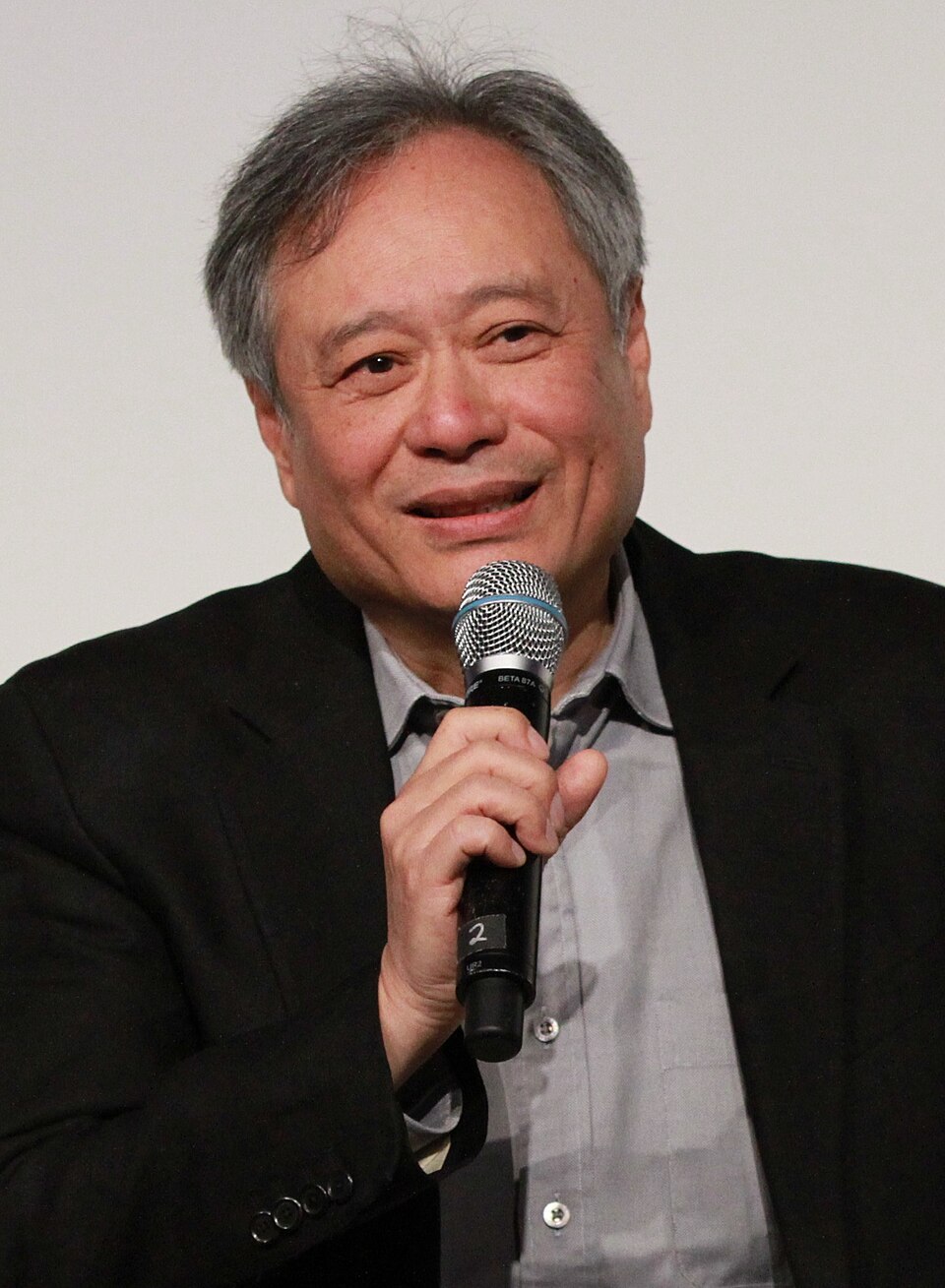
The 2016 NAB photograph used above comes from a Future of Cinema context, after Lee had become strongly associated with technical experimentation in high-frame-rate and digital presentation.[6] That could make technology look like a late-career deviation. The interview points the other way. Lee's technical questions were always tied to emotional credibility. He changes tools because he keeps asking what kind of image can make a viewer believe in an inward state.[1]
That is why Life of Pi belongs beside the earlier work rather than outside it.[3] On paper, a boy, a lifeboat, and a tiger could become either a mechanical effects demonstration or a fable flattened by prettiness. Lee's recurring problem is how to keep wonder accountable to fear, grief, and doubt. The same problem appears in different materials across the career: family meals in the early films, parlor etiquette in Sense and Sensibility, bamboo and rooftops in Crouching Tiger, mountains and silence in Brokeback Mountain, oceanic digital space in Life of Pi.[2][3][4]
The interview's best use, then, is not to supply trivia. It is to recalibrate what "range" means. Lee's range is not a playlist of genres. It is a repeated test of whether a form can carry emotion without explaining it to death. The sources around the video support that reading: DGA emphasizes border-crossing craft, Britannica tracks the unlikely breadth of the filmography, Sony's Crouching Tiger page keeps action and feeling in the same frame, and the later lifetime-achievement coverage recognizes the range without reducing it to inconsistency.[2][3][4][5]
Seen this way, Ang Lee's career becomes less puzzling. The question is never "why did this director jump to another genre?" The question is "what kind of pressure did this genre let him apply?" That is what the HBO interview keeps making visible. Before spectacle takes over, Lee wants genre to do emotional work.
Sources
- HBO, "HBO Directors Dialogues: Ang Lee," YouTube video.
- Directors Guild of America, "Crossing Borders" - DGA Quarterly interview with Ang Lee.
- Britannica, "Ang Lee" - biography and filmography overview.
- Sony Pictures Classics, "Crouching Tiger, Hidden Dragon" film page.
- Associated Press, "Ang Lee to receive DGA Lifetime Achievement Award."
- Wikimedia Commons, "Ang Lee delivers the keynote at the 2016 NAB Show's Future of Cinema Conference" - photographic file page.