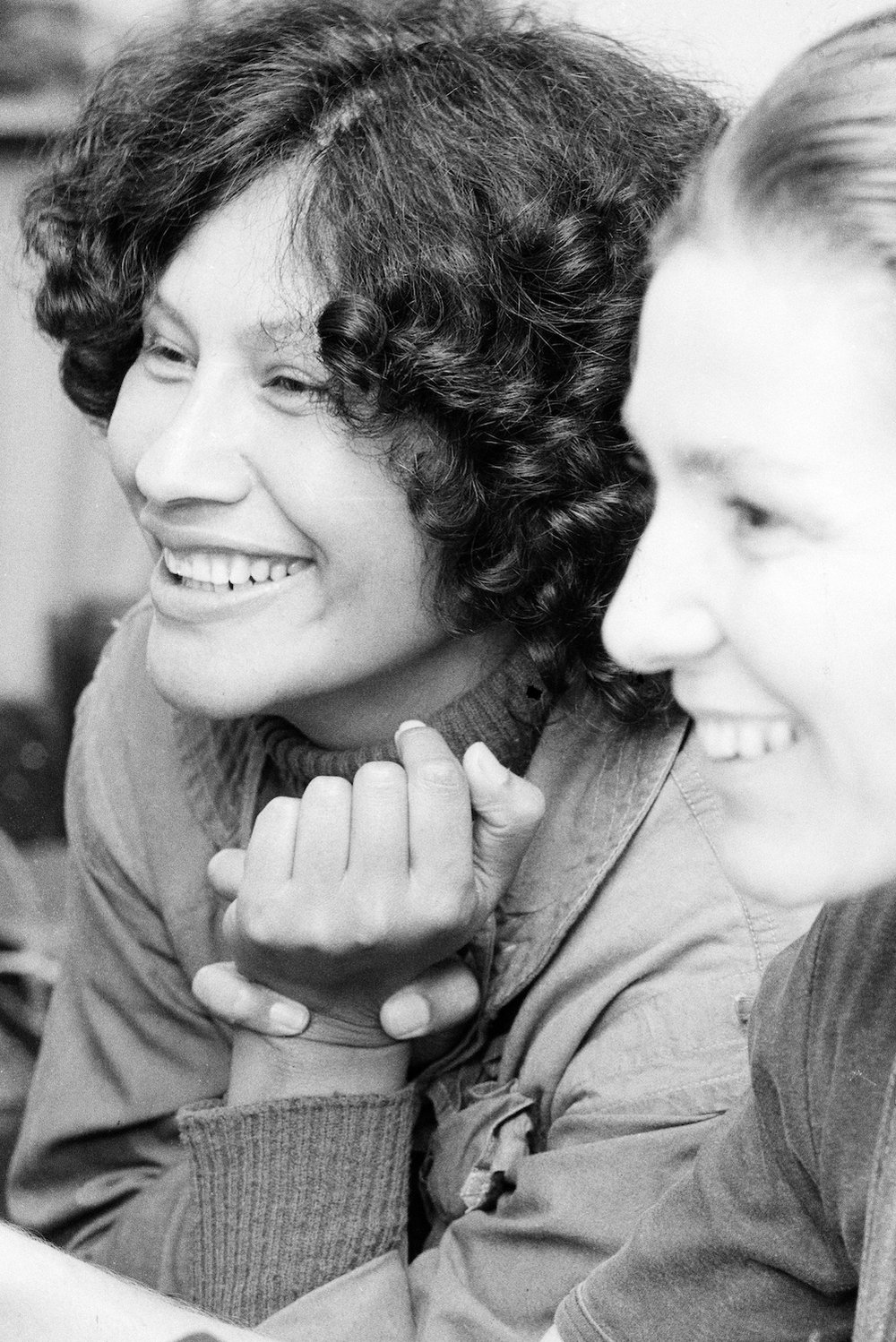
In May 1983, Merata Mita and editor Annie Collins were photographed while working at an editing bench, laughing with their hands joined. Between them, Patu! was still becoming a film: many hours of 16 mm footage, gathered by a large volunteer crew during the 1981 Springbok rugby tour, had to be inspected, protected and made to speak together. The image is warm. Its context is not. Police had repeatedly sought material that could identify protesters; reels were hidden, and some were sent to Australia for processing.[1][2][5]
That tension offers a way into Mita's direction. Her films do not pretend that a camera can hover outside the relationships it records. It stands somewhere. Someone has been trusted to carry it. Someone else may try to seize what it saw. Editing can expose an injustice, but it can also strip images from the people whose lives give them meaning.
Across the protest documentary Patu! (1983), the dramatic feature Mauri (1988), and the archival documentary Mana Waka (1990), Mita kept changing genre without abandoning that principle. Her signature was not one lens, one kind of cut or one recurring composition. It was a politics of position: the camera belongs inside a network of obligation, and a director is responsible for who controls that network.[1][3][4]
A point of view is not a defect
Mita's career is sometimes compressed into the label “political filmmaker,” as though politics were a subject laid over otherwise neutral images. Her early work makes the opposite argument. When Mita, Gerd Pohlmann and Leon Narbey filmed the mass eviction at Takaparawhā/Bastion Point in May 1978, they did not disguise their sympathy with the occupiers. Bastion Point: Day 507 used little commentary and emphasized the disproportion between the state operation and the people it removed. Mita later described that approach as specifically suited to Māori filmmaking.[1]
The point was not that every image made from within a movement becomes true. It was that the conventional view from outside already contained a politics—it simply called its distance objectivity. Mita moved the camera across that boundary and made the position visible.
Patu! expands the method to feature length. The film follows the nationwide opposition to a South African team touring Aotearoa while apartheid remained in force. Several operators shot on the run as protesters, police lines, batons, shields and bodies collided in streets around rugby grounds. Mihi Murray's account of the production describes footage that is jerky and close because the camera operators themselves were dodging people and objects.[2] The instability is not ornamental vérité style. It is physical evidence of where the camera stood.
Mita and Collins then had to turn footage from many sources into a coherent viewpoint. They largely refused a commanding narrator. Images of rugby and confrontation answer one another; newspaper stills interrupt moving footage; speeches and street noise retain their own pressure. The film does not offer two neatly balanced positions and invite the viewer to score them. It asks what “balance” would mean when a sporting tradition is being defended against an anti-racist movement—and when racism abroad throws local racism into sharper view.[2]
That second movement is crucial. Patu! ends not by sealing the Springbok tour into a finished historical episode, but by turning toward a march against the New Zealand government's treatment of Māori.[2] The edit changes the scale of the question. Solidarity with Black South Africans cannot remain a moral performance directed safely overseas. The ground beneath the protesters also has a colonial history.
Mauri refuses the visitor's timetable
Five years later, Mauri changed the apparent rules. It is a dramatic feature set in an East Coast community, organized around love, birthright, racism, changing ways of life and the characters' relationships with whenua. With it, Mita became the first Māori woman to direct a dramatic feature on her own.[1][3]
The production itself belonged to the film's meaning. NZ On Screen records a crew of 33 Māori and 20 Pākehā, including interns from a Hawke's Bay wānanga; Hirini Melbourne composed the music, Ralph Hotere served as production designer, and land-rights leader Eva Rickard appeared in the cast.[3] Those credits describe more than representation in front of the lens. They show Mita treating a film set as a place where skills, authority and cultural knowledge had to be redistributed.
That redistribution caused conflict. Mita said some Pākehā crew members wanted to remove marae material and objected to less experienced Māori colleagues. She dismissed members of the crew whose behavior obstructed the production.[1][3] A conventional production history might file this under difficulty. In Mita's cinema, it is part of direction. Control over pace, personnel and what remains in the frame determines whether a Māori story merely supplies content to an inherited production system or changes the system that tells it.
The same issue shaped the film's reception. Mita defended Mauri's layered construction against critics expecting a more familiar line of exposition and causality. She connected its form to oral tradition: meaning deepens through accumulated layers rather than arriving as a single explanation.[1] That does not exempt the film from criticism. It changes the terms of attention. A viewer cannot demand immediate translation, treat unfamiliar rhythm as failure, and still claim to be encountering the work on neutral ground.
This is why Mauri matters inside Mita's profile rather than as a narrative detour between documentaries. Patu! places the camera among people whose political position mainstream images had distorted. Mauri asks what happens when the story's structure, crew and intended intelligibility are also allowed to begin there.
Mana Waka returns the archive to a living world
Mana Waka makes the question of position material. In the late 1930s, Waikato leader Te Puea Hērangi commissioned waka taua for the 1940 centennial at Waitangi and engaged photographer R. G. H. Manley to record their construction. The footage was never completed as a film. Its nitrate negatives remained unseen for decades before the New Zealand Film Archive began preservation work in 1983.[4]
When Mita joined the project in August 1989, she and Collins did not simply receive old pictures as anonymous raw material. They moved the edit to Tūrangawaewae Marae. Kaumātua who remembered the events helped clarify what the footage held and guided how it should be shaped. The resulting 85-minute black-and-white documentary premiered in 1990.[1][4]
That location changes the meaning of archival authorship. The archive may have preserved the nitrate, but preservation alone could not supply the relationships inside the images. Nor could the original cameraman's viewpoint settle their meaning forever. By editing at the marae, Mita placed technical work—selection, duration, sequence, voice and sound—within a community of memory and custodianship.
The result also complicates the easy metaphor of “giving voice” to silent footage. Mita was not rescuing a mute past through solitary authorship. She was helping a historical record re-enter a living Māori world that had never been absent from it. Mana Waka therefore joins Patu! at the editing bench: both films are made from dispersed material, and both insist that assembly is an ethical act before it is a claim to mastery.
Direction continues after the final cut
Mita extended that idea of authorship through teaching and mentorship. She led an Indigenous filmmaking program at the University of Hawai‘i at Mānoa and worked with Sundance Institute's Native Filmmakers Lab. Sundance records her service as an adviser and artistic director from 2000 to 2009; its Merata Mita Fellowship now supports Indigenous women pursuing feature direction.[1][6]
It would be too tidy to call that work a legacy separate from the films. It continues their method. Patu! depends on a collective of people willing to carry cameras, guard reels and share labor. Mauri makes the composition of a crew part of cultural authorship. Mana Waka lets custodians and witnesses alter what an archive can become. Mentoring enlarges the same field by changing who gets to occupy the director's position next.
Mita's cinema is partisan, but “partisan” is not the opposite of rigorous. It names an accountable relation. Her films show where the camera stands, what pressures reach it and which community can question its use. They also leave room for friction: collective production can be difficult, cultural authority can be contested, and a view from within is not automatically complete.
What her work refuses is the innocence of an unplaced gaze. The camera inside the struggle may shake. The edit may have to defend its material. A story may decline to explain itself on a visitor's schedule. An archive may need to travel home before it can become a film. For Merata Mita, those were not obstacles surrounding direction. They were the substance of it.
Sources
- NZ On Screen, “Merata Mita” — career profile covering Takaparawhā/Bastion Point, Patu!, Mauri, Mana Waka, teaching and mentorship.
- Mihi Murray, “A Perspective: Patu!,” NZ On Screen (2013) — production history and analysis of the multi-camera footage, minimal narration, montage and final shift toward racism in Aotearoa.
- NZ On Screen, “Mauri” — film overview, production context, crew composition and Mita's position as the first Māori woman to direct a dramatic feature alone.
- New Zealand International Film Festival, “Mana Waka” (2011 archive note) — provenance of the 1937–40 footage, nitrate preservation, marae-based edit and guidance from kaumātua.
- Ngā Taonga Sound & Vision, “‘Merata’ around the world” (2019) — archival account and the May 1983 photograph of Mita and Annie Collins editing Patu! used for the article hero.
- Sundance Institute, “Indigenous Program: Merata Mita Fellowship” — Mita's Native Filmmakers Lab service and the fellowship established in her memory.