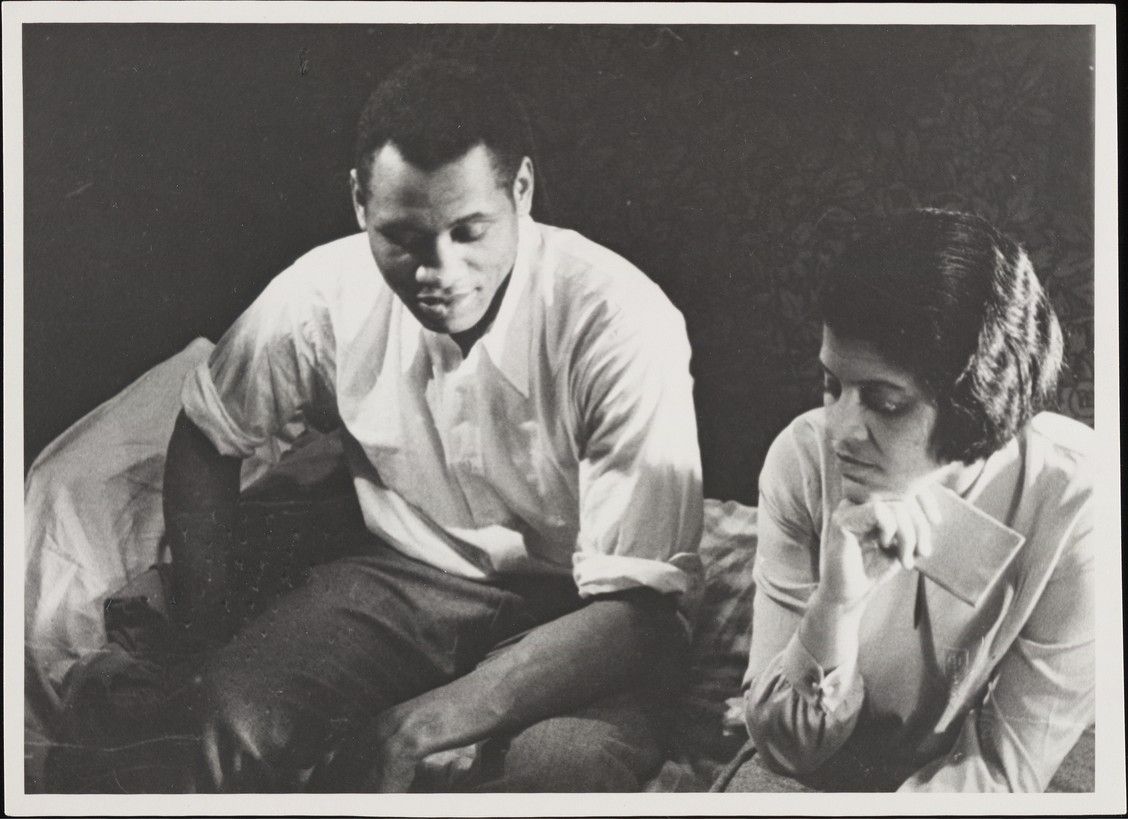
A glass of water balances near the edge of a table. A pianist's fingers attack the keys. A barmaid dances, but Kenneth Macpherson will not grant her body the continuity of an ordinary performance: an arm, a face, a skirt and a low-angle glimpse arrive in separate bursts. The inn's manager speaks on the telephone. The glass remains one jolt away from falling. Nothing in Borderline stays privately inside the person who feels it.[3]
That is the 1930 film's governing sensation. Desire does not pass neatly from one character to another; it ricochets among faces, hands, rooms, animals and objects. Macpherson's editing makes emotion contagious before the plot has made it legible. Yet the surrounding town responds to this instability by enforcing one brutally stable distinction. White characters may cross erotic and moral lines, but the Black couple at the center will bear the public cost.[2][3]
Made by the Pool Group near Montreux, Switzerland, Borderline brought Paul and Eslanda Robeson together with the poet H.D., the writer and patron Bryher, and other members of their modernist circle.[2][4][5] The BFI places it inside Britain's experimental feature tradition, emphasizing both its taboo subjects and its expressive editing and cinematography.[2] Those qualities belong together. The film does not merely tell a story about social boundaries. It tests whether a cut can make those boundaries tremble—and whether formal daring is enough to overcome the assumptions inside the gaze.
Spoiler note: this essay discusses the film's killing, acquittal and expulsion.
A town made of thresholds
The story takes place in a mountain village somewhere in Europe, a place specific enough to have stairs, windows, streets and a crowded inn but vague enough to feel like a social experiment.[3][4] Pete arrives after his wife, Adah, has begun an affair with the white Thorne. Thorne's wife, Astrid, wants the affair ended. The premise could be arranged as a tidy diagram of two couples. The movie immediately refuses that tidiness.
Its key location is the inn's bar. Private rooms sit above it; the village gathers below. A staircase connects scandal to spectators. A telephone carries news across spaces. Windows admit wind that lifts newspaper pages, turning information into restless matter. The bar is therefore not just a setting but a pressure valve between private desire and public judgment. Every entrance risks converting intimacy into rumor.
The people who run this room also complicate the couples' apparent symmetry. The manager, played by Bryher, and the barmaid have often been read as a lesbian pair; the pianist gazes at a photograph of Pete. The film does not give these desires a clarifying declaration. It locates them in glances, proximity and performance, at the edge of the heterosexual melodrama.[2][3] The background keeps suggesting that the official pairings are not the only attachments in the room.
This makes the title more than a label for forbidden romance. H.D.'s accompanying pamphlet describes the characters as social cases who are neither fully outside life nor securely inside it.[4] Their town is built from provisional memberships. A person can be a guest and an intruder, a spouse and a deserter, an object of fascination and a target of expulsion. The threshold is not a line they cross once. It is where they are made to live.
The cut moves feeling into things
Macpherson's most distinctive move is to take emotion away from the face just when a conventional close-up would promise to explain it. Astrid's agitation cuts into the stuffed seagull pinned to a board. Thorne's attempted departure flickers between Astrid, Adah and his suitcase until the object seems charged with the feelings of all three. A glass threatens to tip. Loose paper flaps in a room. The world behaves as if it has caught the characters' nerves.[3]
H.D.'s accompanying pamphlet praised Macpherson for sculpting with light—arranging planes of shadow across a moving face as deliberately as a sculptor works bronze.[4] The metaphor captures the film's hard, luminous portraits, but its editing does something sculpture cannot. It collides one surface with another. A face does not disclose a sealed interior; it becomes one element in a temporary circuit with a hand, a bird, a window or a case being carried toward the door.
The cat-and-fish sequence makes the power and danger of this method especially clear. As Pete follows Adah, Macpherson cuts to a cat circling a small glass that contains a fish. The paw enters; the fish is caught. Later the cat moves through the inn and struggles when Thorne clutches it. The association gives pursuit a physical pulse, but it also transfers predatory, animal meaning onto Pete and Adah from outside them.[3]
That distinction matters. The image does not simply reveal Pete's mind. It reveals the symbolic machinery through which the white characters—and at moments the filmmakers—imagine him. Modernist montage can rupture a stereotype's smooth surface while still carrying primitivist ideas inside the fragments. The cut is not automatically liberating because it is new.
The camera gives Robeson presence—and turns presence into a problem
When Paul Robeson enters the film, Macpherson changes the visual temperature. Pete is often still while the white characters twitch, clutch and fracture. Light models Robeson's face and shoulders against curtains, walls or sky. The camera approaches his body with an intensity it grants no one else. H.D.'s language of bronze and sculpted light was written to honor that effect.[3][4]
The image is genuinely commanding. In 1930, Robeson was already celebrated on stage and in concert, but mainstream screen opportunities remained constrained by racism. He and Eslanda had settled in Britain partly because it offered possibilities denied to them in the United States; Borderline placed both inside an avant-garde production that addressed interracial desire rather than disguising it.[5] Pete is not visually marginal. The film knows it possesses a star.
But centrality is not the same as subjectivity. Simone Knewitz's close analysis identifies an imbalance: white hands flutter, telephone, carry, stab and issue commands, while Pete's hands are frequently shown at rest. His calm becomes a charged contrast to white anxiety, yet it can also make him a screen for fantasies of bodily authenticity, sexuality and “natural” force.[3] The film looks at Robeson with admiration and appetite at once.
The difference becomes sharper when Adah is considered. Eslanda Robeson gives her quick changes of resolve and distress, but the montage often recruits her face into the psychic drama of Astrid and Thorne. Adah is desired, blamed and made to signify disruption. Pete is monumentalized. Both receive less room to define the social world than the white characters receive to convulse within it.
This is why Borderline remains more interesting than a claim that it was simply progressive for its time. Its image of Robeson is neither reducible to stereotype nor free from racial projection. The film can recognize the violence of white panic while reproducing some of the era's idea that Black presence is more physical, elemental or authentic. Its radical gaze and its limiting gaze occupy the same frame.
Hands turn atmosphere into punishment
For much of the film, prejudice behaves like atmosphere: a stare held too long, a rumor moving downstairs, a face tightening when Pete enters. The climax gives that atmosphere an administrative hand.
Astrid threatens Thorne with a knife during their final confrontation. In the struggle, he kills her. He is arrested, then cleared on a claim of self-defense. The white man at the center of the scandal remains legally inside the community. Pete, who did not commit the killing, is told to leave town.[2][3]
The expulsion order arrives in a close-up of an anonymous hand wearing a white glove. Earlier hands have touched bodies, gripped objects and performed violence; this one barely needs a body at all. It makes collective racism look clean, impersonal and procedural. A town does not have to acknowledge its desire, voyeurism or complicity. It can turn a note into policy and make the innocent person carry disorder beyond its border.[3]
Pete and Thorne exchange a handshake before Pete goes. Read alone, the gesture might promise masculine reconciliation. Read beside the gloved order, it reveals the limit of personal recognition. Thorne can acknowledge Pete without surrendering the legal and social protection that separates them. A handshake crosses the space between two bodies; it does not redistribute the consequences.
Here the montage's politics become exact. Form has spent the film making borders porous. A dance breaks into a telephone call and a trembling glass. Desire passes between official couples and queer observers. Faces merge with suitcases and animals. Yet when the town decides who belongs, ambiguity ends. Thorne's violence can be absorbed as self-defense. Pete's presence cannot be absorbed at all.
Restoration cannot make the contradiction disappear
For decades, Borderline was difficult to see, and its survival has its own threshold history. The Cinémathèque suisse says elements thought lost for almost fifty years were recovered in 1984. In 2024 it created a new 4K digital copy from the image negative, grading it against a period nitrate print.[6] The Yale still used above preserves a parallel production trace: the Robesons seated together, the film surviving as a photographic object even outside projection.[1]
That material afterlife matters because the film is about visibility without secure belonging. Its return to circulation has brought Macpherson, H.D., Bryher and the Robesons back into accounts of British, Swiss, Black and queer film history. It has also made the work's tensions easier to inspect. Restoration can recover facial detail and the velocity of a cut. It cannot convert an ambivalent image into an innocent one.
The most useful way to watch Borderline is therefore to resist choosing between celebration and indictment. The film's experiment is real. Its bar feels electrically unstable; its objects pulse with thought; its close-ups make silent faces almost tactile. Its critique of a town that punishes Black presence for white violence is unmistakable.[2][3] So is its dependence on racialized ideas of bodily authenticity.
Prejudice moves at the speed of a cut because it does not live only in declarations. It travels through associations: calm becomes “natural,” desire becomes threat, threat becomes blame, and blame becomes a polite order to depart. Macpherson's montage lets us feel that transmission before we can name every link. The film's enduring achievement is not that it abolishes the borderline. It shows how quickly a culture can redraw one—especially after desire has crossed it.
Sources
- Beinecke Rare Book & Manuscript Library, Yale University, archival film still of Paul and Eslanda Robeson in Borderline — digitized image used for the article hero.
- David Somerset, “10 great British experimental feature films,” British Film Institute (2016) — Borderline's production circle, taboo subjects, expressive editing, sculptural cinematography and restored score.
- Simone Knewitz, “Black Bodies, White Subjects: Modernist Authenticities and Anxieties in the Avant-Garde Film Borderline,” FORUM: University of Edinburgh Postgraduate Journal of Culture and the Arts 12 (2011) — close analysis of the barmaid's dance, hands, objects, animal motifs, montage and racialized embodiment.
- Alison Fraser, “The Borderline Pamphlet,” National Poetry Foundation (2009) — discussion and excerpts from H.D.'s 1930 pamphlet on sculpted light, moving “bronze,” dream and Macpherson's film practice.
- Nathalie Morris, “Paul Robeson: the singer and activist who pioneered a path for black actors,” British Film Institute (2016) — Robeson's British screen career, the Pool Group collaboration and contemporary response to Borderline.
- Cinémathèque suisse, “Borderline” — Swiss production setting, archival recovery in 1984 and the 2024 4K preservation copy made from the image negative with a period nitrate print as grading reference.