Max Ophuls is one of those directors whose reputation can accidentally flatten him.[1][3] He is regularly introduced as the supreme master of the moving camera, which is true, but not yet useful. Plenty of directors move the camera beautifully. Ophuls matters because his camera does not simply decorate space or advertise virtuosity. It turns movement into emotional law. Lovers miss each other because time keeps sliding. Social rank reveals itself in how bodies enter a room, descend a staircase, or cross a ballroom. Shame takes architectural form. Desire becomes something that circulates, returns, and arrives too late.[1][3][4]
That is why the smoothness of an Ophuls shot rarely feels relaxed. It feels fated.[1][3] The camera glides, cranes, pans, and tracks with such grace that a first-time viewer may register only pleasure, then notice a second sensation underneath: the world is already carrying the characters somewhere they did not fully choose to go. Ophuls does not use movement to liberate people from melodrama. He uses movement to show how melodrama already lives inside time, class, etiquette, and public display.[1][5][6]
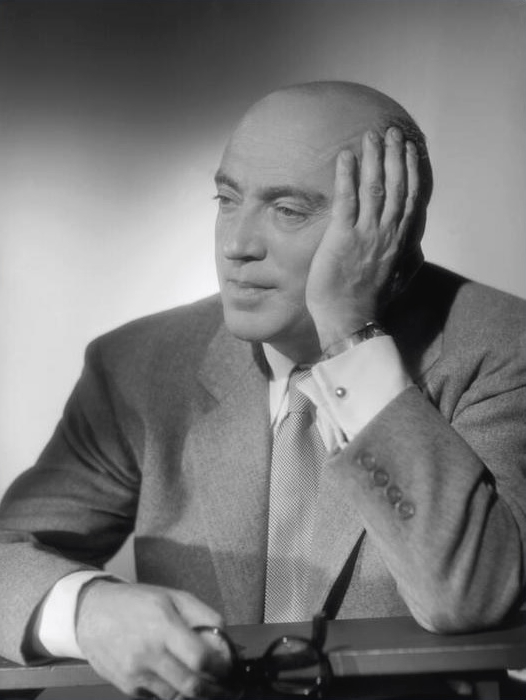
Image context: the lead image is a real Studio Harcourt portrait of Max Ophuls from the 1950s. It belongs here because a director profile benefits from a documented image of the filmmaker himself rather than a generic collage or fan-made poster. The portrait also fits the argument of this essay: Ophuls's cinema is immaculate on the surface, but the stillness of the face carries the same inward pressure his moving camera keeps releasing into rooms, mirrors, and stairways.[7]
The camera moves because feeling has already exceeded the room
The best short explanation of Ophuls's style is that movement in his films is always attached to emotional pressure.[1][3] Criterion's note on "The Ophuls Shot" makes this point directly when it argues that the famous gliding setups are not flourishes for their own sake.[3] That matters because Ophuls can look, at a glance, like a virtuoso one might admire from a slight distance. In practice, he is far more intimate than that. His long takes and sweeping tracks do not stand outside the characters and observe them with superior wit. They stay with the way feeling spills past social form.
This gives even his most elegant scenes a strange double quality.[1][3] They are light on their feet and heavy in implication. A doorway never stays just a doorway; it becomes a threshold between one social state and another. A staircase does not merely connect floors; it stretches embarrassment or anticipation across time. A ballroom is not a backdrop for romance; it becomes a machine for delay, display, and public risk. Ophuls's cinema is full of surfaces that appear civilized and motions that appear effortless, but the beauty is always carrying consequence.[1][4]
His biography helps explain some of that pressure without reducing the work to biography.[1] Senses of Cinema traces the route from Germany through exile, Hollywood, and postwar France, and what emerges is not a wandering stylist in search of prettier décor but a filmmaker acutely alert to instability, displacement, and the way social worlds can change their meaning overnight.[1] Ophuls's films are rarely loud about historical catastrophe. Even so, they are deeply alert to fragility: status can vanish, intimacy can fail to arrive on time, and public life can turn private feeling into spectacle before a person has found the words for it.[1][6]
In Letter from an Unknown Woman, movement turns missed time into destiny
BFI's page on Letter from an Unknown Woman gets to the core of the film by stressing Ophuls's flowing camera and Viennese melancholy.[2] The crucial point is that the camera does not merely romanticize Lisa's devotion to Stefan. It gives physical form to the asymmetry of their lives.[2][3] Lisa experiences love as duration, memory, waiting, and recurrence. Stefan experiences it as charm in the present tense. Ophuls organizes the film so that this mismatch is felt not only through plot but through motion itself: staircases, passing carriages, corridors, and musical entrances all carry the ache of one life moving at a different moral speed from another.[2][3]
That is why Letter from an Unknown Woman feels so devastating without becoming static or solemn.[2][3] The camera is always alive, yet its life keeps sharpening the tragedy. Motion here does not mean freedom. It means that time cannot be held in place long enough for recognition to happen when it should. Lisa passes repeatedly through spaces charged with memory, while Stefan treats those same spaces as interchangeable stations in a life of seduction and drift.[2] Ophuls turns the mechanics of passage into heartbreak. By the time Stefan finally understands what the letter means, movement has already done its work; the years have flowed one way, and there is no reverse track available.
In La Ronde, circulation itself becomes the subject
If Letter from an Unknown Woman makes movement intimate and tragic, La Ronde makes it social and mischievous.[5] Criterion's essay on the film emphasizes how central the carousel structure is, and that image is exactly right.[5] The movie links lovers across class positions and erotic episodes, with Anton Walbrook's master of ceremonies guiding the viewer through the pattern like a benevolent manipulator. Ophuls turns circulation into the subject. Desire no longer belongs to one tormented pair. It moves across a whole city, crossing thresholds of rank, profession, money, and self-presentation.[5]
What makes the film richer than a clever roundelay is the tenderness Ophuls brings to that design.[1][5] He is too amused by human inconsistency to moralize, but too precise to pretend the game is weightless. The camera's glide keeps giving the encounters buoyancy while quietly revealing how much each character depends on role-play, costume, and timing.[5] A soldier, a maid, an actress, an aristocrat: everyone enters the circle thinking desire might suspend hierarchy for a moment. Ophuls stages the fantasy beautifully, then lets structure reassert itself. The roundabout turns, the scene changes, and another combination begins. Motion here is not only sensual. It is social grammar.
In The Earrings of Madame de..., elegance becomes accounting
Ophuls may have made no film more exact than The Earrings of Madame de..., where feeling travels through an object that keeps changing hands.[4] MoMA's note on the film calls attention to the symmetrical structure kicked off by the sale of the earrings, and symmetry is exactly the point.[4] The movie is built from transfer: gift, sale, return, recognition, concealment, dance, debt. Ophuls uses camera movement not to blur those transactions but to make them legible as emotional accounting. Every glide through a salon or sweep around a couple in motion suggests that love and money are already tangled before anyone speaks the truth aloud.[4]
This is where Ophuls's reputation for elegance is both deserved and incomplete.[3][4] No one stages a ballroom with more seductive fluency, yet in Ophuls even the waltz has teeth. The famous dance passages in Madame de... do not merely show attraction blooming. They show how repetition changes value. One turn becomes many; formal politeness becomes a private rhythm; public decorum slowly admits the force it was designed to contain.[4] Ophuls films aristocratic polish as a medium through which passion can circulate only by becoming more dangerous. The camera seems to float, but what it is really measuring is cost.
In Lola Montès, spectacle swallows movement back as punishment
If one wants the harshest version of Ophuls's worldview, Lola Montès may be the clearest place to look.[1][6] The Criterion essay on the film describes the circus frame and its relentless movement through time and spectacle, and that structure feels like Ophuls turning his own signature inside out.[6] In earlier films, motion often tracks desire as it searches for form or recognition. In Lola Montès, motion becomes exhibition. Lola's life is chopped into attractions, reenacted before paying audiences, and managed by a ringmaster who knows that scandal can be monetized if it is given enough theatrical momentum.[6]
What makes the film so powerful is that Ophuls never abandons sympathy while showing how spectacle degrades it.[1][6] The camera remains magnificent, but magnificence no longer promises romance or reciprocity. It becomes the very medium through which a woman is circulated as a public object. The circus ring compresses the entire director's art into one cruel machine: all movement, all display, all recurrence, no safety. By the end, the famous Ophulsian glide feels almost accusatory. It asks what the audience is doing with its pleasure, and what kind of looking modern entertainment has trained people to enjoy.[6]
Why Ophuls still feels modern
Ophuls's afterlife has been so strong because later filmmakers recognized that his camera could think.[1][3][4] He did not separate technique from subject. Movement was the subject. When later directors borrow his cranes, his tracks, his rotating social spaces, or his stairway melancholy, what they are really trying to borrow is a deeper principle: that cinema can render feeling as a problem of time, social placement, and bodily passage through space.[1][3]
That remains modern because contemporary life is still full of elegant systems that quietly govern emotion.[4][5][6] Social performance, public display, romantic timing, class coding, spectacle, repetition, and late recognition have hardly disappeared. Ophuls understood that people often suffer less from one grand event than from the accumulated motion of smaller ones: a room crossed at the wrong moment, a dance extended past safety, a gift recirculated, a letter read too late, a life retold as entertainment.[2][4][6]
Seen from that angle, Ophuls is not simply the patron saint of beautiful camera movement. He is one of the great directors of emotional mechanics. He makes the viewer feel that motion is never innocent. Someone always arrives late, descends too visibly, remembers too much, or gets turned into part of the show. The camera glides because the world has already started moving under the characters' feet.[1][3][6]
Sources
- Senses of Cinema, "Max Ophuls" (Great Directors essay by Tag Gallagher).
- BFI, "Letter from an Unknown Woman (1948)" film page.
- The Criterion Collection, "The Ophuls Shot."
- MoMA, "Madame de... (The Earrings of Madame de...). 1953. Directed by Max Ophuls."
- The Criterion Collection, "La ronde: Vicious Circle."
- The Criterion Collection, "Loving Lola."
- Wikimedia Commons, "File:Max Ophüls.jpg" - Studio Harcourt portrait file page and metadata.