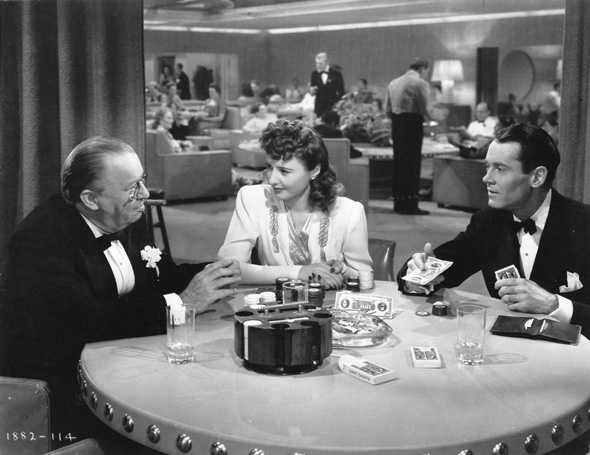
Most great screwball comedies turn attraction into an argument. The Lady Eve goes one step meaner and smarter: it turns attraction into a class test. Charles Pike, the wealthy brewery heir and snake specialist coming home from the Amazon, thinks of himself as innocent because he is sincere, bookish, and awkward.[1][4] Jean Harrington sees the harder truth at once. His innocence is inseparable from money, protection, and the assumption that the world will announce danger before it strikes. Her con works because it is aimed not only at his desire but at his confidence that he can tell the difference between authenticity and performance.[1][2][4]
That is why Preston Sturges's film still feels fresher than a lot of romantic comedies built on mere misunderstanding.[1][3] The movie does not set an honest man against a dishonest woman. It sets two performance systems against each other. Jean and her father perform fraud professionally; Charles performs class purity without knowing he is performing at all. James Harvey's Criterion essay gets close to the center when it argues that Sturges is at his best when he works through Hollywood formulas rather than above them.[2] The Lady Eve takes the formula of the rich innocent and the worldly temptress, then keeps showing that the supposedly natural side of the pair is just another costume.
Image context: the lead image is a real promotional still showing Colonel Harrington, Jean, and Charles at a shipboard card table. It belongs here because the film's romance begins as a reading exercise. Before Jean kisses Charles or impersonates Lady Eve Sidwich, she studies him across a table, inside a room designed for leisure, money, and soft surveillance.[6]
Charles likes danger only when it is cataloged
Sturges makes Charles an ophiologist for a reason.[1][4] BFI summarizes him as a millionaire boffin returning from South America, and AFI's production history notes that Sturges fought to keep the snake material even when early readers thought it served no purpose.[1][4] It serves a great deal of purpose. Charles can adore danger when danger is behind glass, given a Latin name, and handled as expertise. He loves risk once it has been turned into knowledge.
Jean is the unruly version of what Charles thinks he already understands. She is quick, beautiful, observant, and opportunistic; she moves through the same cruise-ship luxury that protects him, but she reads it as an environment for hunting.[1][3][4] The film's first great joke is that Charles, who has spent a year with snakes, cannot recognize the far more sophisticated predator sitting two tables away. Yet Jean is not played as venomous. Stanwyck gives her too much appetite, wit, and eventual vulnerability for that.[2][3] The film keeps its balance by refusing to make knowledge morally simple. Charles's scientific seriousness is genuine. Jean's duplicity is genuine too. Sturges's comedy begins when one kind of worldly intelligence outplays another.
Falling is the film's real class diagram
Jean first gets Charles's attention by tripping him as he leaves the dining room.[4] That action is miniature, flirtatious, and programmatic all at once. From there onward, Charles's body keeps betraying what his breeding and money are supposed to stabilize. Rafferty calls him the Platonic ideal of a sap and notes his repeated face-plants; Harvey hears in the movie a delight in aggression that belongs to screwball comedy at full charge.[2][3] The point is not just that Charles is clumsy. The point is that desire makes him vertically unreliable.
Those falls do several jobs at once.[2][3][4] They are funny because Henry Fonda plays them with such startled dignity; they are erotic because Jean's control over his body is obvious before any declaration of love; and they are social because each stumble strips a little authority from the brewery heir who is used to moving through the world as if nothing will really touch him. Screwball comedy often humiliates men in order to free them. Sturges sharpens the formula by making humiliation the only language Charles can actually understand. Patter does not teach him enough. Loss of balance does.
That is why the film never feels like a simple battle of the sexes. It is closer to a struggle over who gets to define reality inside a courtship. Charles thinks sincerity should be enough. Jean knows that courtship is already theater: costume, timing, feints, entrances, misdirection. The pratfalls are not interruptions to that theater. They are its clearest truth.
Lady Eve works because snobbery needs very little evidence
The second movement, in which Jean returns as the aristocratic Lady Eve Sidwich, is sometimes treated as pure farce, a test of how blind Charles can be.[1][4] But the disguise is sharper than that. Harvey puts it bluntly: Lady Eve is designed to appeal to Charles's snobbery.[2] The miracle is not that he fails to recognize Jean's face. The miracle is how little the upper-class world around him requires in order to ratify the transformation. A title, an accent, a revised wardrobe, a controlled entrance, and the room does the rest.[1][2][5]
This is where The Lady Eve becomes one of Hollywood's funniest essays on class desire.[1][2] Charles does not merely want Jean purified. He wants her translated into a form his family and social world can admire without embarrassment. Lady Eve gives him exactly that fantasy. The same wit becomes breeding. The same sexual confidence becomes continental elegance. The same woman becomes newly legible because Edith Head's costumes, Victor Milner's glossy black-and-white cinematography, and Sturges's drawing-room staging wrap her in a finish that wealth recognizes as its own.[5]
Muggsy's refusal to be fooled matters because it keeps the film from drifting into fairy-tale nonsense.[4] Somebody on screen can still see plain facts. Charles cannot, because what he is recognizing is not a face but a class script. That is the movie's coldest joke: aristocracy is the one con the rich most want to believe.
The ending stays tender because the con is also a confession
Jean's wedding-night revenge is cruel, and Sturges does not sand down the cruelty.[1][3][4] By inventing a sordid romantic past for Lady Eve and watching Charles break under it, she gives him the humiliation he earlier gave her when he rejected Jean as socially unfit. But the movie does not finally argue that revenge purifies love. It argues something more embarrassing and more adult: love in this world arrives mixed with vanity, theater, grievance, and wishful projection.[2][3]
Rafferty's larger point about the con movie helps here. Confidence games are seductions; they promise people a version of reality they are already primed to want.[3] That is exactly how The Lady Eve ends. Back on the ship, Jean trips Charles again, resets the scene, and the film chooses not exposure but renewed surrender.[4] This is not because truth no longer matters. It is because Sturges has spent the whole film showing that romance itself runs on selective belief. Charles can only reach Jean once he stops treating performance as something beneath him and starts accepting it as part of how intimacy works.
That is why the movie still bites in 2026.[1][2][3] The Lady Eve understands that class is not only money; it is posture, confidence, the management of embarrassment, the fantasy that one can remain untouched by the very desires one pursues. Sturges turns all of that into comedy, then lets Barbara Stanwyck walk away with the film because she understands the lesson first. In this shipboard world of cards, snakes, and upholstered luxury, the smartest person is the one who knows that innocence is also a role.
Sources
- BFI, "The Lady Eve (1941)" film page.
- James Harvey, "The Lady Eve," The Criterion Collection.
- Terrence Rafferty, "For the Love of the Con," The Criterion Collection.
- AFI Catalog, "The Lady Eve" (1941).
- The Criterion Collection, "The Lady Eve" film page and edition notes.
- AFI, "AFI Movie Club: THE LADY EVE."