Howard Hawks's His Girl Friday is usually introduced as the fast-talking one.[1][2] That is true as far as it goes, but it still understates the achievement. The movie does not simply move quickly because the actors speak quickly. It moves quickly because Hawks turns speech into traffic. Lines overlap, doors keep opening, telephones interrupt, reporters drift in and out of the frame, and every room feels arranged for the next interruption before the current one has finished landing.[2][4][5] Speed in this film is not decoration laid on top of a conventional romantic comedy. It is the governing condition of the world.
That helps explain why the 1940 film still feels brisk in a way many later comedies do not.[1][2] Hawks and screenwriter Charles Lederer reworked Ben Hecht and Charles MacArthur's The Front Page by changing Hildy Johnson from a male reporter into Rosalind Russell's ex-wife reporter, then letting Cary Grant's Walter Burns turn professional pursuit into remarriage pursuit.[2][3][6] The gender switch matters, but the movie's real coup is structural. Hawks does not merely add romance to a newspaper story. He makes romance operate at newsroom tempo. Hildy's deepest compatibility with Walter is audible in their timing, visible in how they occupy rooms, and legible in the fact that ordinary domestic life never seems able to offer her the same density of response.[3][4][6]
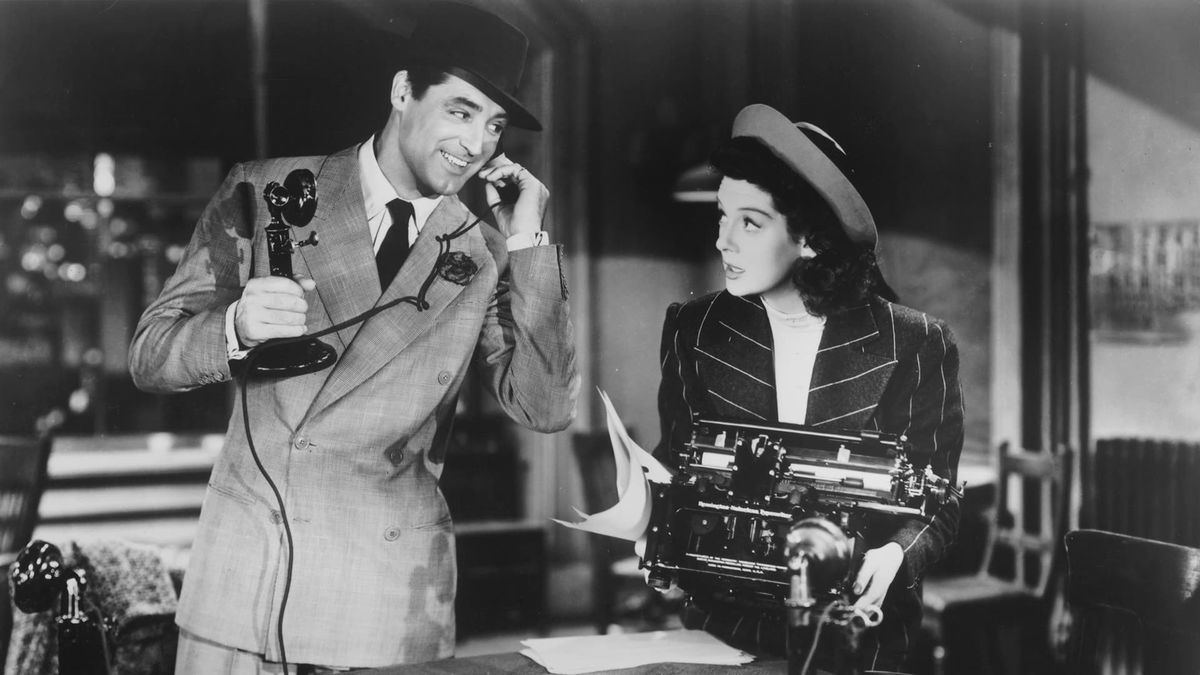
Image context: the cover uses a publicity still of Cary Grant and Rosalind Russell from His Girl Friday. It is the right recognition image for this essay because the film's electricity arrives through shared professional rhythm. Long before the plot resolves, Hawks has already shown that Walter and Hildy belong to the same pressure system, each quickening the other's reflexes inside one charged frame.[7]
Overlapping dialogue is the film's engine, not its party trick
The movie's most famous formal choice remains the overlapping dialogue, yet even that phrase can make the effect sound ornamental.[2][4] Criterion's dialogue study notes that the script ran to around 191 pages while the finished film comes in at roughly ninety-two minutes.[4] The compression is not just a feat of delivery. It changes how information behaves. In many comedies, dialogue communicates wit and plot, then cutting and blocking carry the scene forward. In His Girl Friday, speech itself becomes a blocking device. One character's line does not wait politely for another's line to end because the movie has no interest in politeness as a governing rhythm.[3][4]
That matters especially for Hildy and Walter. Their exchanges do not play like set-piece zingers launched across empty space. They sound like two people thinking at the same voltage.[3][4] Each interruption is partly a challenge and partly an embrace. When Walter needles Hildy about leaving journalism, or when Hildy tries to keep the conversation on her imminent marriage to Bruce Baldwin, the interruptions are already the argument: each one proves how quickly the other can answer, redirect, or seize initiative. Hawks turns repartee into evidence of professional equality. Hildy is not special because Walter talks at her speed; she is special because she can take his pace, sharpen it, and send it back.
The lack of conventional musical padding sharpens the effect.[3][4] Rather than leaning on score to regulate comic tempo, Hawks lets ringing phones, typewriters, footsteps, and human voices supply the pulse. That gives the movie an urban hardness that still feels startling. The newsroom never fully settles into background. It keeps asserting itself as a sound field in which any private conversation can be swallowed, reframed, or accelerated by the demands of work.[1][2][4]
Hawks turns offices, hallways, and doorways into relay lanes
If the dialogue is the most audible part of the film's speed, the staging is the part that makes the speed sustainable.[5][6] David Bordwell's analysis is useful here because it shows how unshowy Hawks can be while still choreographing several actions at once.[5] A doorway is never just an exit. It is a pressure valve. Someone leaves in anger, someone else steps in with a lead, a call comes through, a deputy appears, and the room's emotional temperature changes before the camera has needed to call attention to itself. Hawks does not have to slice scenes into frantic fragments. He can hold on bodies in space and let the tempo arise from layered entrances, pivots, and relays.[5]
The press room is the clearest example. It is not a neutral workplace set but a circulation machine.[1][2][6] Desks, benches, windows, and the adjoining hallway keep sorting people by urgency: reporters push toward a detail, officials try to manage exposure, and Walter and Hildy occupy the room as if they were its most gifted predators. Harvard Film Archive's note on the film stresses how Hawks wrings comic and erotic charge from these cramped interiors, and that is exactly the point.[6] The movie's romance is never staged away from work. Work is the space in which the attraction becomes undeniable.
This is why the film still feels more modern than many prestige screen comedies that advertise their cleverness through rapid cutting.[5] Hawks trusts staging in depth, partial obstruction, and the energy of bodies crossing one another's lines of action. He lets people talk from the side of the frame, from behind a desk, on the move toward another room, or while handling a phone call that changes the value of everything just said.[4][5] The viewer is constantly re-sorting priorities. Which conversation matters more? Which interruption is strategic, and which is accidental? That mental re-sorting becomes part of the pleasure. The comedy comes from the audience having to think at nearly the same clip as the characters.
The remarriage plot works because work is the seduction
Farran Smith Nehme's Criterion essay gets to the center of the film by refusing to treat the romance as a simple sentimental return.[3] Walter wants Hildy back as his wife, but he also wants her back on the paper, and Hawks is far too intelligent to pretend those motives can be cleanly separated. The film's mature edge comes from recognizing that Hildy's emotional and intellectual animation lives inside the labor of reporting. Bruce offers decency, money, and a more orderly future. Walter offers a story, a chase, a conspiracy, a room full of people talking too fast, and the implicit compliment that Hildy is built for all of it.[2][3][6]
That is why His Girl Friday never treats journalism as mere backdrop. The Earl Williams case is not just plot machinery designed to keep the couple in one place.[1][2] It is the mechanism that reveals Hildy's professional appetite and moral alertness under pressure. As the story twists through corruption, delay tactics, and public spectacle, Hawks keeps demonstrating that Hildy comes most alive when facts are unstable and the room needs somebody who can impose order on them. Walter recognizes that not out of generosity but out of appetite. He is drawn to competence with the same hunger he brings to the scoop itself.[3][4]
The film's famous cynicism lands differently once seen from that angle. Walter is manipulative, evasive, and almost indecently resourceful, but Hawks does not build the movie around the fantasy that love will redeem him into an entirely different person.[2][3] Instead he shows that Hildy understands the species of person Walter is because she is, professionally, of the same species. Their chemistry comes from mutual recognition before it comes from tenderness. The remarriage plot holds because the workplace has already trained them in each other's methods.
Why the movie still feels new
BFI places His Girl Friday securely in the canon of Hollywood comedy, yet its continuing freshness has less to do with prestige than with form.[1] So many later films have borrowed the idea of fast dialogue while missing Hawks's deeper discovery: talk speeds up when space, labor, and desire all run on the same clock. His Girl Friday never asks the audience to admire verbal brilliance in isolation. It embeds that brilliance in doors slammed too soon, calls taken mid-argument, reporters orbiting a story, and an ex-couple whose emotional truth appears most clearly when both are working flat out.[1][3][5]
That is why the movie feels so contemporary in offices shaped by notification fatigue, multitasking, and professional identities that bleed into private life.[4][5] Hawks had no laptops or message threads to work with. What he had was a newsroom, a courthouse-adjacent press room, and the intuition that modern tempo is social before it is technological. People become modern when they are forced to think, answer, pivot, and improvise faster than manners would prefer. Hildy Johnson thrives inside that demand, and His Girl Friday knows it. The film's romance endures because Hawks understood a hard truth: for some people, the surest way to show love is still to offer a harder, faster, more interesting day at work.[2][3][6]
Sources
- BFI, "His Girl Friday (1940)" film page.
- The Criterion Collection, "His Girl Friday" film page.
- Farran Smith Nehme, "His Girl Friday: The Perfect Remarriage," The Criterion Collection.
- Imogen Sara Smith, "Words in Edgewise: Dialogue in His Girl Friday," The Criterion Collection.
- David Bordwell, "My girl Friday, and his, and yours," Observations on Film Art.
- Harvard Film Archive, "His Girl Friday" screening note, June 28, 2019.
- Wikimedia Commons, "File:HisgirlFriday.jpg" - publicity still file page and metadata.