Max Ophuls is one of those directors whose reputation can shrink into a single adjective if you let it: graceful.[1][2][3] The adjective is earned, but it is also too soft. Ophuls did not move a camera simply to make cinema feel luxurious. He used motion to show how people are carried, cornered, displayed, delayed, and rearranged by the worlds they enter. Lovers cross ballrooms, women climb staircases, men pause in doorways, mirrors split a room into rival truths, and a tracking shot turns courtesy into pursuit or desire into social trap.[2][3][5]
That is why his films keep feeling more severe than their sheen first suggests.[1][2][7][8] Across a career broken by exile from Germany to France, through a difficult Hollywood period, and back to France for the late masterpieces, Ophuls kept building the same emotional machine in different national settings.[1][4] Love in his cinema is rarely private for long. It passes through money, rank, performance, memory, public gossip, and the plain fact that somebody is always watching. His famous camera movements matter because they give those pressures visible form.
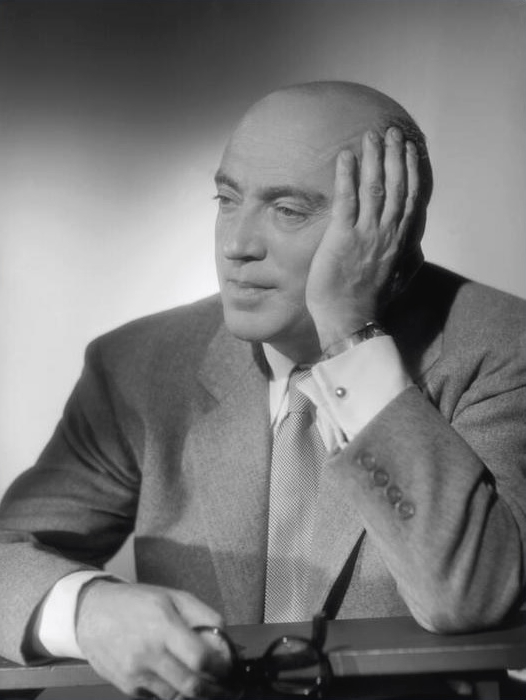
Image context: the lead image uses a real Studio Harcourt portrait from the 1950s preserved on Wikimedia Commons.[9] It fits this article better than a single film still because the piece is about a directorial method carried across many countries and productions: a poised public face hiding a cinema built on circulation, imbalance, and emotional risk.
Exile gave him a cinema of thresholds
Britannica's biography is useful not only for the outline of Ophuls's life but for the scale of it.[1] Before film took over, he had already worked as an actor, stage director, and producer in Germany and Austria and had passed through some two hundred plays.[1] The 1950 Sight and Sound interview deepens that picture by showing how quickly he moved through theater culture as a young man and how instinctively he treated directing as a matter of staging people in relation to one another rather than of merely illustrating text.[4] That theatrical training never left him. It migrated into film as a fascination with entrances, exits, crossings, curtains, backstage spaces, and the unstable line between performing a role and living inside it.
The other decisive fact is exile.[1][4] After the rise of the Third Reich, Ophuls left Germany, worked across several European countries, became a French citizen, then fled again and eventually found a second phase in Hollywood.[1] That history is more than biography. It helps explain why so many Ophuls films feel built around provisional belonging. Train compartments, hotel rooms, apartments, salons, dance floors, circus stages, and backlot cities are never just neutral containers. They are places where people are temporarily installed and quietly judged.
You can feel this acutely in Letter from an Unknown Woman.[6] Charles Dennis's Criterion essay notes how lovingly Ophuls recreates turn-of-the-century Vienna on a studio backlot and how the transparent theatricality of those sets heightens the film's atmosphere of memory and illusion rather than weakening it.[6] That is a perfect Ophuls solution. Artificiality does not cancel feeling. It clarifies that feeling is always being staged inside a social world already full of scripts, rituals, and inherited positions.
In Ophuls, movement is moral pressure
Criterion's short piece "The Ophuls Shot" offers the clearest compact statement of the basic principle: his camera glides, tracks, and cranes, but never for flourish alone; the movement always carries emotional and thematic work.[3] The example it chooses from Le plaisir is revealing. The bravura opening of "The Tellier House" maps the brothel and its relation to the street, yet withholds the interior, making movement itself a rule about access.[3] Ophuls is not just showing off his command of space. He is telling you who gets to enter, who must stay outside, and how desire is organized before anyone speaks.
Brad Stevens's BFI essay on Ophuls and Hitchcock sharpens the point further by linking Ophulsian movement to power.[5] In Lola Montès, a character crossing the frame does not only create visual excitement; she shifts the balance of authority inside the shot.[5] Ophuls understands that motion on screen is never innocent. The question is always who can move, who must stop, who gets followed by the camera, and who becomes an object within somebody else's arrangement.
Senses of Cinema is especially strong on the way this style remains actor-centered rather than decorative.[2] Ophuls pushes performers into physically expressive action by having them climb stairs, run, dance, drag burdens, or simply pass through rooms in long takes that refuse to chop behavior into inert pieces.[2] The mobile camera works in service of those efforts. It makes bodies think. A face turning in place is one kind of revelation; a face discovered at the top of a staircase after the climb is another.
That is why the common description of Ophuls as merely "elegant" misses so much.[2][3][5] Elegance in his cinema is the surface under which coercion and longing keep changing places. A shot can feel weightless while still carrying humiliation, risk, or fatal delay.
His women are central because his films treat love as a contract with consequences
Senses of Cinema puts the matter plainly: Ophuls's recurring subjects are women, more precisely women in love, very often women to whom love brings misfortune.[2] That formula, though, needs one addition. The women in Ophuls are not there to decorate male melancholy. They are the figures through whom the films test how romance is shaped by money, propriety, prestige, and spectatorship.[2][6][7][8]
Take Lisa in Letter from an Unknown Woman.[6] Dennis describes the film as a hypnotic tale of fatal attraction, but what makes Lisa unforgettable is not only devotion. It is the way Ophuls films devotion as an entire life reorganized around timing, memory, and self-fashioning.[6] She does not merely wait for love; she rebuilds herself around an idea of love that the social world can neither honor nor sustain.
Or take The Earrings of Madame de . . ..[7] Criterion's film page describes it as a tale of deceptive opulence and tragic romance, and that phrase reaches the center.[7] Ophuls's women often move through beautiful environments that are already accounting systems. Jewelry, names, titles, uniforms, introductions, and seating arrangements all carry value before the heart does. Love arrives inside a network of exchange. That is why it hurts so much.
Then there is Lola Montès, where the final film of his career turns romantic history into a circus of public consumption.[8] Criterion is right to call it both a romantic melodrama and a meditation on celebrity.[8] Ophuls had always understood that desire and spectatorship travel together. In Lola Montès, he makes that link brutal and explicit. The heroine is looked at, sold, narrated, and recirculated until performance itself becomes the residue of a life.
Yet none of this turns into contempt.[2][4] The 1950 BFI interview repeatedly suggests a director attentive to actors, workers, and the emotional temperature of a room, and Senses emphasizes how thoroughly his films empathize with women caught inside humiliating arrangements.[2][4] He sees the traps clearly, but he never treats the trapped as foolish for wanting more life than the system allows.
Stairs, mirrors, and circles turn romance into geometry
One of the finest observations in Senses of Cinema is that Ophuls's mise en scene grows through partitions, mirrors, and frames within frames, all of them serving themes of deception, doubleness, and staging in depth.[2] This is where the films become unmistakably his. A staircase is never just a staircase. It is a device for delay, exposure, and difference in rank. A mirror does not merely reflect a face. It splits a self between social appearance and private cost.
You see it in the retrospective elegance of Madame de . . . and in the remembered Vienna of Letter from an Unknown Woman.[6][7] You see it again in Le plaisir, where a tracking shot can make a whole community orbit a house whose inner sanctum remains withheld.[3] And you see it at a maximal pitch in Lola Montès, where circular performance spaces literalize the repeated loop by which a woman's past is turned into public entertainment.[5][8]
The circles matter because Ophuls is not a straight-line dramatist.[2][5][8] His characters revisit, repeat, circle back, re-encounter, and misrecognize. Love returns as memory, or arrives too late, or gets translated into an object that keeps changing owners. Even when the camera moves forward, the emotional structure often moves by recurrence. That is part of what gives the films their ache. Motion keeps promising freedom, while form keeps reintroducing fate.
This is why Ophuls's style survived the old accusation of empty prettiness and emerged stronger in later criticism.[1][2] Once critics took seriously the relation between movement and vulnerability, between decor and humiliation, between elegance and social violence, the films no longer looked ornamental. They looked exact. Ophuls's camera does not float above feeling. It discovers the route feeling is forced to take through the world.
That remains his great directorial signature.[1][2][3][5] He made cinema move beautifully, but he also made beauty carry cost. In his films, romance is never just confession between two people. It is architecture, circulation, ritual, commerce, memory, and display. A staircase, a ballroom, a letter, a pair of earrings, a circus ring: each becomes part of the same system. Ophuls keeps that system in motion long enough for us to feel both its intoxication and its cruelty.
Sources
- Encyclopaedia Britannica, "Max Ophüls" biography page.
- James Steffen, "Ophuls, Max," Senses of Cinema.
- The Criterion Collection, "The Ophuls Shot."
- Francis Koval, "An outstanding film director and a good European: an interview with Max Ophüls," Sight and Sound / BFI.
- Brad Stevens, "Masters of space: mise en scène in Ophuls and Hitchcock," Sight and Sound / BFI.
- Charles Dennis, "Letter from an Unknown Woman," The Criterion Collection.
- The Criterion Collection, "The Earrings of Madame de . . ." film page.
- The Criterion Collection, "Lola Montès" film page.
- Wikimedia Commons, "File:Max Ophüls.jpg" archival portrait page.