In the mirrored salon of India Song, people dance, pause, smoke, and drift past one another, but their lips do not produce the words we hear. Speech has left the body. Unseen voices remember Anne-Marie Stretter, contradict one another, slip between past and present, and circle a reception that may already be over. Carlos d'Alessio's music returns with the insistence of a memory that cannot decide whether it is summoning the room or mourning it.[1][4]
This separation is Marguerite Duras's most famous cinematic gesture, but it is easy to describe it too neatly. Sound is not simply detached from image as an avant-garde refusal of realism. The two tracks are given different work. A face can remain silent while a voice remembers it. A room can hold bodies while the soundtrack belongs to another time. An old recording can enter a newly emptied building and turn reuse into an argument. Duras made films in which image and sound remember separately—and the viewer has to live inside the interval.
The writer did not arrive to illustrate herself
Duras entered cinema with formidable literary authority already behind her. She had written novels, plays, and the screenplay for Alain Resnais's Hiroshima mon amour before co-directing La Musica with Paul Seban in the mid-1960s. Frustration with other filmmakers' adaptations helped push her behind the camera; Destroy, She Said followed in 1969 as her first solo feature. She would direct nearly twenty films while continuing to move characters, phrases, locations, and situations among books, theater, radio, and cinema.[2][3][5]
That movement can make her films sound like extensions of literature. They are better understood as experiments in assigning authority. Who owns a sentence once the visible actor is no longer speaking it? Does a location illustrate a story, or can it resist one? Must a film show the event its soundtrack describes? Duras's direction begins when those elements stop reporting to a single dramatic center.
Even Destroy, She Said, made before her strongest image-sound ruptures, works by loosening ordinary identification. Four people occupy a secluded hotel and speak with unnerving clarity, yet their relations never settle into the reliable psychology that dialogue usually supplies. In a 1975 interview, Duras argued that the film pushes viewers outside the usual route of identifying with a character; they must find another way back into it.[2] The essential move is already present: film is not a transparent window onto completed people. It is a room whose distances the spectator must negotiate.
A house learns to listen
In Nathalie Granger (1972), Duras started not from an event but from a country house. Two women pass a day among chairs, windows, a garden, domestic tasks, children, a piano, and long stretches of watchfulness. A radio carries news of a nearby murder. The young Nathalie's violence at school hangs over the rooms. Then a door-to-door salesman, played by Gérard Depardieu, enters to pitch a washing machine and discovers that his practiced flow of speech has almost nothing to attach itself to.[3][6]
The film's quiet is not the absence of incident. It redistributes incident across channels. Public threat arrives by radio; the child's disturbance appears through adult vigilance; household labor is visible but refuses the reassuring rhythm of a domestic routine. The salesman talks because selling depends on controlling the room with language. The women do not reward that language with the expected answers. His pitch gradually exposes its own neediness.[6]
This is an important stage in Duras's development because the house does not serve as a container for plot. It becomes a listening instrument. A piano note can carry more menace than an explanation. A broadcast can make the garden feel permeable without bringing a criminal through the door. Silence can join the two women without turning them into a single psychology. The camera attends to bodies, but sound establishes the pressures those bodies will not explain.
India Song gives speech to the room
By Woman of the Ganges (1974) and India Song (1975), Duras had made the break explicit. India Song stages the remembered world of French colonial society in South Asia through a handful of performers, a mirrored French interior, gliding camera movements, recurring music, cries, and voices recorded apart from the visible action. The actors never open their mouths for the exchanges on the soundtrack. Some voices seem to belong to the people before us; others belong to unseen onlookers trying to recover a story that keeps receding.[1][4]
The production method deepened the dislocation. Duras played taped dialogue during filming, including speech and directions the actors had recorded earlier. They moved while hearing their own past performances, unable to settle fully into present-tense naturalism. Small gestures—a turn from the piano, a cigarette, a passage before the mirror—therefore feel both physical and posthumous. The body performs now; the voice has already happened.[2][4]
That structure makes listening active. In conventional synchronization, a viewer quickly joins voice to mouth and moves on to meaning. Here the join never locks. We keep testing which voice belongs to which figure, whether a sentence describes the present or remembers it, whether the music accompanies desire or survives it. The film does not withhold a completed reality that could be solved with enough attention. It makes incompletion the reality of memory.
The colonial setting keeps this beauty from becoming a free-floating dream. The salon's white diplomats and lovers inhabit luxury while hunger, illness, the beggar woman's voice, and the vice-consul's cries disturb its perimeter. Duras's India is openly phantasmic rather than geographically exact; she grew up within French colonial Indochina, and the places of the Indian Cycle recur through her own memory and invention.[4][5] Sound-image separation exposes the salon as a construction, but it does not make the construction innocent. Instead, the soundtrack brings what the elegant image cannot comfortably contain to its edge.
One soundtrack, a different ruin
Duras tested the independence of these elements with unusual rigor in Her Venetian Name in Deserted Calcutta (1976). She took the soundtrack of India Song—voices and music—and placed it against new images of the château, now empty and decaying. Performers who had seemed ghostlike are gone. The reception continues acoustically while the building loses the social bodies that made it legible.[3][4]
This is more than a sequel made from leftovers. It demonstrates that a soundtrack is not permanently owned by its first images. In India Song, voices turn visible people into memories. In Her Venetian Name, the same voices test whether architecture itself can remember. Peeling surfaces, vacant corridors, and abandoned light do not illustrate the old dialogue; they answer it. Glamour becomes residue. Colonial fantasy loses even its human tableau and is left speaking through a ruin.
The reuse also clarifies Duras's economy as a director. Across her films, materials migrate rather than disappear: characters return under altered conditions, locations receive another story, discarded footage becomes a new work, and a recorded voice outlives the body first assigned to it.[3][5] Repetition is not a failure to invent. It is how difference becomes audible.
Le Camion makes the unrealized film visible
With Le Camion (1977), Duras and Depardieu sit at a table and read or discuss a film that might be made: an older woman catches a ride with a truck driver and speaks as the vehicle moves through an industrial landscape. The proposed scenes do not become a conventional acted drama. The reading, the conditional language, and the images of the truck remain adjacent. Cinema holds the possible film and the present act of imagining it at once.[1][3]
Again, Duras turns what could look like a limitation into the subject. The table does not become the truck cab, and the readers do not disappear into characters. Their voices invite images without commanding them to materialize. The moving truck is real as photographed motion, but its narrative passengers remain provisional. A viewer is not asked to pretend that the film has been completed; we are asked to notice completion as only one of cinema's options.
This is why calling Duras's cinema “literary” can mislead even when the writing is unmistakable. Literature is one material among others. Her direction lies in the cut between a sentence and a road, the duration of a silent face, the acoustic pressure placed on a house, the choice to let a soundtrack survive its cast. She does not reduce cinema to words. She gives words physical conditions—and sometimes refuses them the bodies they seem to demand.
The interval is where the viewer enters
Duras's method can be severe. It denies the easy momentum of cause and effect, makes glamorous spaces feel airless, and leaves viewers without the ordinary reassurance that speech reveals character. The opacity is a boundary as well as a strength: disjunction can become a manner if every absence is treated as automatically profound.
Her best films prevent that by making the split consequential. In Nathalie Granger, sound carries violence across the walls of domestic life. In India Song, unsynchronized voices fracture the apparent unity of a colonial salon. In Her Venetian Name, reuse turns spectacle into ruin. In Le Camion, the gap between reading and enactment preserves political and imaginative possibility. Form changes what a room, a body, or a voice is allowed to know.
Marguerite Duras did not ask sound to explain the image, or the image to prove the voice. She directed the distance between them. In that distance, cinema stops delivering memory as a finished flashback. It becomes the harder act of listening to one time while looking at another.
Sources
- Adam Scovell, “Where to begin with Marguerite Duras,” British Film Institute, updated July 1, 2024 — career overview and notes on India Song, Nathalie Granger, and Le Camion.
- Carlos Clarens, “Colonial guilt: India Song and Marguerite Duras,” interview with Duras in Sight and Sound / BFI, originally published Winter 1975 — primary testimony on direction, voice-off, physical movement, and spectatorship.
- Gabriela Trujillo, “Marguerite Duras, la nuit consolante du cinéma,” La Cinémathèque française, January 18, 2024 — filmography, image-sound separation, reuse, and career context.
- Ivone Margulies, “India Song and Baxter, Vera Baxter: In the Thrall of Duras,” The Criterion Collection, February 28, 2023 — production method, the Indian Cycle, sound, performance, and colonial space.
- Museum of Modern Art, “The Films of Marguerite Duras,” March 1995 — retrospective notes on her film career, recurring performers and motifs, Indochina, and the passage between media.
- Institute of Contemporary Arts, “Nathalie Granger + Gaumont-Palace,” 2024 — program note on the house, radio, piano, salesman, and the film's emerging sound practice.
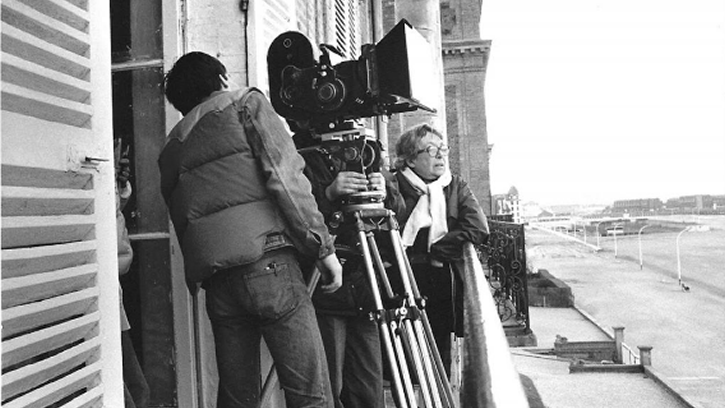
- La Cinémathèque française, “Duras filme” — record for Jérôme Beaujour and Jean Mascolo's 1981 documentary and source page for the archival frame used as the cover image.