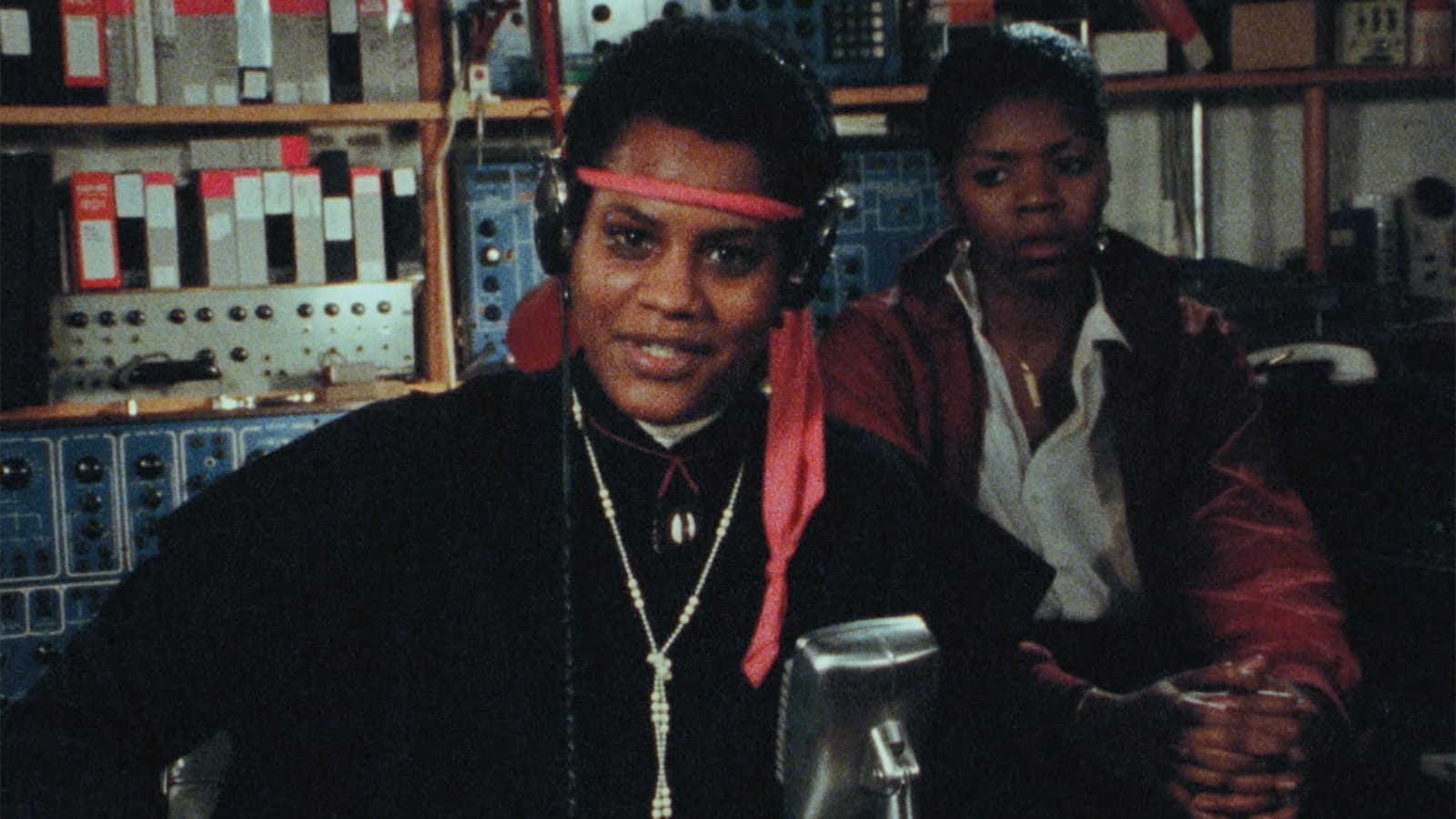
A fixed broadcast desk asks to be mistaken for nowhere. The presenter faces forward, the frame is clean, and a whole apparatus of studios, transmitters, money, regulation, and labor disappears behind the voice of authority. In Born in Flames, that voice announces that history has already worked. Ten years after a peaceful social-democratic revolution, official television describes a society moving steadily toward equality. The streets and workplaces keep contradicting it.[1][2]
Lizzie Borden answers with equipment that never disappears. Honey sits among microphones, headphones, tape boxes, and control panels at Phoenix Radio. Isabel runs Radio Ragazza from another cramped room. Telephones ring. Cameras wobble. Women cross the city on bicycles, then carry a combined station in U-Haul trucks after the original studios are destroyed. At the end, the film looks up at the transmission tower on the World Trade Center and makes centralized reach brutally physical.[2][3][4]
This is the movie's most concrete political argument. Speech always has an address, and an address creates both capacity and danger. A studio gives a voice continuity but also gives repression a target. A bicycle can reach a sidewalk before an institution does. A van can move before it is found. A tower can cover the city because it cannot move at all. Born in Flames maps a struggle between media that own fixed positions and organizers who survive by changing theirs.
Spoiler note: this essay discusses Adelaide Norris's death and the film's final attack on the broadcast tower.
Every voice has a room
Phoenix Radio and Radio Ragazza sound different, but the film first makes them material. Honey's measured delivery is surrounded by the visible labor of a station: another woman in the booth, shelves of recorded material, a microphone close enough to register breath. Isabel's punk address arrives through its own small setup, with “Undercover Nation” giving speech a rhythm that can move beyond the room. Borden wanted music and spoken argument to run simultaneously, so viewers could catch phrases without receiving a compulsory lecture.[3][4]
The rooms protect concentration. They let Honey and Isabel return, build recognition, and address listeners they cannot see. Yet the very stability that makes a station reliable also makes it locatable. Cables lead somewhere. Equipment has to be stored. A regular voice implies a place from which it regularly speaks.
Borden keeps that vulnerability inside the image. The radio booth never becomes an abstract emblem of free expression. Its crowded surfaces say that independence has operating costs: space, hardware, recordings, electricity, people willing to keep the signal alive. Before the film puts broadcasting on wheels, it shows what has to be moved.
The bicycle changes the time of protection
One of the film's clearest action scenes begins with two men attacking a woman on a sidewalk. Women converge from several directions on bicycles, blowing whistles until the men flee; they help the woman, then disperse. The scene is fast, inexpensive, and exact. A bicycle carries no armor and claims no permanent territory. Its value is arrival.[2][5]
The brigade changes the usual timetable of screen violence. In a police procedural, harm produces a call, a dispatch, an official arrival, an investigation, and perhaps a later judgment. Here the response is already moving through the neighborhood. Whistles turn separate riders into an audible presence, while bicycles let them gather and vanish before a slower authority can take control.
The next official account reverses the event. A newscast describes organized bands of women attacking men in the street. Mobility therefore has two consequences: it lets the brigade intervene, and it deprives the state of a stable subject it can interview, license, or arrest. Television supplies that missing stability by fixing the women inside a label. The patrol sees protection in progress; the news sees a threatening group.[2]
Borden has called the bicycle an instrument of revolution, connecting the scene to her own experience riding in New York and confronting street harassment.[5] The phrase sounds grand until the scene restores its practical scale. Revolution here is a cheap vehicle, a whistle, local knowledge, and enough people close by to alter what happens in the next thirty seconds.
Official television hides its address
Government media appears more settled. Presidents, mayors, anchors, and talk-show hosts keep placing the revolution inside a finished frame. They can acknowledge a “woman question,” propose wages for housework, or report Adelaide Norris's death while preserving the larger story that the system is fundamentally complete. Dissent becomes a temporary management problem rather than evidence against the picture.[2][3]
The film's science fiction depends on this fixed authority. There are no futuristic skylines or miraculous devices. Borden filmed guerrilla-style in pre-gentrification New York, using worn streets, workplaces, lofts, and real institutional interiors as a future that has failed to leave its present behind.[1][4] Official television performs most of the world-building. Its composure makes the false promise of completion look administratively normal.
Phoenix and Ragazza show their machinery because they need viewers to understand how a marginal signal exists. Official television can conceal its infrastructure because its place in the city is treated as natural. That asymmetry matters more than polish. One side has to assemble the means to speak; the other side owns the expectation of being heard.
The camera is already moving
The film itself rarely stays put. It cuts through construction, clerical labor, childcare, hair cutting, food processing, sex, reading, telephoning, broadcasting, and organizing. Red Krayola's title song returns across these passages, giving dispersed work a shared tempo without turning the images into one continuous scene.[2]
The production accumulated in similarly mobile pieces. Borden worked for nearly five years, often finding money in increments of about $200, renting cameras and Nagra recorders cheaply, and discovering the story at the editing table. Nonprofessional performers brought their own speech and political experience into a fictional framework that could expand as people, footage, and locations became available.[3][4]
Constraint does not automatically make a film politically alive. What matters is how Borden uses it. The handheld camera can enter rooms that a larger production would have rebuilt. A telephone call can open another part of the city. Footage brought back from the Western Sahara can interrupt New York's boundaries. A song can carry energy between jobs that the official economy keeps separated.[2][3]
The jump cut becomes a form of transport. It does not smooth the city into a master view; it keeps finding another site where the official revolution has failed to arrive. The movie's roughness is therefore geographic information. It records the distance between a government that speaks from one center and lives that have to be reached place by place.
A known location becomes a target
Adelaide gives the Women's Army a recognizable leader, but surveillance turns recognition into exposure. Government agents watch meetings, record associations, and translate lesbian life into the suspicious category of a “lifestyle.” Borden has said that this faux-FBI gaze is political: the point of looking is to make a community available for suppression.[3]
When Adelaide dies in custody and officials call it suicide, the state controls both a body and its public explanation. The film does not solve the death like a mystery. It shows how easily an institution can attach a closing sentence to someone it already controls. Even the photograph of her body becomes a contested object: evidence, grief, and a possible spectacle at once.[2][3]
The radio studios face a related danger at a different scale. After Phoenix and Ragazza have made opposition audible, the film shows their rooms in ruins. Whatever the precise perpetrators, the lesson is material. A station can be smashed because a station occupies a place. The same equipment that sustains a public voice can reveal where to silence it.[2]
The U-Haul is a political form
The replacement station operates from U-Haul trucks. It is one of the film's best production-design decisions because nothing about it looks metaphorical. A commercial rental vehicle becomes a studio, storage room, escape route, and temporary antenna site. If one location becomes unsafe, the broadcast can begin somewhere else.[2]
Mobility does not make infrastructure disappear. The women still need transmitters, power, recordings, drivers, technical knowledge, and a place to park without attracting the wrong attention. The truck exchanges permanence for uncertainty. It is harder to target, but its working conditions are tighter and its reach more fragile.
That tradeoff shapes the later television takeover. Radio can move and continue addressing its listeners; television offers a larger audience but requires entering somebody else's fixed system. The women bring a videotape, force a technician to put it on the network feed, and occupy the broadcast briefly. They do not persuade official media to become fair. They use its hardware before control can close around them.[2][3]
The scene clarifies why Born in Flames is interested in more than “having a voice.” Honey and Isabel have voices from the beginning. What they lack is secure distribution at scale. The film's politics lies in the gap between the ability to speak, the ability to remain on air, and the power to determine what a city receives.
A van can evade; a tower can reach
The final target is the transmission tower atop the World Trade Center. Seen after 2001, the image carries an association the film could not have intended, and Borden has spoken about the real building in the sequence with grief and nostalgia. In the movie's 1983 media geography, however, the target is precise: a fixed structure whose height gives centralized communication its range.[3]
Borden describes the film's escalation as a series of attempts to be heard—leafleting, radio, then the television takeover—ending in violence against the means of communication.[3] The blast gives architectural form to the problem the vans cannot solve. Mobility can preserve an underground station, but preservation is not the same as reach. A tower can reach millions because institutions have concentrated technical power in one defended point.
That does not make destruction a complete answer. Bringing down an antenna can interrupt a monopoly; it cannot establish who builds, owns, and governs the next system. The film does not show how the mobile station becomes durable, how access is allocated after seizure, or how spectacular violence changes the audience. Its ending exposes the fixed infrastructure beneath public speech and then stops at the edge of replacement.
Return to the image of Honey in the booth. The most radical object in the frame is not the microphone alone. It is the whole working room—and, later, the decision to make that room movable. Born in Flames understands that political speech survives through mundane things: a key, a cable, a tape, a driver, a bicycle, a borrowed truck. Before a signal can change the world, somebody has to keep its equipment from being pinned down.
Sources
- Janus Films, “Born in Flames” — official distributor page with release metadata, DCP format, synopsis, and downloadable film stills.
- Yasmina Price, “Born in Flames: From the Ashes,” The Criterion Collection, September 16, 2025 — critical essay on media, labor montage, the bicycle brigade, destroyed studios, and the mobile broadcast.
- So Mayer, “The Urgency of the Moment: A Conversation with Lizzie Borden,” The Criterion Collection, April 22, 2024 — director interview on production, surveillance, Adelaide's death, attempts to be heard, and the transmission-tower attack.
- Alison Kozberg, “Stay Ready: Lizzie Borden on the Post-Revolutionary Future of Born in Flames,” Walker Art Center, April 27, 2016 — director interview on the two stations, editing-table construction, soundtrack, budget, performers, and restoration.
- Queensland Art Gallery | Gallery of Modern Art, “In queer time: Lizzie Borden, director Born in Flames in conversation,” August 6, 2022 — director testimony on New York cycling, street harassment, and the bicycle as a revolutionary instrument.