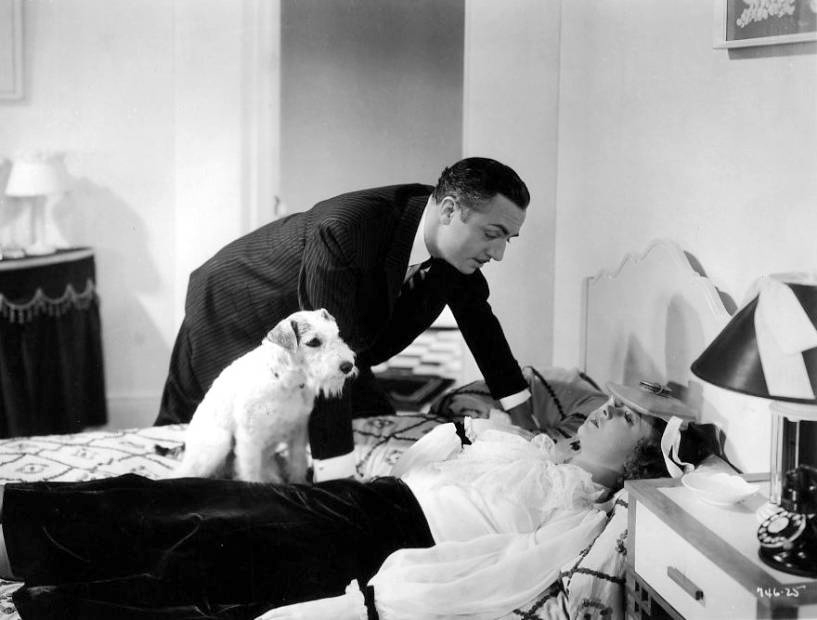
The murder in The Thin Man is busy, but it is not the movie's center of gravity. The case has a missing inventor, frightened relatives, shifty hangers-on, police interruptions, a laboratory prowl, and the mandatory dinner-table unmasking. What gives the film its afterlife is stranger and lighter: Nick and Nora Charles make marriage look like the best available detective method. They do not solve the mystery by withdrawing into grim concentration. They solve it by staying socially porous, listening while joking, letting rooms fill with suspects, and turning domestic pleasure into a way of gathering evidence.[1][2][4]
That is why the film still feels crisp rather than merely charming. W. S. Van Dyke's 1934 MGM comedy-mystery, adapted by Albert Hackett and Frances Goodrich from Dashiell Hammett's novel, runs on a tonal reversal: the violence is real enough, but the movie's real pleasure is the couple's ability to remain playful without becoming stupid.[1][2][5] Nick's retired-detective expertise gives the plot its skeleton. Nora's curiosity, appetite, interruptions, and refusal to be parked outside the action give it circulation. The film is often remembered as cocktail wit, and the drinks do matter, but the deeper fantasy is not drunkenness. It is a marriage in which attention itself is companionable.
Image context: the cover is a real 1934 MGM photographic promotional still, later scanned from the August 1938 issue of The American Magazine. It is film-related, archival, and specific to the article's claim: Powell, Loy, and Asta appear not as isolated stars but as the compact social machine that made the series durable.[6]
The plot is a host, not a master
The conventional detective story usually narrows the world. A crime occurs; suspects are sorted; clues are interpreted; the detective's mind becomes a funnel. The Thin Man widens instead. Nick and Nora arrive with money, luggage, a dog, a hotel suite, a line of old acquaintances, and the leisure to let mess come to them. AFI's production record is blunt about the movie's architecture: the title character is Clyde Wynant, not Nick Charles, but audiences quickly transferred the title's glamour to Nick, and the series followed that misunderstanding.[1] That slippage tells the truth. Viewers were not primarily attached to the victim's puzzle. They were attached to the way Nick and Nora inhabited the puzzle.
The film's rooms keep confirming this. A bar becomes a reintroduction scene. A hotel suite becomes a revolving door. A Christmas party becomes a police-adjacent information exchange. The final dinner turns suspects into guests and law enforcement into service staff. Detection is not staged as an ascetic retreat from society; it is staged as society at its most revealing. People talk too much when they are flattered, fed, watched, teased, or allowed to underestimate the listener.
This is where Hammett's hard-boiled inheritance gets softened without disappearing. The world around Nick still contains fraud, sex, money, resentment, and murder.[5] What changes is the detective's social posture. Nick is not Sam Spade guarding a private moral code in a corrupt city. He is a former professional whose competence is wrapped in hospitality. His ease is a disguise, but not only a disguise. It is also the condition that lets people approach him, misread him, and expose themselves.
Nora changes the rhythm of intelligence
Nora is not simply a sparkling accessory to Nick's work. The film would collapse into a clever-man exercise without her because its central rhythm depends on response. TCM's account of the production stresses that Van Dyke noticed Powell and Loy's off-camera banter and folded that energy into the picture; the director's casting instinct was not just about glamour, but about reciprocal timing.[2][3] Powell can appear to glide through danger because Loy gives the glide a counterweight. She listens, prods, stumbles, needles, admires, complains, and insists on entry.
That matters because Nick's intelligence is most attractive when it is not sealed off. Nora makes his method legible as play. If he withholds information, she turns the withholding into a marital game. If he tries to keep her away from a risk, she treats the exclusion as negotiable. If the plot threatens to become a diagram, she restores motion by wanting something: a drink, an explanation, a look at the case, a place in the room.
The film's romance therefore works through procedure rather than decoration. Nick and Nora do not need a separate love plot because their marriage is expressed in how they investigate. The jokes are not pauses between serious business. They are how the pair tests pressure without letting pressure govern the scene. The most revealing exchanges have the shape of a dance: one partner feints, the other answers, and the case advances almost as a side effect.
Speed made the style feel lived-in
The movie's relaxed surface came from a fast production machine. AFI notes a reported sixteen-day shoot; TCM gives the broader range of twelve to eighteen days and connects the pace to Van Dyke's reputation for speed.[1][3] That constraint could have produced flat efficiency. Instead, it sharpened the film's best quality: spontaneity that still lands in clean compositions. The production did not have to build a massive world because the social world is carried by entrances, blocking, wardrobe, props, and voices.
James Wong Howe's black-and-white photography and Cedric Gibbons's MGM interiors give the characters just enough polish to float above the Depression-era world outside the frame.[1][4] The film is not realistic about money, drinking, or consequences, and that unreality is part of its appeal. Roger Ebert's reading of the film as a triumph of personal style is useful because it names the movie's true object: not mystery mechanics, but a way of moving through modern life as performance.[4] The Charleses have wealth, wit, stamina, and a hotel-room ecosystem that seems to generate new guests whenever the plot needs oxygen.
Yet the style is not empty. The film's apparent frivolity lets it treat competence as social intelligence. Nick's great skill is not only deduction; it is knowing when to appear unserious. Nora's great skill is not only loyalty; it is knowing that play can be a claim on equal presence. Their marriage looks enviable because neither partner has to become solemn to be taken seriously by the other.
Comedy turns class into camouflage
The film's class fantasy is impossible to miss. Nick and Nora are insulated from ordinary work, and their money lets them convert danger into anecdote. Britannica's summary places the film among the sophisticated Hollywood comedies of the Depression, which is exactly the contradiction that gives it charge: a murder mystery released in 1934 offers audiences elegant rooms, formalwear, liquor, and marital freedom at a moment when many viewers had little of any of those things.[5]
But the film does something more interesting than pure escape. It turns class privilege into camouflage and then lets that camouflage become comic exposure. Nick can move through lowlife contacts and high-society rooms because everyone assumes he is too amused, too retired, or too lubricated to be dangerous. Nora can ask questions and force proximity because her curiosity reads as social sparkle before it reads as intervention. Together, they make leisure tactical.
That is why the movie's drinking jokes, however dated their glamour, have a structural purpose. The glass gives characters something to do with their hands. It lubricates movement across rooms. It makes suspicion look like conviviality. It converts interrogation into hosting. The film's fantasy is not that alcohol solves crimes. It is that social ease can loosen the fixed roles that crime stories usually impose: detective, wife, suspect, cop, servant, witness, guest.
The series begins with a misunderstanding worth keeping
The first film became one of 1934's major hits, earned four Academy Award nominations, and led to five MGM sequels with Powell, Loy, and Asta recurring across the series.[1][2] That success is easy to explain if the mystery is treated as secondary. Audiences did not need five more versions of the Wynant case. They wanted more of the operating principle: a married pair entering disorder without surrendering their private tempo.
The title's drift from Clyde Wynant to Nick Charles is therefore not a mistake to correct so much as a history of reception in miniature.[1] The "thin man" viewers kept wanting was not the missing body but the elegant line of Powell's movement, the way Nora's presence bent that line, and the comic promise that adulthood could be flirtatious without being irresponsible. The movie offers a marriage where intimacy sharpens perception rather than domesticating it.
That is the durable trick. The Thin Man is not a great detective film because its clues are unforgettable. It is a great detective film because it makes clue-gathering feel like a form of married conversation. The case gives Nick and Nora somewhere to go; the marriage gives the movie a reason to keep moving. Murder supplies the appointment. Banter keeps the appointment alive.[2][4][5]
Sources
- American Film Institute Catalog, The Thin Man (1934) - production credits, release date, runtime, reception, award nominations, and series history.
- Margarita Landazuri, "The Thin Man," Turner Classic Movies (July 28, 2003) - production overview, Powell/Loy casting, mystery-versus-banter emphasis, and sequel context.
- Rob Nixon, "The Thin Man (1934)," Turner Classic Movies Behind the Classics (October 30, 2006) - account of Van Dyke's fast production method and Powell/Loy spontaneity.
- Roger Ebert, "The Thin Man" Great Movies review (December 22, 2002) - critical reading of the film's style, dialogue, luxury interiors, and plot as secondary pleasure.
- Encyclopaedia Britannica, "The Thin Man" - reference overview of the 1934 film, its Depression-era sophistication, Hammett source, and Powell/Loy pairing.
- Wikimedia Commons, "File:Thin-Man-Powell-Loy-Asta-American.jpg" - source page for the 1934 MGM promotional still used as the article image.