Spoilers for the nightmare sequences in John Frankenheimer’s 1962 film.
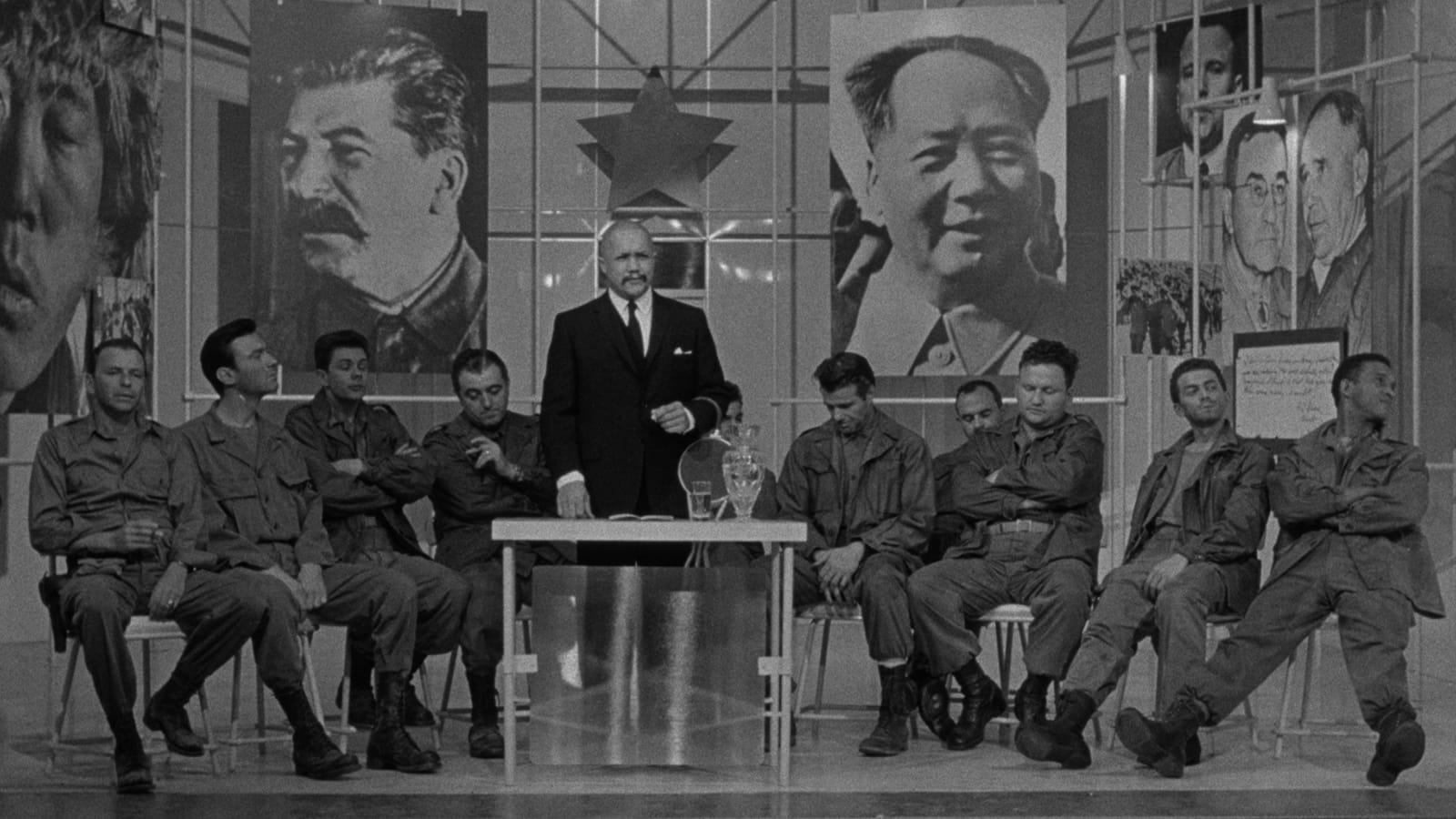
A woman is talking about hydrangeas. American soldiers sit through the lecture while a camera surveys the room. Then the genteel gathering gives way to a Communist demonstration of brainwashing. The soldiers remain the subjects of the meeting; the meaning of their presence has changed. In The Manchurian Candidate, even a camera movement that seems to explain where we are can leave us less certain.[3]
The sequence belongs to the recurring nightmares of Major Bennett Marco, played by Frank Sinatra. He and his fellow soldiers have returned from captivity during the Korean War believing that Sergeant Raymond Shaw, played by Laurence Harvey, saved their lives. Their memories have been manufactured. Shaw has been conditioned to kill, and Marco’s disturbed sleep starts to expose what the official account conceals.[1][5]
Frankenheimer gives that premise a precise cinematic form. We can follow the meeting even while its participants and surroundings change. My reading is that this continuity supplies the scene’s deepest unease: the machinery of polite attention keeps working after everything that should justify politeness has disappeared.
Build the room more than once
The production solution required repetition. As Rob Nixon’s TCM account explains, the brainwashing sequence was filmed in full against three different sets: the garden-club setting, the Black soldier’s version of that setting, and the Communist gathering. Each set allowed the camera to turn all the way around. The versions were then edited together.[2]
That account helps distinguish the sequence’s apparent freedom from the work needed to create it. The film could draw on complete performances in several environments, choosing when one version should yield to another. Cinematographer Lionel Lindon, production designer Richard Sylbert, and editor Ferris Webster are among the collaborators credited on the film.[1]
The resulting passage gives the viewer something stable to hold: a speaker, an audience, and men awaiting instructions. The substitutions become legible because those relationships survive. If every change also destroyed our understanding of who was addressing whom, we would spend the sequence rebuilding its geography. Here, recognition arrives quickly enough to become disturbing. We understand the new situation while still remembering the old one.
Let the camera finish looking
Howard Hampton’s Criterion essay singles out the circular camera movement that carries us from the New Jersey club into the Communist amphitheater.[3] Its leisurely survey matters. Looking around a room usually feels like gathering evidence. We inspect the listeners and their surroundings, expecting the additional information to settle our bearings.
Frankenheimer turns that expectation against us. The movement supplies more space without supplying security. The garden-club image has already recruited our recognition of a harmless social occasion; the revelation forces us to reconsider how easily we accepted it. A familiar arrangement of bodies has done much of the persuading before anyone explains the deception.
The crucial craft choice is to give the false setting enough duration to feel inhabitable. It has a social purpose, a speaker with something to say, and an audience expected to listen. The later revelation can therefore damage a world we have begun to understand. A fleeting insert would have offered less to lose.
Keep the lecturer’s composure
The nightmare moves beyond a change of decor. Dr. Yen Lo, played by Khigh Dhiegh, demonstrates Shaw’s conditioning through lethal orders. The garden-club women and the captors occupy corresponding positions within the sequence’s shifting presentations.[1][2][3] The ordinary form of a lecture accommodates an appalling subject.
This is where performance becomes as important as the change of set. A demonstration needs people to watch, someone to explain, and a subject who will do what is requested. The scene’s social arrangement makes obedience visible. Shaw’s actions become exhibits, and his companions are held in the role of spectators.
The viewer cannot share that composure. We recognize an emergency inside an occasion that continues to conduct itself as a meeting. That mismatch produces a particular helplessness: the scene offers plenty of witnesses, yet the presence of witnesses provides no protection. Its measured exchanges make the violence harder to absorb because the surrounding behavior refuses to acknowledge the rupture we feel.
A different witness changes the flowers
The film returns to the experience through Corporal Allen Melvin, played by James Edwards. His imagined garden-club audience is Black, whereas Marco’s is white. The PBS discussion of the film identifies these as two subjective versions of the same brainwashing session, alongside the captors’ actual gathering.[6]
The variation makes the deception more specific. My interpretation is that the film treats familiarity as something supplied by the person experiencing it. A supposedly reassuring American room does not look identical to both men. The shared violence persists underneath the differing social pictures.
There is a useful limit to that observation. This is the film’s stylized invention of conditioning. J. Hoberman’s account, republished by the BFI, describes its understanding of brainwashing as highly fanciful and situates it within Cold War political spectacle. The film opened in October 1962, during the Cuban Missile Crisis.[4] Its confidence as cinema should not be mistaken for evidence about how minds can actually be controlled.
What survives that historical distance is the precision of the scene’s construction. Repeated staging lets incompatible rooms remain comprehensible; the camera invites inspection; the performances allow the meeting to proceed. When the setting changes, the scene does not need to start again. That is the frightening discovery: an orderly occasion can absorb something monstrous and carry on with its business.
Sources
- The Criterion Collection, The Manchurian Candidate (1962) — cast, filmmaking credits, premise, and distributor-published photographic stills.
- Rob Nixon, “Behind the Camera,” Turner Classic Movies, August 14, 2006 — filming the complete brainwashing sequence in three settings and editing the versions together.
- Howard Hampton, “The Manchurian Candidate: Dread Center,” The Criterion Collection, March 15, 2016 — the hydrangea lecture, circular camera movement, and nightmare’s violent demonstration.
- J. Hoberman, The Manchurian Candidate, Sight & Sound, December 1993; republished in BFI Southbank Programme Notes, August 1, 2022 — Cold War context, October 1962 release, and the film’s fanciful treatment of brainwashing.
- American Film Institute, The Manchurian Candidate, AFI Catalog — the soldiers’ false memories, Shaw’s conditioning, and Marco’s investigation.
- Glenn Holland, “The Manchurian Candidate,” Saturday Night at the Movies, WQLN/PBS, March 16, 2023 — presenter’s discussion and transcript distinguishing Marco’s and Melvin’s versions of the garden-club lecture.