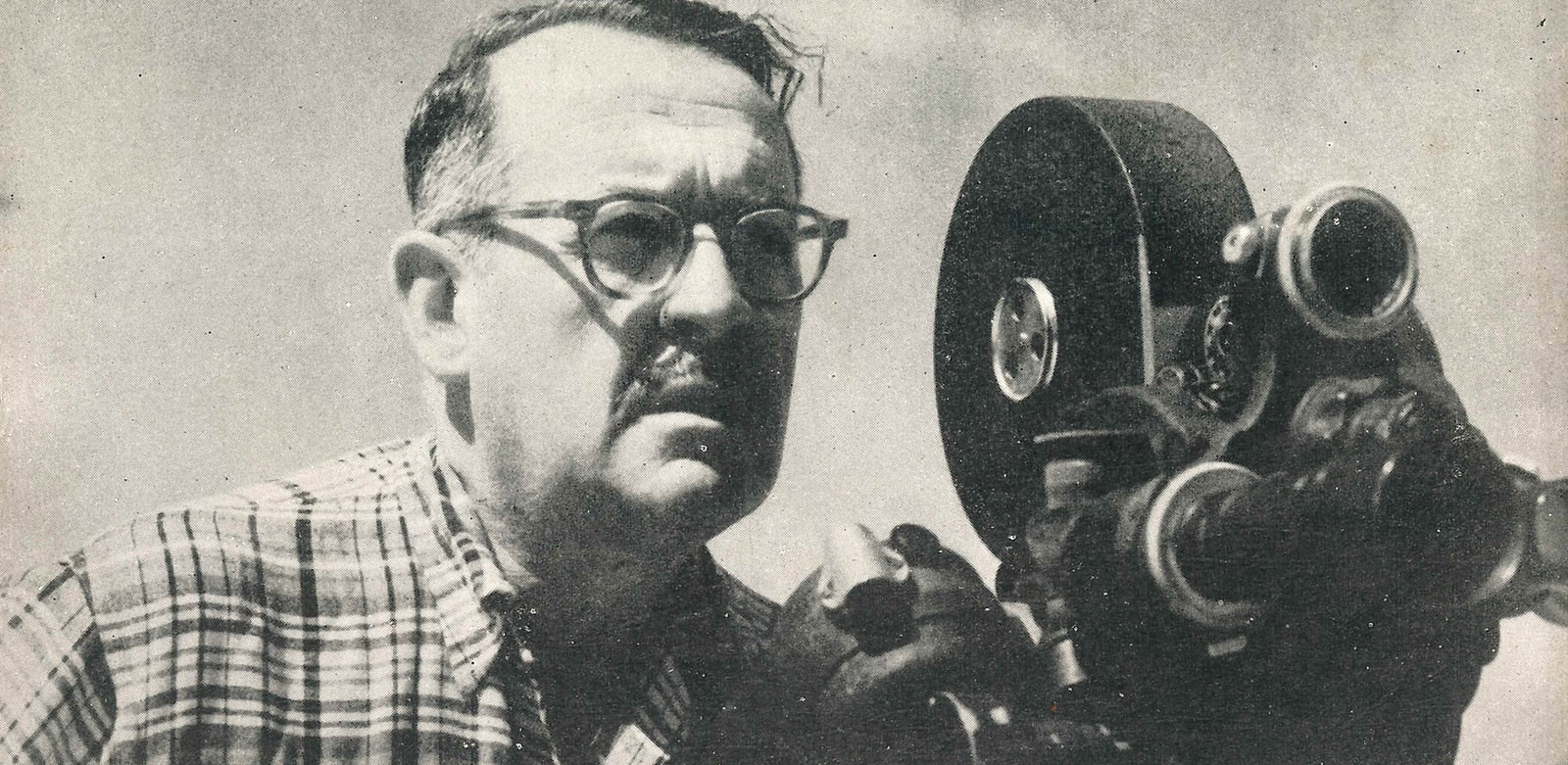
The mine in Coal Face (1935) has a sound you could never have captured by lowering a microphone into a shaft. Silent footage of mining, gathered by different cameramen, meets percussion, piano and voices. The images record work; the soundtrack gives that work a pulse, a weight and an uneasy grandeur.[1] For Alberto Cavalcanti, putting sound to a picture opened another space in which to make the film.
That distinction helps explain a career scattered across countries, genres and job titles. A set designer in French cinema, a formative presence in British documentary, a director of studio fiction and a filmmaker returning to Brazil, Cavalcanti carried practical knowledge between institutions.[3] His most useful signature may be a permission he gave himself and his collaborators: the visible world could be rearranged without losing its claim on our attention.
Paris without a studio
Born in Rio de Janeiro in 1897, Cavalcanti reached the Parisian filmmaking circle around Marcel L'Herbier after studying in Switzerland. He entered cinema through set design.[3] It is a revealing beginning for someone whose work would repeatedly ask how much of a convincing world had to be physically present before the camera.
Rien que les heures (Nothing But Time, 1926) emerged from a very practical frustration. In an interview reproduced in the BFI's programme notes, Cavalcanti recalled that another production's unpaid bills had left its negative unavailable. He gathered friends to make something quickly and cheaply, filming in the streets without a studio. Everyday urban life offered a subject close enough to reach.[4]
The resulting Paris contains sharply different lives: wealth and deprivation occupy the same city, without becoming the same experience. Elizabeth Sussex's account emphasizes the film's combination of dramatic construction, social concern and surrealist impulses.[4] Those elements belong together. Editing can make a relationship visible that no single view of a boulevard could establish.
There is a productive tension here between the designer and the street filmmaker. A designer must decide what belongs in a space; a street filmmaker encounters what is already there. Cavalcanti's example suggests that discovery and arrangement can remain active at the same time. The city supplies material, but its meaning does not arrive ready for projection.
The mine as a composition
John Grierson brought Cavalcanti into the GPO Film Unit in Britain in 1934.[3] Cavalcanti brought experience in early sound films.[2]
In Coal Face, nothing was recorded on location. Britten scored even the narration, using piano, choir and unexpected instruments: chains, sandpaper, coconut shells and a cup in a bucket of water.[2] The apparent machinery has been performed.
This freedom has a limit worth keeping in view. The BFI's account asks whether the documentary movement's aesthetic treatment of workers could turn them into admired symbols while falling short of political protest.[1] A stirring collective rhythm cannot, by itself, tell us what any individual miner wants. The film's beauty invites attention; it does not settle whether its subjects have been sufficiently heard.
Britten helped shape the film; Auden supplied verse.[2] Direction here was collaborative.
A face that is listening
The later British fiction gives listening a smaller, more intimate form. In For Them That Trespass (1949), Vida Hope plays Olive Mockson. BFI curator Josephine Botting singles out a scene in a shabby attic kitchen: Olive's face appears in a small mirror while she listens to Jim discussing another woman's murder.[5]
The scene offers a useful way into Cavalcanti's attention to performance. A reflected listener can become the emotional center of a conversation. The speaker supplies information, but the face receiving it gives the information its human cost. Sound creates an event inside a person who does not need to explain herself aloud.
Cavalcanti's care for actors had a practical side. Richard Todd recalled staying to watch the day's rushes while the director gently identified mistakes and suggested improvements. Yet the production's ingenuity did not guarantee success: the film lost money, and some contemporary critics found its London milieu unconvincing.[5] An observant director can draw out a performance inside a world whose construction remains too visible.
Returning with unfinished work
After his years at Ealing and subsequent British features, Cavalcanti accepted an invitation to lecture in Brazil and stayed to work in its film industry.[5] His return produced O canto do mar (Song of the Sea, 1953), about a family worn down by poverty on the northeastern coast, where migrants wait to travel south. The credits name Guerra-Peixe as composer and Sergio Alvarez responsible for sound.[6]
The setting brings migration into the work of a filmmaker who had himself repeatedly crossed borders. That parallel is suggestive, though it cannot explain away the family's material circumstances. His international experience had returned him to a specific place, with its own collaborators and pressures.
The 2026 documentary Cavalcanti, directed by Jairo Neto and Graubi Garcia, takes up the problem of how to assemble such a career. The São Paulo International Film Festival describes a film built entirely from archival material and guided by Cavalcanti's own voice.[7] The choice suits its subject: recordings can return a person to images that have circulated without him.
For a viewer coming to his work now, Coal Face offers a compact entrance. Listen to the relationship between a movement and the sound accompanying it. Then notice how easily the ear accepts a connection that the filmmakers had to invent. Cavalcanti's cinema begins to feel less scattered when that act of attentive construction comes into focus.
Sources
- British Film Institute, “Coal Face (1935)” — compilation footage, added sound and the limits of the film's representation of miners.
- Geoffrey Cox, Organised Sound (2017), sections 6–7.2 — Cavalcanti and the constructed soundtrack.
- Museum of Modern Art, “The Films of Alberto Cavalcanti: Museum Program Spans Four Decades,” archival press release, 1971 — early biography, set design and arrival at the GPO Film Unit.
- BFI Southbank, “100 Years of Film as Art,” programme notes, 18 May 2025 — Elizabeth Sussex's 1975 account and Cavalcanti's recollections of making Rien que les heures.
- Josephine Botting, “Alberto Cavalcanti's neglected British ‘low-life’ drama For Them That Trespass.” BFI, 1 May 2026 — Vida Hope's mirror scene, Richard Todd's recollections, reception and the director's departure for Brazil.
- Instituto Moreira Salles, “O canto do mar” — 1953 film record, coastal setting and production credits.
- São Paulo International Film Festival, “Cavalcanti,” 2026 — Jairo Neto and Graubi Garcia's archival documentary, its use of the filmmaker's recorded voice and the photograph reproduced here.