Spoilers throughout, including the ending of the 1949 film.
Lucia Harper comes home with a Christmas tree and finds a blackmailer waiting. The encounter brings together the two kinds of business she must somehow keep separate: making the household comfortable and keeping it out of a criminal investigation. Joan Bennett plays Lucia; James Mason is Martin Donnelly, the stranger whose arrival makes an ordinary homecoming dangerous in Max Ophüls’s The Reckless Moment.[2]
The tree is a wonderfully inconvenient object. Christmas still needs arranging, whatever has happened down by the water. Lucia’s emergency cannot clear her calendar. That gives this thriller its particular tension: every secret task has to fit into a day whose familiar tasks remain due.
A second set of errands
Lucia’s daughter Bea has been seeing Ted Darby against her mother’s wishes. After an argument with Bea at the boathouse, Darby falls onto an anchor and dies. Lucia finds his body the following morning and disposes of it to protect her daughter. Donnelly subsequently arrives with Bea’s letters to Darby and demands payment for them. The film was released in 1949 and was Ophüls’s final American production.[1]
The mistake would be to treat the household as a pleasant setting temporarily interrupted by this plot. It determines what Lucia can do. Another trip to Los Angeles will prompt questions from her family. Raising money proves difficult without her husband’s signature. Even pawning her jewelry brings in too little.[1] Resources that make a family look secure are not necessarily available to one member in an emergency.
My reading is that the film gives secrecy a practical cost before giving it a moral one. An unexplained absence, access to a car, a sum of money: each requires an account of herself. Lucia can act decisively, as the disposal of the body establishes. What she cannot easily obtain is permission to stop being available.
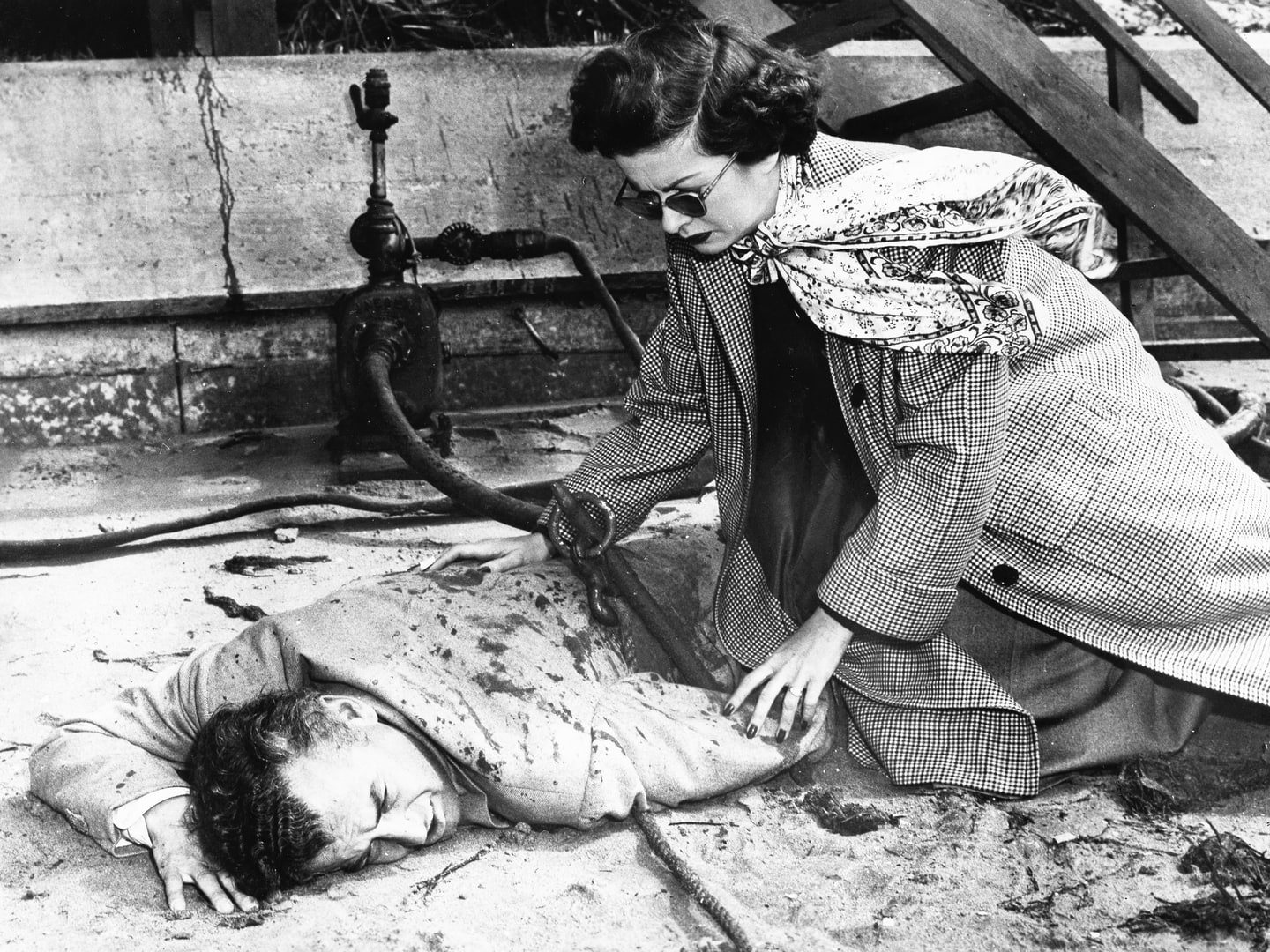
Let a conversation keep its interruptions
Film scholar John Gibbs describes the film’s reliance on long takes, medium or long shots, camera movement, and sequences that maintain continuity of time.[3] Those choices suit Lucia’s predicament. A wider view leaves room for another person to become part of a conversation. A sustained shot can make us wait while she manages an interruption. Time spent attending to somebody else is time she cannot spend resolving the threat.
This is a useful way to watch Bennett. The drama lies in the distance between what Lucia knows and what the person addressing her needs. She has to remain intelligible as a mother or hostess while keeping the larger reason for her anxiety out of the exchange. Ordinary competence becomes a performance with an unusually demanding audience: people who already know her habits.
The result also complicates our position as viewers. We want Lucia to have a moment alone because privacy would let the thriller advance. That wish can make a harmless family demand feel intolerable. The film briefly recruits us into the impatience of someone who cannot explain why she is impatient.
The blackmailer supplies the change
At the drugstore, Lucia makes a call concerning Bea and runs out of coins. She turns to Donnelly for change; he follows her, searching his pockets. Amy Gentry’s account in The Paris Review draws attention to the comic reversal: the man who came to extract money is suddenly supplying it, caught up in the urgency of her errand.[4]
The size of the transaction matters to the scene’s effect. A few coins let Donnelly be useful immediately. He need not solve the blackmail scheme or announce a new identity before helping her. For a moment, the person creating an impossible demand becomes the person meeting a manageable one.
That small cooperation makes his attachment more persuasive than an isolated declaration would. Lucia’s busy life provides an opening for him, even as it denies her room to maneuver. His attraction does not abolish the coercion that brought him there. It puts assistance and threat into the same relationship, leaving her to judge how much trust either can bear.
Gibbs identifies another significant choice when Donnelly later telephones Lucia. Once the film cuts to him, it remains with him through the rest of the conversation, cutting to a closer view rather than returning to her reactions. Drawing on Lutz Bacher’s production research, Gibbs notes that Ophüls resisted studio pressure to supply shots of Lucia for intercutting.[3] Mason consequently has to carry the exchange on his side of the line. We are given time with a man whose feelings have begun to exceed his role in the scheme.
A voice that must sound reassuring
Donnelly’s eventual sacrifice removes the criminal threat. Before dying after a car crash, he confesses to Darby’s death, protecting Lucia and Bea.[1] Yet the film has one more demand to make on Lucia. Back home, grieving, she is called to the telephone to speak to her absent husband. In her discussion of Far from Heaven, Laura Mulvey identifies this ending as a scene Todd Haynes would echo: a woman’s tears interrupted by the summons to answer a husband’s call.[6]
The interruption brings the opening’s problem back at a different emotional pitch. Lucia has finished the extraordinary work of protecting the household. Now she must resume the ordinary work of reassuring it. Her husband’s distance allows him to receive a version of events that the audience can no longer mistake for the whole story.
The ending leaves a painful gap between safety and relief. A resolved blackmail plot can restore the family’s outward life without giving Lucia a place to put what she has experienced. The telephone rings, and once again somebody needs her to answer.
Sources
- American Film Institute, The Reckless Moment, AFI Catalog — credits, production history, accidental death, financial obstacles, and the resolution of the blackmail plot.
- Turner Classic Movies, The Reckless Moment — cast identification and the scene description for “There’s a Gentleman,” including Lucia’s return with the Christmas tree.
- John Gibbs, Filmmakers’ Choices, Movie: A Journal of Film Criticism, 2015 ebook, University of Reading repository — pp. 7–9 on sustained staging and temporal continuity; pp. 13–14 on Donnelly’s telephone conversation and Lutz Bacher’s production research.
- Amy Gentry, “Safe as Houses,” The Paris Review, December 9, 2016 — the drugstore exchange and Donnelly’s absorption into household errands.
- BFI, “100 essential thrillers,” October 16, 2017, The Reckless Moment entry — identification and source of the photographic film still reproduced above.
- Laura Mulvey, “Far from Heaven,” Sight and Sound, March 2003; republished in BFI Southbank Programme Notes, November 2, 2025 — comparison with The Reckless Moment’s final telephone call.