Leo McCarey's Make Way for Tomorrow has one of the plainest premises in studio-era American cinema.[1][2][5] An elderly couple lose their house, summon their grown children, and discover that everyone can absorb them only in fragments. Barkley is sent one way, Lucy another. What keeps the film from becoming a pious "respect your elders" sermon is that McCarey never builds its pain out of one monstrous child or one theatrical denunciation. He builds it out of arrangement. Bedrooms, parlors, phone calls, train schedules, borrowed evenings, and the small humiliations of being fitted into someone else's routine do the heavy work.[1][3][5]
That is why the movie still feels harsher than many louder family melodramas.[2][4][6] The Criterion edition's capsule is right to call it an unsung masterpiece and to stress the unflinching ending McCarey refused to soften under studio pressure.[2] Duke's screening note helps sharpen the historical frame, placing the film in the 1937 Roosevelt Recession and describing the children as middle-class strivers rather than cartoon villains.[6] That distinction matters. The movie does not ask us to hate them from a moral height. It asks us to watch how ordinary upward-striving households turn love into scheduling. McCarey's technique makes that conversion visible.
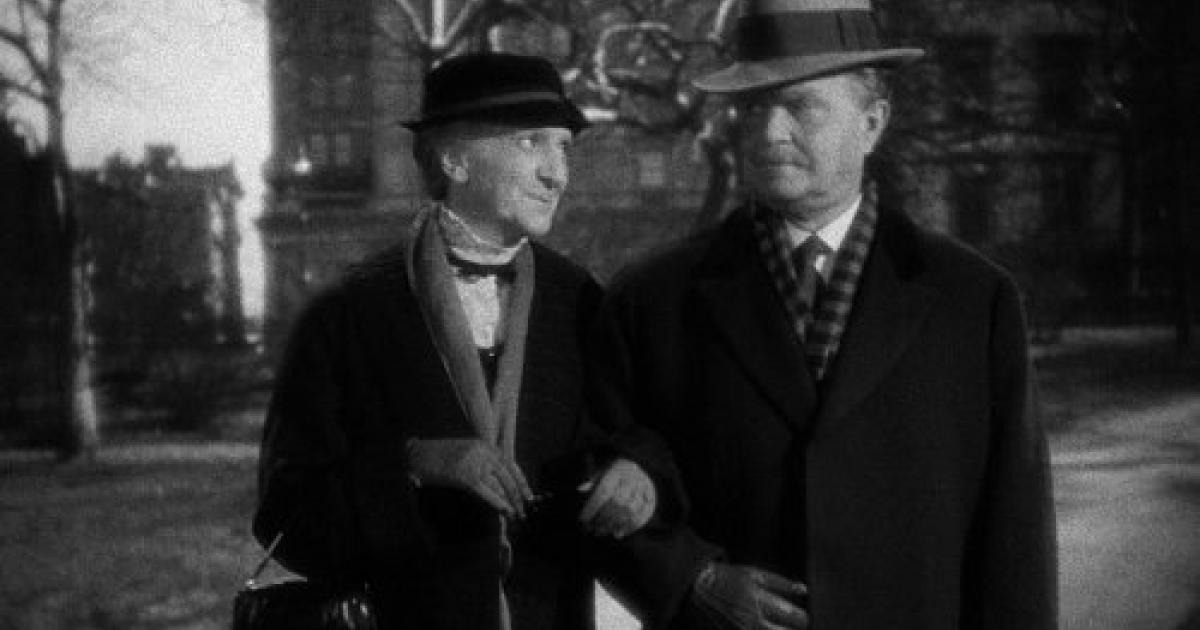
Image context: the lead image uses the BFI still of the elderly couple together in a park from Make Way for Tomorrow.[1] It fits this essay because the film's emotional breakthrough comes when public space briefly gives Barkley and Lucy more room than family space does. The apartments shrink them into problems; the city lets them look like a couple again.
McCarey makes family cruelty feel administrative before it feels tragic
The first technical accomplishment is tonal.[1][4][5] TCM's synopsis describes the story cleanly: an elderly couple are forced to move in with their children after the bank takes their home, only to be separated and subjected to their offspring's selfish whims.[5] Yet on screen that selfishness is rarely performed as melodramatic villainy. It comes wrapped in domestic realism: there is not enough room here, the daughter is studying, the bridge game is tonight, the phone has to be used, the evening must be rearranged, the aunt can maybe take Lucy for a few hours if someone calls in time.[3][5]
Those logistics matter because they convert morality into management. Barkley and Lucy are not expelled in one grand scene; they are continuously processed. McCarey keeps showing how a family can remain technically polite while making two parents feel spatially surplus.[1][3][6] A room is available, but only on conditions. Hospitality is offered, but in forms that erase privacy. The film's pain arrives because every practical solution produces a new social diminution. Duty survives, but dignity gets shaved down at each step.
This is where McCarey's understatement becomes brutal.[4][6] Duke's note calls his style subtle and unshowy, without clear-cut villains even when the children begin plotting a harsher solution.[6] That is exactly the craft point. A blunt melodrama would simplify guilt. Make Way for Tomorrow keeps guilt distributed. Everyone can justify the next inconvenience. Precisely for that reason, the emotional pressure accumulates instead of discharging.
Reaction shots make the viewer finish thoughts the dialogue refuses to say aloud
Tag Gallagher's Criterion essay is especially useful because it explains how much of the film's force lies in reaction rather than declaration.[3] He describes McCarey's cinema as one that draws the audience into characters by making us discover a telltale gesture or barely hinted thought, turning us from passive watchers into active completers of the scene.[3] That description gets right to the center of Make Way for Tomorrow. Faces in this movie are rarely neutral rests between lines. They are half-finished arguments.
The great example is the confrontation between Anita and Lucy.[3] Gallagher focuses on the sequence because McCarey stages it through direct, almost accusatory looks, turning the exchange into something like a collision of souls rather than a routine family spat.[3] Anita's patience cracks, but the effect is larger than one daughter's failure of charity. McCarey frames the moment so that the viewer feels trapped between sympathy and irritation, between the younger household's exhaustion and Lucy's helpless insistence. The scene hurts because it does not allow easy allegiance.
That is one reason the performances land so hard.[2][3][4] Beulah Bondi and Victor Moore are touching, but not embalmed in saintly reverence.[2][4] Fay Bainter's Anita is just as crucial. Her face often carries the film's hardest task: registering genuine decency under conditions that make decency feel unmanageable. McCarey understands that heartbreak deepens when no one can speak at full volume without falsifying the situation. So he lets body language, pauses, and glances keep the moral accounting open.
Telephone relays and offscreen errands turn love into a systems problem
One of the cleverest things in the film is how often information moves by relay rather than by full dramatic confrontation.[3][5] TCM's clip descriptions are revealing on this point. "There's A Bank For You" introduces the family as a linked unit facing economic collapse; "You Know I Worry" and "You Know How It Is" reduce the emotional problem to errands, movie-theater retrieval, and a city phone call asking whether another relative can absorb Lucy for the evening.[5] These are not decorative side incidents. They are the film's operating system.
Gallagher notes that McCarey even makes us work to infer what happened across scenes, asking us to chew over stray lines and delayed implications rather than delivering everything in one emphatic speech.[3] That method suits the material exactly. The parents' displacement is not only a moral event; it is an information problem handled by people who would prefer not to state the full ugliness of what they are doing. Calls are placed, excuses are phrased, arrangements are softened, and everyone keeps trying to make necessity sound temporary.[3][5]
By leaning on relays, McCarey also shows how modern family feeling has become infrastructural.[1][5] Telephones, transit, and apartment boundaries do not merely support the story. They define what kinds of care are possible. Barkley and Lucy are loved within the limits of available rooms, commuter schedules, and social embarrassment. The film becomes devastating because it never lets the logistical frame disappear behind pure sentiment. Affection keeps colliding with systems.
The last Manhattan afternoon changes the film's scale from management to grace
The final act feels almost like a different city has opened inside the same movie.[4][6] Duke's note calls it spellbinding and describes the couple's brief reunion as a theft of happiness, remembrance, and freedom that carries the film into territory Hollywood rarely reaches.[6] Tavernier is equally precise when he writes that McCarey avoids bathos and keeps the exact distance from his characters, close enough for us to feel with them yet far enough to witness flaws, comedy, and pain at once.[4]
That balance is what makes the ending unbearable. Barkley and Lucy do not suddenly escape their circumstances; the social facts remain intact.[1][2][4] What changes is the amount of air around them. In the apartments, every gesture had been observed, rationed, or fitted into another household's priorities. In Manhattan, public places briefly restore scale. They can talk, remember, flirt with the old shape of their marriage, and occupy time without first justifying their presence. The city gives them borrowed dignity.
Seen this way, the park image is not sentimental garnish but formal evidence.[1] McCarey has spent the film turning interior family space into a series of pressure chambers. The late public-space passages reverse that pressure just enough for us to understand what has been lost. The heartbreak comes not because the film suddenly discovers love at the end, but because it reveals how much of that love had been compressed by rooms, duties, and well-mannered evasions all along.[3][4][6]
This is why Make Way for Tomorrow endures as technique, not merely topic.[2][3] McCarey makes reaction shots do the work of accusation, makes phone relays and room assignments do the work of social critique, and makes one last afternoon in the city do the work of tragic release. The film does not need speeches about civilization failing its elders. It has already shown the failure in where people are asked to sit, when they are asked to move, and how carefully everyone avoids naming the cost.[1][3][5]
Sources
- BFI, "Make Way for Tomorrow (1937)" film page, including the still used for this article.
- The Criterion Collection, "Make Way for Tomorrow" film page with credits, restoration details, and editorial notes.
- Tag Gallagher, "Make Way for Tomorrow: Make Way for Lucy . . ." The Criterion Collection.
- Bertrand Tavernier, "Make Way for Tomorrow: We Laugh, and Our Hearts Ache," The Criterion Collection.
- TCM, "Watch Make Way for Tomorrow" page with synopsis and related clip descriptions for "There's A Bank For You," "You Know I Worry," and "You Know How It Is."
- Duke Cinematic Arts, "Make Way for Tomorrow (Leo McCarey, 1937)" screening note.