Claire Denis's Beau Travail is often remembered through its ending, which is an easy way to misdescribe the film.[2][3][4] Once people reduce it to "the one with the final dance," the previous ninety minutes can start sounding like pure severity waiting for release. Denis's real achievement is harder and more exact. The release is already present in the drills, in the ironing, in the bed-making, in the boxing practice, in the shoreline walks, and in the way Agnes Godard's camera watches torsos, shoulders, and backs as if command itself were a kind of unwanted dance notation.[1][2][5][6] The movie does not tack choreography onto discipline at the end. It reveals that discipline had been a choreography all along.
That is why the film's loose relation to Herman Melville's Billy Budd matters so much.[1][2][7] Denis and Jean-Pol Fargeau do not simply transplant a literary triangle into a new setting. They move the drama into gesture. In Djibouti, among French Foreign Legion men who spend their days repeating forms that are supposed to erase individuality, jealousy cannot declare itself openly, desire cannot speak plainly, and colonial purpose has already gone stale.[2][3][4] Form has to carry what language will not. Beau Travail therefore becomes a movie in which technique is not decoration around the theme. Technique is the theme.
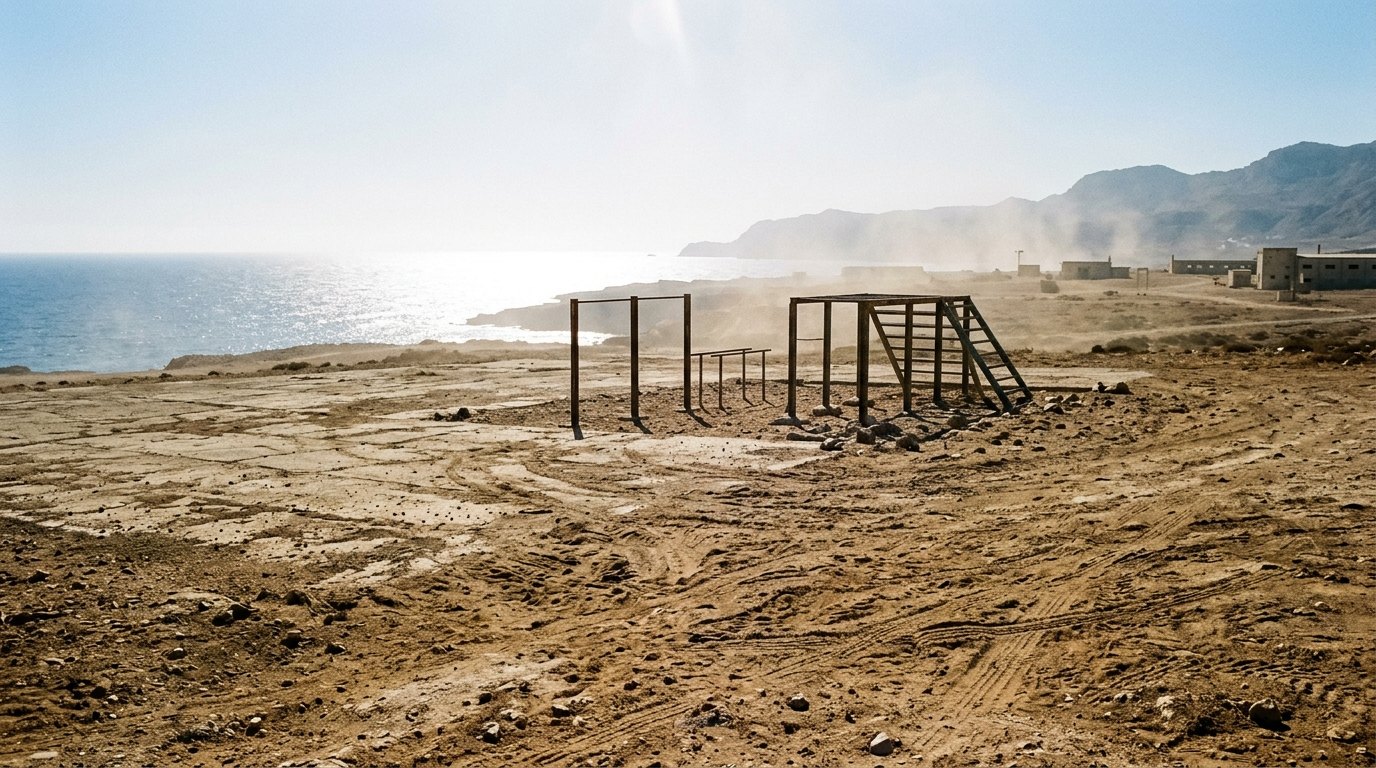
Image context: the hero image now uses an immersive training-ground photograph rather than a film still. That choice matches the article's claim: the movie's emotional pressure is never located in one face only; it is distributed across repeated bodily tasks that make a whole military system look both beautiful and untenable.
The drills are the film's editing grammar before they are military business
The training sequences matter because Denis shoots them less as exposition than as a recurring visual sentence.[1][2][5][6] We watch men vault, crawl, stretch, box, balance, polish, and make beds with a precision that should communicate readiness. Instead, the repetition starts to drain simple function out of the actions. The movements become too measured, too tactile, too rhythmically isolated to stay neutral. Sophie Monks Kaufman, writing for BFI, gets close to the key point when she notes the men's extraordinary grace and the way proximity coexists with emotional constraint.[5] Denis takes that contradiction and turns it into a full method. The legion is an institution built to standardize bodies, but the camera keeps discovering difference, vanity, resentment, and attraction inside the very exercises meant to suppress them.
Music intensifies this shift from procedure to ritual.[1][6][7] Janus describes the film's young recruit and sergeant meeting under the operatic pressure of Benjamin Britten, and Adrian Martin's Billy Budd essay points out that Denis makes the source material overt by using Britten's opera most memorably during the legionnaires' ritualized physical tests.[1][7] That decision is crucial. Britten does not merely add grandeur to the soundtrack. He makes the drills feel inherited, theatrical, and faintly doomed. A push-up is no longer just a push-up; it becomes part of a ceremonial structure that seems older than the men performing it. The labor of maintenance, meanwhile, is cut with the same seriousness as the displays of strength. Ironing and bed-straightening are not lesser tasks than boxing or climbing. They belong to the same regime of formal control.
The result is that Galoup's point of view never reads like simple narration.[2][6] He is remembering a system through surfaces. The film keeps giving us the outside of action because the outside is where the pressure has settled. Denis does not need explanatory dialogue about repression when a line of torsos under sun can already show command mutating into fixation. By the time Galoup singles out Gilles Sentain as a threat, the viewer has already been trained to understand how seeing itself works inside this world: attention is selective, prolonged, and never innocent.[2][5][6]
Heat, glare, and distance make Djibouti look less like backdrop than like a colonial stage nobody fully occupies
The landscape work in Beau Travail is just as technical as the bodily work.[1][2][3][4] Janus emphasizes the azure water and sunbaked desert, while BFI's film page is sharper about the historical irony: these men serve in a former French colony where the colonial project is already obsolete.[1][3] Denis uses heat shimmer, open shoreline, black volcanic ground, and long-distance compositions to keep reminding us that the legionnaires do not truly belong to the place they patrol. They are visible everywhere and at home nowhere.
This matters because the film never turns Djibouti into a generic test of masculine hardness.[2][3][4] Apolline Caron-Ottavi's BFI introduction to Claire Denis describes Beau Travail as a heady, hypnotic experience in which beautiful people and landscapes attract the viewer at the same time that they trouble Galoup.[4] The camera's distances do exactly that. Sometimes the men look sculptural and immaculate; sometimes they shrink into the terrain and seem almost foolish, white uniforms and imported routines scattered across a space that has no need of them. Denis was commissioned to make a film about foreignness, and BFI's film page notes the joke at the heart of her answer: she made a movie in which her own people are the foreigners.[3] The technique follows the joke all the way down. Every radiant horizon carries the trace of mismatch.
Because of that mismatch, even ordinary motion acquires political weight.[3][4][6] A group run across the shore is not only athletic display. It is an image of imperial leftover energy with nowhere legitimate to go. A truck crossing scrubland or a line of men descending toward the sea can look majestic for a second, then emptied out by the next cut. Denis never shouts the colonial critique, but she never lets the frame forget it. Beauty and irrelevance keep arriving in the same shot.[1][3][4]
The nightclub scenes and final dance do not break the film's form; they disclose what the form was hiding
The film's nightlife scenes are therefore not a vacation from the drills.[2][3][5] They are the place where the same physical intelligence reappears under looser rules. BFI's synopsis notes that the legionnaires spend their evenings circling girls at the local nightclub, and Kaufman writes of men living in sensual proximity while trapped by military values.[2][5] Denis stages those rooms as half-release, half-carryover. The bodies are off duty, but not free. Looking is still tactical. Male rivalry is still measured through posture, nearness, hesitation, and display. The club is softer than the training ground, yet it reveals the same problem: these men have learned to communicate through arrangements of bodies before they have learned to speak honestly.
That is why the ending feels earned instead of ornamental.[2][3][4][6] Simran Hans calls the final scene pure release, and she is right, but the release has force only because the whole movie has been tightening a formal screw.[3] Galoup's dance does not introduce movement into a static film. It takes a film already obsessed with repeated movement and lets one body finally stop obeying military syntax. Kicks, turns, rebounds, lunges against the wall: the gestures are still disciplined enough to recall training, but they have shed rank, command, and usefulness. The movie has spent its entire length asking what happens when desire is forced to live inside drill. The answer arrives when drill survives but purpose falls away.
Seen that way, the famous final dance is less an add-on coda than the clearest summary of Denis's craft.[1][2][6] She builds a full grammar out of exercises, grooming rituals, landscape distances, and musical incursions, then lets that grammar crack open from the inside. Beau Travail remains so powerful because it never chooses between sensuality and analysis. It shows how institutions aestheticize bodies, how images can make that aestheticization seductive, and how one burst of apparently private motion can expose the strain required to keep the whole structure standing. The title translates as "good work," but the film's deeper question is what kind of work these forms have really been doing. By the end, the answer is visible in movement itself.
Sources
- Janus Films, "Beau travail" film page with synopsis and restoration framing.
- BFI Player, "Watch Beau Travail online" synopsis page.
- Simran Hans, "Beau travail (1998)," BFI.
- Apolline Caron-Ottavi, "Where to begin with Claire Denis," BFI.
- Sophie Monks Kaufman, "6 films about masculinity directed by women," BFI.
- Tamara Tracz, "Beau travail," Senses of Cinema.
- Adrian Martin, "Billy Budd," Senses of Cinema.