Spoiler note: this article discusses the opening ball, the sleigh-versus-automobile transition, the George-Fanny staircase scene, and the film's ending, including the studio-imposed coda.
The Magnificent Ambersons is famous partly because it survives in wounded form.[1][4] Orson Welles lost control of the film, RKO cut it down to 88 minutes, and the removed footage was destroyed.[1] That history matters, but it can also become a distraction. The strongest way into the film we still have is not to treat it mainly as a ruin for scholars to mourn. It is to notice how complete its inner logic remains. Welles does not present the fall of a rich Midwestern family as a broad civics lesson about old money and new industry. He gives decline rooms, staircases, doorways, winds, sleigh rides, dining tables, and camera paths. The Ambersons do not merely lose power. They go on living inside a house that continues to display their self-image long after history has started withdrawing the floor from under them.[1][2][3]
That is why the Amberson mansion matters more than any one speech about progress.[1][2] BFI describes the film as an elegy for a passing upper-class way of life, while Lucy Sante's Criterion essay sharpens the visual mechanism: the house is an enormous physical armature, dark-stained and baronial, with a three-story staircase that behaves like a central nervous system.[1][2] This is more than production design praise. Welles turns architecture into fate. The house stores ritual, vanity, family myth, and social theater. Once the outside world begins changing tempo, the mansion does not simply stand there as a backdrop for tragedy. It starts to look like a machine that can preserve pride and trap it at the same time.[1][2][4]
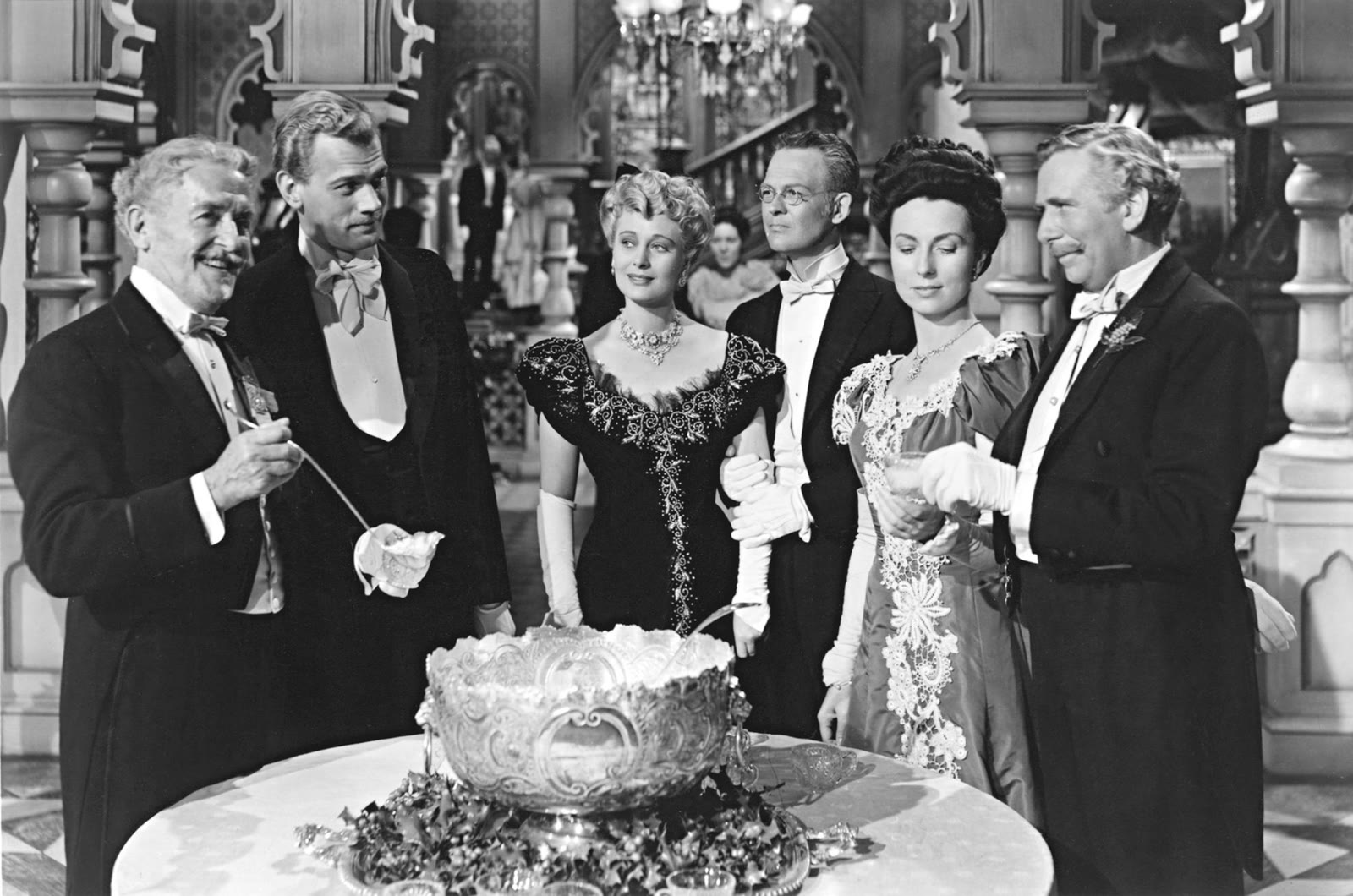
Image context: the lead image uses a 1942 RKO publicity still from Wikimedia Commons showing formally dressed Amberson-world figures gathered around a punch bowl beneath the mansion staircase.[5] It fits this essay because the film's key idea is visible in one frame: splendor appears as arrangement. The bowl, the columns, the evening clothes, and the staircase all make prestige feel less like personality than like a system of interior space.
The ballroom sequence turns prestige into movement before it turns into memory
The opening movement of Ambersons is one of the greatest acts of historical compression in American cinema.[3][4] Molly Haskell notes that Welles introduces the family through a world already vanishing as we look at it: horse-drawn streetcars, changing seasons, ritualized courtship, and narration that makes splendor sound inseparable from its own expiration date.[3] Jonathan Lethem catches the next decisive shift. After the first nine minutes of witty historical framing, the camera pushes through the mansion doors into "the last of the great, long-remembered dances," and the film drops us into overlapping dialogue, sensation, and a denser emotional weather.[4] The effect is startling. The movie stops summarizing society and starts inhabiting it.
This is why the ballroom matters so much. It does not merely show that the Ambersons were once important.[2][4] It makes importance into choreography. People circulate through the house as if they were animated by its prestige. The camera does not isolate one hero and then arrange the set around that person. It glides through a living social organism. Gossip, resentment, flirtation, vanity, and ceremonial politeness all move along the same architectural channels. The Ambersons look powerful because the house can still convert private flaws into public style.[2][4]
Welles is already planting the film's catastrophe inside this grandeur.[3][4] Eugene Morgan's old humiliation and later return do not feel like detached subplots; they enter the ballroom as delayed time.[3] George Minafer's arrogance also belongs here, because the movie keeps showing him as a person who mistakes inherited atmosphere for personal destiny. He has grown up in a structure so complete that he assumes completeness is natural. The ballroom sequence gives him the illusion that the house can keep conferring significance forever. The rest of the film is the patient destruction of that illusion.[2][3][4]
The automobile does not just symbolize progress. It changes the film's speed.
Welles's great modern machine in Ambersons is not frightening because it is loud or visually monstrous.[1][2][3] It is frightening because it alters tempo. Haskell emphasizes the film's opening sense that the old world already contains the seeds of its own displacement: the horsecar pauses, time looks plentiful, and then modern life starts accelerating the frame.[3] Sante makes the point even more precisely in her discussion of the sleigh being bested by Eugene Morgan's automobile, followed by the iris-out that works as both cinematic ellipsis and historical wound.[2] The car does not merely arrive as one more object in the plot. It reorganizes the unit of time by which the Amberson world can understand itself.
That distinction matters because George's most famous blindness is not simply moral snobbery toward industry.[1][3] It is a failure to grasp that time has become infrastructural. The automobile changes travel, courtship, commerce, urban spread, and daily rhythm all at once. BFI's capsule description of the film as an elegy for a disappearing upper-class world is useful here because Welles never lets disappearance feel abstract.[1] The Ambersons are not felled by one villainous innovation. They are undone by a world that no longer waits for ceremonial people to finish being ceremonial.
This is why the automobile scenes carry such melancholy even when the dialogue is not explicitly tragic.[2][3][4] Welles understands that modernization first registers as embarrassment. A sleigh loses its prestige. A routine suddenly looks slow. A family that once set the town's tempo begins reacting to other people's inventions instead of defining the horizon themselves. George resists the car as if it were only a bad taste problem. The film knows better. It is the arrival of a new calendar.
The staircase is where family feeling stops being private
If the ballroom is the film's ceremonial lung, the staircase is its exposed nerve.[2][4] Sante's description is exact: the staircase functions as the mansion's central nervous system, linking private rooms, ballroom height, and the channels through which emotional contagion travels.[2] Welles uses it as far more than elegant décor. On the staircase, people are neither fully on display nor fully concealed. They are caught in transit, which makes every pause and every exchange feel unstable. It is the ideal place for a family that lives by status to discover that status cannot manage feeling once envy and panic begin moving through the walls.
That is why the George-Fanny material on and around the staircase lands so hard.[2][4] Lethem writes of the ballroom sequence cascading into a darker postlude up the grand stairs, where Fanny's manic energy and George's obtuse pride start driving the film toward catastrophe.[4] Sante frames the same scene structurally: this is where the disease metastasizes, not only George's vanity but the Amberson family's larger incapacity to survive history.[2] The staircase gives that metastasis shape. It is not the place where one secret is revealed and neatly explained. It is where the house itself seems to conduct humiliation from one level to another.
Welles keeps the scene brutal by refusing to separate personal weakness from class architecture.[2][4] Fanny's frustration is intimate, but the house magnifies it. George's aggression is childish, but the staircase turns it into a family event. The film's pity is severe. No one here is reduced to a slogan about old money. Instead, Welles shows how a grand interior can keep people close enough to wound one another continuously. The staircase does not cause the tragedy, but it makes tragedy circulate.
The film's mutilation echoes its subject because the house is already a ruin in waiting
It would be false to ignore the missing version of Ambersons, yet it would be just as false to treat the surviving film as merely incomplete evidence.[1][4] The mutilation story haunts the viewing experience because it rhymes with what the movie is already doing. Lethem argues that to watch the film is to feel a work and a family alike being picked over by loss.[4] BFI's summary of the studio recut and the replacement happy ending makes the historical damage explicit.[1] But even before that imposed coda arrives, Welles has built a drama about structures that continue standing after their meaning has begun leaking away.
That is why the surviving film still hits with such force.[2][3][4] The opening ball feels overripe even while it dazzles. The automobile arrives before the Ambersons have learned how to measure its consequences. The staircase keeps redistributing injury. By the time George kneels at his mother's bedside, the film has already shown that magnificence was always less permanent than it looked.[3] The house remains one of cinema's great interiors because it is both monument and trap. Welles does not merely show a family being overtaken by the future. He shows them trapped inside the very spatial form of their self-regard.
That is the lasting precision of The Magnificent Ambersons.[1][2][3][4] It does not tell us that history defeats pride in some abstract, classroom sense. It shows history entering a room, changing the speed of a street, climbing a staircase, and draining a house of the social fantasy that once animated it. The ballroom, the automobile, and the staircase are not three memorable touches attached to a famous damaged film. They are one argument. Magnificence, Welles says, was never a possession. It was a temporary arrangement of space, ritual, and belief. Once time stops agreeing to that arrangement, the house begins haunting its owners before they have even left it.
Sources
- BFI, "The Magnificent Ambersons (1942)."
- Lucy Sante, "Surfaces and Depths," The Criterion Collection.
- Molly Haskell, "What Is and What Might Have Been," The Criterion Collection.
- Jonathan Lethem, "Loving the Ruins; or, Does The Magnificent Ambersons Exist?," The Criterion Collection.
- Wikimedia Commons, "File:The-Magnificent-Ambersons-1.jpg."