Spoiler note: this essay discusses major plot turns and key scenes, including the lake sequence, Ellen's fall down the stairs, and the courtroom framing device.
People often approach Leave Her to Heaven (1945) through its label first.[1][2][3] It is the Gene Tierney picture with the impossible surface, the melodrama that also belongs to noir, the film whose beauty seems almost improper once its cruelty starts to spread. That description is accurate as far as it goes. The stronger question is technical. Why does the film feel so poisonous when so little of it depends on the usual machinery of darkness? John M. Stahl and cinematographer Leon Shamroy do something more unsettling. They move menace into clarity. Bright landscape, polished interiors, warm color, and immaculate composition do not soften Ellen Berent. They make her possessiveness look natural enough to pass for romance until the damage is already underway.[1][2][5]
That is why the film still feels modern inside classic studio form.[1][3][5] The Criterion edition presents it as a Hollywood masterpiece drawing freely from both the woman's picture and film noir, while Megan Abbott's essay emphasizes Ellen as one of cinema's most dangerous and sympathetic femmes fatales, a figure who cannot settle inside the gender arrangement waiting for her after the war.[1][2] The Museum of the Moving Image program note names the formal paradox with real precision: Leon Shamroy films the story in Technicolor so lush, and in compositions so immaculate, that the cinematography begins to feel perversely complicit in Ellen's crimes.[5] That complicity is the heart of the film's craft.
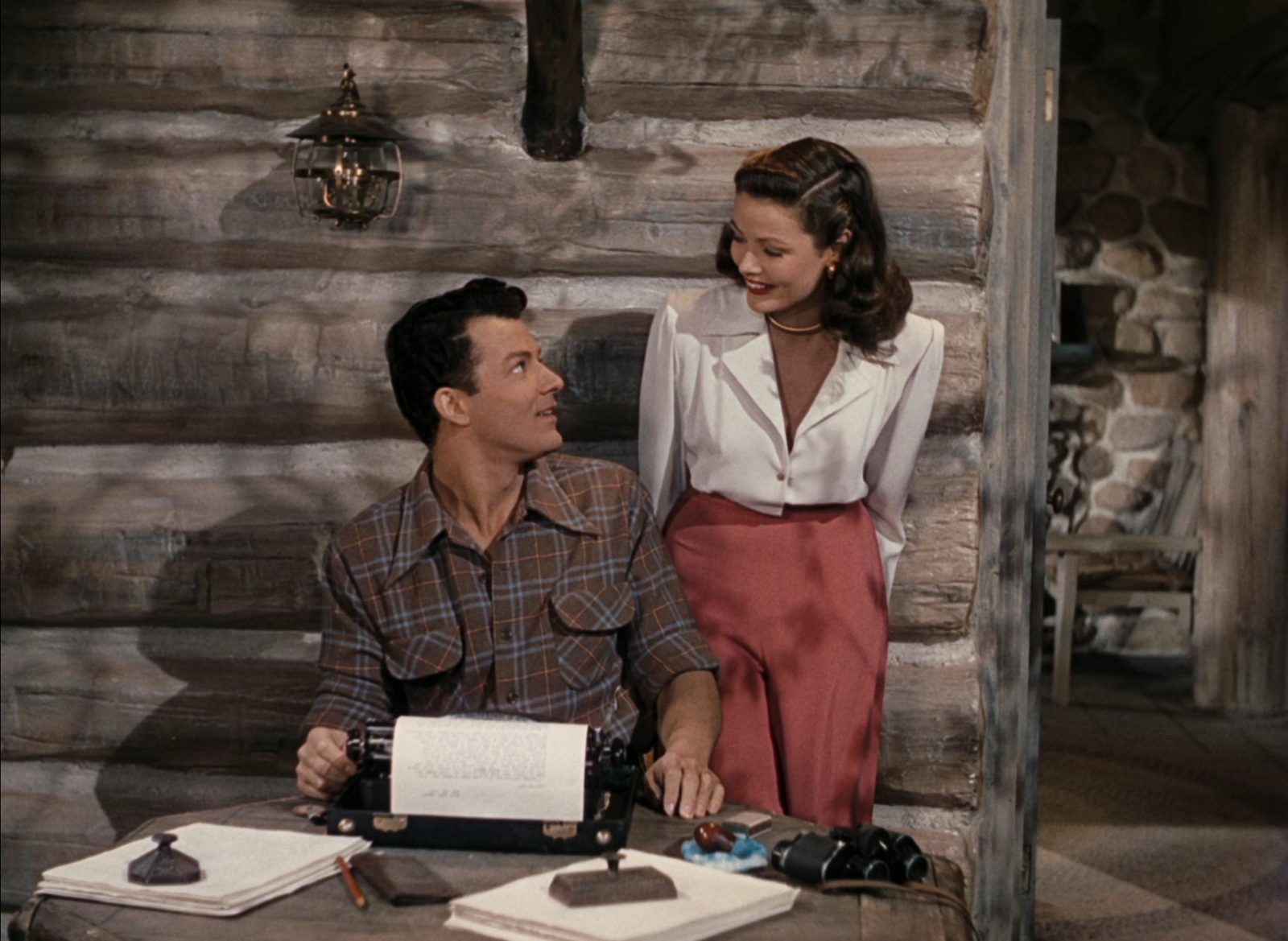
Image context: the lead image uses a real 1945 screenshot from the film showing Cornel Wilde and Gene Tierney in the cabin interior.[6] It fits this essay because the movie's central trick is visible at a glance: Richard appears to be settled into authorship and domestic comfort, while Ellen enters the frame like a dream image already arranging the room around herself. The wood, the lamplight, the rose-toned skirt, the white blouse, and the typewriter all promise warmth; the promise is exactly what makes the frame dangerous.
Leon Shamroy makes brightness do the work that noir usually gives to shadow
The film's reputation as color noir can make viewers expect an elegant novelty, as if the main point were simply that a dark story has been painted in richer tones.[1][3] The movie is doing something harder than novelty. It builds a world in which daylight itself can become accusatory. Ellen and Richard meet on a train moving through the American West; later the story settles among lakes, lodges, terraces, bedrooms, and country-house spaces that are visually open rather than claustrophobic.[4][5][7] The settings invite the viewer to relax into privilege, health, and fresh air. Stahl uses that invitation as camouflage.
The result is a reversal of ordinary suspense habits.[1][2][5] In a more conventional noir register, anxiety gathers in bars, alleys, nighttime streets, and low-key lighting. Leave Her to Heaven keeps placing it in vacation spaces, family spaces, honeymoon spaces, writing spaces, and brightly staged domestic thresholds. The camera's composure is crucial here. These images rarely look feverish or unstable. They look complete. The frame holds its planes cleanly; faces and costumes are given room; backgrounds do not swarm with visual noise. That steadiness lets the viewer feel how much violence Ellen can exercise without ever looking unruly in the frame.[2][5]
Shamroy's Academy Award for the cinematography makes sense on exactly those grounds.[3][7] The achievement is not mere prettiness. It is tonal pressure. The colors carry emotional hierarchy before dialogue catches up. White clothing can look bridal, medical, funereal, or sterilizing. Reds and warm earth tones can register as sensual promise and then harden into warning. Outdoor blue does not guarantee freedom. It can make emotional cruelty feel chillingly public. The film's craft depends on this transfer of meaning from plot into surface. You see possession before you name it.
Ellen's control begins in the frame before it hardens into action
Abbott's description of Ellen as both dangerous and sympathetic matters because Gene Tierney never plays her as a conventional mad spectacle.[2] Ellen is frightening largely through control. Her voice stays measured. Her posture often remains smooth and upright. Her expressions arrive with a fine degree of management, as though she is continually adjusting the emotional temperature of the room by a fraction. Stahl's framing respects that precision. Rather than exposing Ellen through frantic distortion, the film repeatedly gives her centered space, clean sightlines, and an unnerving visual authority over her surroundings.[1][2][5]
That authority is already visible in the cabin screenshot used as the lead image.[6] Richard sits at the typewriter, linked to labor, authorship, and masculine purpose. Ellen does not interrupt the shot by force. She leans into it and takes possession of it by elegance. The frame does not yet look broken; it looks organized around her capacity to convert Richard's attention into her own atmosphere. This is one reason the movie's early passages are so effective. Ellen does not arrive as obvious gothic threat. She arrives as heightened ideality, someone who seems born to inhabit expensive fabrics, polished spaces, and scenic distance. Stahl understands that this kind of perfection is more unnerving than overt disorder because it can circulate socially as aspiration.[2][5]
The camera's treatment of faces deepens that effect.[1][2] Tierney's face is less a confession chamber than a surface that keeps withholding degrees of temperature. The film rarely begs us to diagnose her through exaggerated reactions. It lets her remain legible and unreadable at once. That dual condition matters for craft. When Ellen later acts with breathtaking selfishness, the shock does not come from a sudden switch in style. It comes from the realization that the style had been accommodating her possessive logic from the beginning. The film had already built a visual world in which other people could appear as elements in Ellen's arrangement of life.
The lake sequence is terrifying because the world around it looks healthy
The movie's most infamous scene works because there is no expressionist cover around it.[2][5][7] Water, sun, open air, leisure clothing, and a boat should belong to the iconography of recreation. Stahl turns all of those elements into accomplices. The lake does not surge with storm energy; it lies there with an almost indifferent calm. Ellen's stillness inside that landscape becomes more terrible precisely because the setting offers no external cue that horror is about to take place. The event unfolds inside scenic order.
TCM's production note is useful here because it reminds us how deliberately the film builds that outdoor world, citing California locations including Bass Lake, Monterey, and Busch Gardens for the picture's natural and leisure settings.[7] Those spaces are not incidental backdrop. They are part of the method. Leave Her to Heaven wants nature and luxury to feel continuous with one another, so that Ellen's violence can inhabit a world whose textures normally signal health, money, and restorative escape. The lake sequence therefore becomes a technical thesis: terror can live in a postcard image without changing the postcard's beauty.
That is also why the scene lingers differently from a more conventionally sensational murder.[2][5] The camera does not need to whip itself into frenzy. It lets duration, distance, and Ellen's fixed attention do the work. Her dark glasses, the open water, and the visible physical effort in the frame create one of the film's hardest moral sensations: the viewer is held in a calm visual field while recognizing that calm has become the instrument of cruelty. The scene is shocking, but its deeper accomplishment is structural. It proves that the movie's polished surface is not a shell around the darkness. It is the delivery system.
The interiors turn decor into indictment
If the lake sequence shows how the film poisons open air, the later interiors show how completely it can weaponize order.[1][2][5] Rooms in Leave Her to Heaven are arranged with a degree of visual finish that borders on advertisement. Timber walls, staircases, polished furniture, writing desks, fireplaces, and tasteful wardrobes suggest a fully achieved American life. Yet the more complete these spaces look, the more suffocating they become. Ellen does not merely occupy interiors; she disciplines them. Anyone who diverts attention away from her starts to feel like an intrusion into a design she has already claimed.
That is why the staircase fall is so central to the film's craft.[2][5] The violence occurs within a home space that should belong to privacy, family continuity, and maternal expectation. Stahl keeps the setting recognizable and orderly; the act contaminates the order from within. Later, the courtroom frame extends the same logic into public judgment. The movie does not abandon elegance once scandal becomes visible. It carries elegance straight into accusation, as if the social world itself were too polished to register how sick its ideal picture has become.[1][5]
The point is larger than one femme fatale performance.[1][2][3] The film's technical design keeps asking what kind of American good life is being sold by its own images. If every room is complete, if every color is balanced, if every landscape promises serenity, where is damage supposed to show itself? Leave Her to Heaven answers with frightening rigor: damage can look perfectly at home there. The dream arrangement itself can become the mechanism of exclusion, jealousy, and control. That is what gives the film its aftertaste. Beauty does not stand opposite the violence. Beauty houses it.[2][5]
This is why the picture keeps surviving shifts in fashion.[1][3][5] Its camp value, its melodramatic extremity, and Tierney's unforgettable star turn are all real. So is the deeper technical lesson. Stahl and Shamroy discovered that obsession would land harder if the image refused to advertise danger in advance. They let warm daylight, scenic luxury, and exquisite composure keep their authority all the way through, and the authority itself becomes suspect. Once that happens, the movie no longer looks like a noir curio in color. It looks like one of Hollywood's most exact studies in how control can pass itself off as perfection.
Sources
- The Criterion Collection, "Leave Her to Heaven" film page.
- Megan Abbott, "Leave Her to Heaven: The Eyes of Ellen Berent," The Criterion Collection.
- Jason Altman, "10 Things I Learned: Leave Her to Heaven," The Criterion Collection.
- BFI, "Leave Her to Heaven (1946)" film page.
- Museum of the Moving Image, "Leave Her to Heaven" screening page with Imogen Sara Smith note.
- Wikimedia Commons, "File:Leave Her to Heaven (1945) screenshot.jpg."
- TCM, "Behind the Camera: Leave Her to Heaven."