Otto Preminger's Laura (1944) remains one of the strangest Hollywood films because it asks a detective story to work like a love story without ever letting the two genres separate cleanly again.[1][2][3][4] A police lieutenant investigates the murder of a successful advertising executive. A portrait hangs on the wall. A dead woman's theme music keeps returning. A critic-narrator with exquisite manners keeps talking as if his sentences could preserve her forever.[1][2][3] Before Laura Hunt even fully becomes a person in the viewer's mind, the film has already turned her into an arrangement of surfaces: painting, voice, furniture, perfume, reputation, and male testimony.
That is the source of the movie's lasting unease. AFI's catalog synopsis and BFI's film note both stress the mystery structure and the circle of fascinated men around Laura, yet Laura never behaves like a simple whodunit built to deliver one final answer.[1][2] TCM is especially useful on the film's atmosphere, emphasizing David Raksin's haunting theme and the way Preminger's finished version welded elegance, perversity, and obsession into an enduring noir classic.[3] The mystery matters. The deeper subject is what happens when desire is routed through representation first. In Laura, men do not fall in love with a woman and then describe her. They describe, frame, score, and curate her until description itself begins to function like possession.
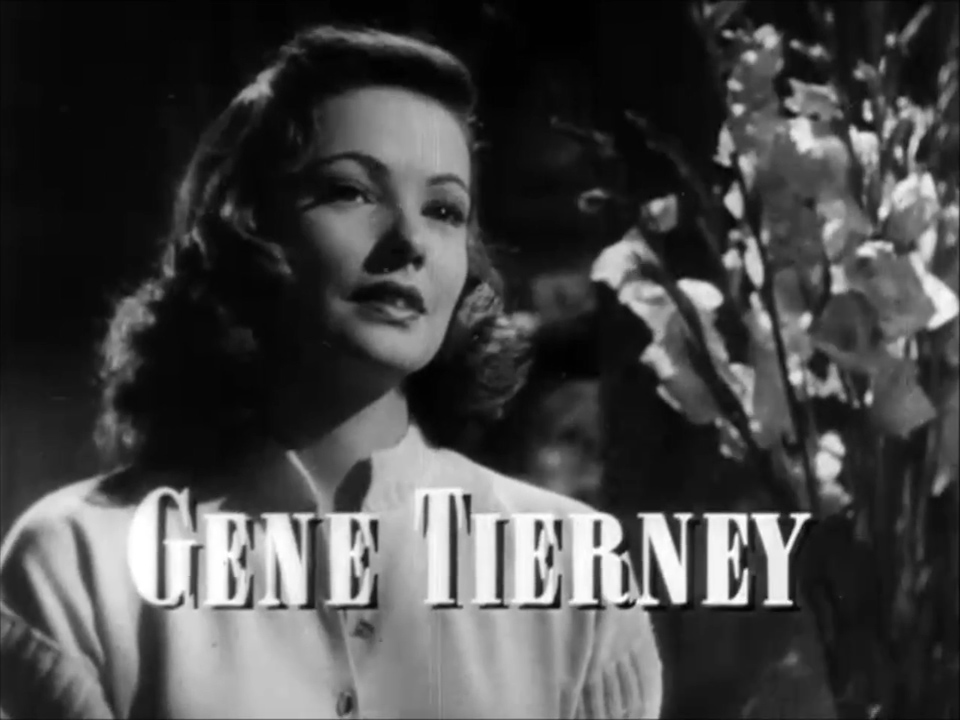
Image context: the lead image uses a real trailer still of Gene Tierney from Wikimedia Commons. It fits this essay because the film's whole mechanism depends on Laura arriving first as a face under controlled light, not as immediate reality. The still already carries that distance. She looks present enough to obsess over and remote enough to be misread.[5]
Spoiler warning: this essay discusses the portrait, Waldo Lydecker's narration, Laura's return to the apartment, and the film's ending.
The portrait makes desire feel like connoisseurship
The portrait at the center of Laura is one of cinema's great machines for converting absence into attraction.[1][2][3] Mark McPherson does not meet Laura first as a living woman. He meets her as a room organized around her image. The painting fixes her into a completed visual object, calm and luminous, while the apartment encourages the detective to read taste itself as character.[1][3][4] He studies her desk, her letters, her clock, her gowns, her cigarettes. Investigation begins to look embarrassingly close to courtship.
That is why the film still feels uncanny. The detective's attachment is born in a space where evidence and intimacy share the same gestures.[1][2][4] He looks closely, lingers, infers temperament from arrangement, and slowly starts treating a murder inquiry like an act of imaginative reconstruction. BFI's note gets at this by calling Laura "an object of fascination" for the men around her.[1] The phrase matters because the portrait does not merely tell us she was admired. It teaches the movie how admiration works when the admired woman is already mediated. Laura becomes desirable at the very moment she becomes collectible.
The apartment strengthens that effect. It is luxurious without feeling warm, intimate without feeling safe.[3][4] Every object seems chosen, and that choice invites fantasy. Mark is supposed to solve a crime; instead he falls under the spell of curation. He is less a romantic hero than a man who mistakes access to someone's designed environment for access to the self. Laura understands that mistake with unusual precision.
Waldo's voice tries to own what the portrait can only display
If the portrait gives Laura a face, Waldo Lydecker's voice gives her a verbal enclosure.[1][2][3] Clifton Webb's narrator is one of the sharpest inventions in studio-era noir because his wit never feels decorative. It feels territorial. AFI and TCM both foreground Waldo's importance as the columnist, mentor, and self-appointed authority who helped make Laura socially legible in the first place.[2][3] He narrates her ascent as though he were editing the terms on which she may exist.
That is why the opening voice-over matters so much. Waldo does not simply provide exposition. He performs authorship.[2][3] His phrases polish Laura into an artifact of cultivation, a woman whose beauty, intelligence, and social finish appear to have passed through his language before reaching anyone else. The murder plot then sharpens the cruelty of that arrangement. Even after Laura is presumed dead, Waldo keeps talking as if style could halt loss. His voice is a mausoleum built from wit.
The famous theme works in parallel.[3] Raksin's music does not just romanticize Laura. It diffuses her through the film as a recurring sensation, a melodic trace that can be summoned whether or not she is present in the frame. The portrait and the voice already turned her into image and narrative. The score completes the process by turning her into atmosphere. No wonder Mark begins to drift. He is not pursuing a person from scratch. He is entering a fully furnished hallucination.
Laura's return does not break the spell. It reveals how badly everyone needs a version of her
The boldest move in Laura is that Laura returns to her apartment and finds a detective asleep beneath her portrait.[1][2][3][4] The scene is often remembered for its plot shock, but its deeper function is structural. Instead of restoring reality against fantasy, the film forces reality to enter a room already saturated with fantasy. Laura does not step into neutral space. She steps into her own afterlife.
That is where the men around her become easiest to read. Mark wants the living Laura to ratify the dream-version he assembled from objects and clues. Waldo wants the living Laura to remain inside the elegant sentence he wrote for her years ago. Shelby Carpenter wants access to her status without submitting to her seriousness.[1][2][3] Each man claims affection, yet each is really negotiating with a version: portrait Laura, narrated Laura, patronized Laura, inherited Laura. The living woman has to push through all of them.
This is what keeps Laura from becoming merely a stylish mystery. The film knows that idealization is not innocent. To idealize someone is to simplify the terms on which they may appear. Laura's return is thrilling because Gene Tierney plays her as both warm and faintly startled by the scale of projection waiting in her own home.[3][4] She is alive, yet the room has already trained everyone to receive her as an image with legs.
The apartment turns detection into a domestic form of haunting
The apartment in Laura is not a background set. It is the movie's real supernatural device.[1][3][4] Nothing overtly paranormal occurs, yet the space behaves like a haunted chamber because it stores competing claims on Laura's identity. The portrait watches over the room. Waldo enters with proprietary ease. Mark stays too long. The door, the clock, the lamp, and the shotgun path all matter because the domestic interior has already become a diagram of obsession.[1][2][3]
ACMI's collection note is brief but useful in calling the film both mystery and romance.[4] That unstable pairing is exactly what the apartment makes visible. In a conventional mystery, the room would yield facts. In a conventional romance, the room would yield confession. Here it yields fixation. People enter to search, accuse, reminisce, and wait. The apartment holds traces, but it also manufactures them. Once Laura has been converted into portrait, melody, and anecdote, the room can no longer function as ordinary living space. It becomes an instrument that keeps replaying desire as evidence.
That is why the ending lands with such force.[1][2][3] Waldo's final violence is not an interruption of the film's logic but its extreme conclusion. He cannot accept Laura as a person whose life exceeds the frame he built around her. If he cannot author the image, he would rather destroy the body attached to it. Laura understands with frightening clarity that possession often presents itself as refinement first.
Why Laura still feels modern
Laura still feels modern because it treats mediation as a romantic problem long before contemporary culture made that problem unavoidable.[1][2][3][4] The portrait, the columnist's voice, the apartment's arrangement, and the theme music all place Laura at a remove before anyone can claim to know her. The men then confuse fluency about that mediated version with intimacy itself. The movie does not merely ask who killed Laura Hunt. It asks what kind of love begins by curating someone into an object one can read, quote, collect, and keep.
That is the film's real disturbance. A portrait, a voice, and an apartment should be secondary things. In Laura, they arrive first, and first contact is enough to reorder feeling.[1][3][4] Preminger turns noir detection into an anatomy of mediated desire: the clue becomes a caress, the room becomes a shrine, and admiration becomes a way of trespassing. The mystery is solved. The unease remains.
Sources
- BFI, "Laura (1944)" - film page on Preminger's noir, its circle of fascinated men, and Gene Tierney's Laura Hunt.
- AFI Catalog, "LAURA (1944)" - production, credits, adaptation context, and plot summary.
- Turner Classic Movies, "Laura (1944)" - article and notes on Preminger's version, David Raksin's theme, and the film's enduring noir atmosphere.
- ACMI, "Laura | Otto Preminger | 1944" - collection note classifying the film across mystery and romance.
- Wikimedia Commons, "File:Gene Tierney in Laura trailer.jpg" - source page for the lead image.