Fritz Lang's M is often introduced as an early-sound landmark, and that label is accurate as far as it goes.[1][5][6] It was Lang's first sound film, Peter Lorre's breakthrough, and one of the foundational serial-killer movies. But the lasting shock of M does not come from hearing synchronized speech for the first time. It comes from how selectively the film uses sound, then binds that sound to absence, paperwork, surveillance, and crowd behavior until Berlin itself starts to feel like an acoustic trap.[1][2][3]
That is why M still feels more modern than many later thrillers.[1][3][4] Lang does not rely on plot twists or on a detective hero with unusual intuition. He builds tension out of systems. A whistle can identify a murderer before the camera proves anything. A stairwell can feel louder once it falls silent. Police raids and criminal lookouts can mirror one another so closely that law and underworld begin to look like rival bureaucracies running the same search pattern. The film's real innovation is formal: sound becomes evidence, and the city becomes an instrument for processing fear.[1][2][5]
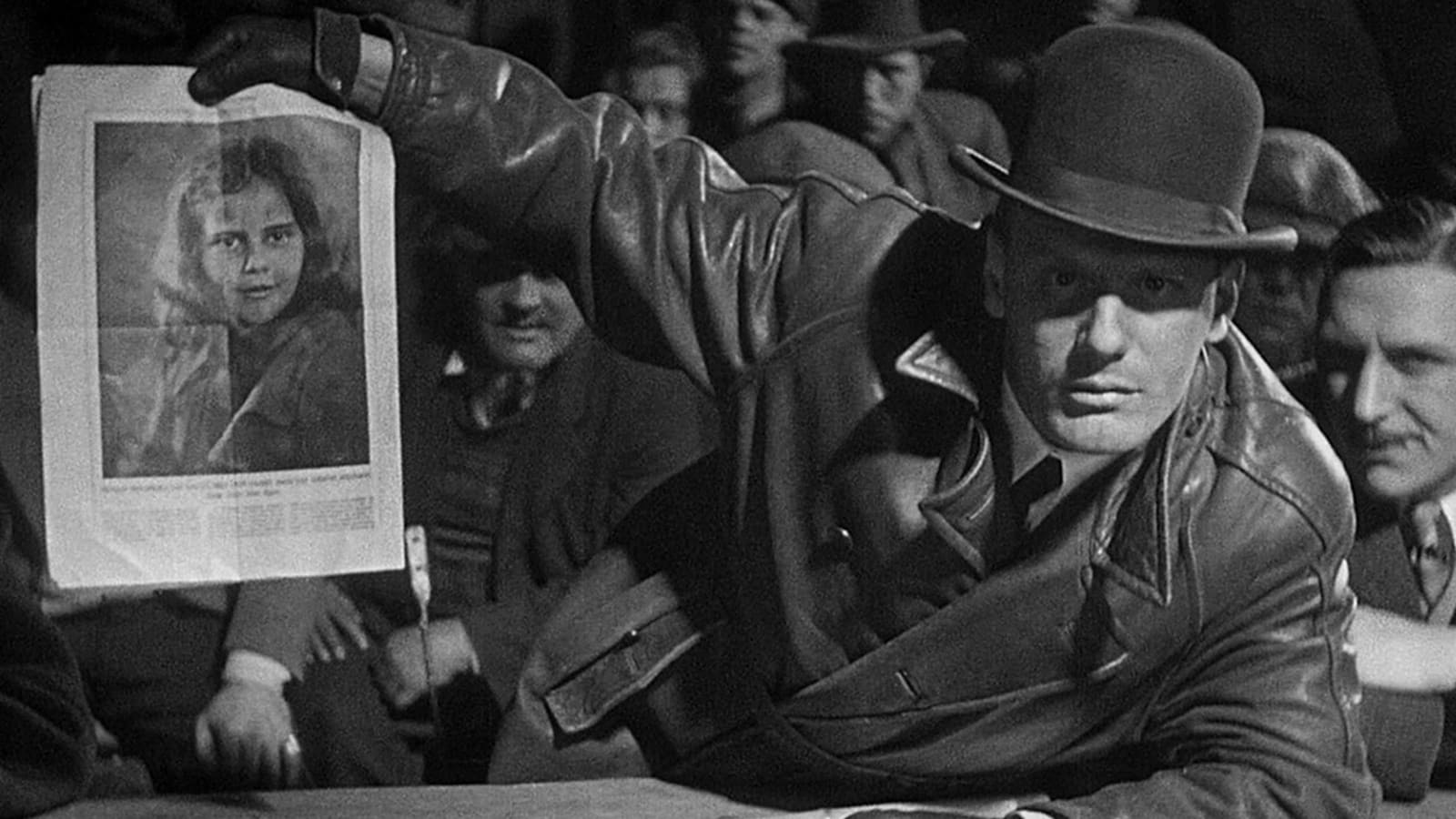
Image context: the cover uses an official Janus still from M showing Peter Lorre pressed into the frame beside a newspaper image of a missing child. That is the right lead image for this essay because Lang's film keeps turning public circulation into dramatic pressure: names, posters, rumors, faces, and printed descriptions move through the city until private pathology is forced into social visibility.[1]
The whistle matters because Lang makes sound arrive before the body does
The most famous device in M is also the simplest: Hans Beckert can be recognized by the tune he whistles from Edvard Grieg's "In the Hall of the Mountain King."[1][2][3] In a weaker film, that motif would function as a villain tag, a neat recurring signal that tells the audience to prepare for danger. Lang does something more unsettling. He lets the sound work as both dramatic cue and practical trace. The whistle is memorable enough for the viewer to register immediately, but it is also ordinary enough to travel through the city as something overheard, half-noticed, and finally connected by other people.[1][3]
That distinction is crucial. M does not treat sound as ornamental accompaniment to image. It treats sound as a public event.[2][3][6] The early scene around little Elsie Beckmann is still devastating because Lang refuses sensational emphasis. We hear the approach of danger in banal, almost casual form: a voice, a tune, a bit of street routine. Then the film withholds the murder itself. Instead, the aftermath lands through objects and spaces that continue after the child's body is removed from the frame: the empty place at the dinner table, the unattended plate, the staircase, the balloon caught in wires.[2][3][4] Sound opens the wound; silence and vacancy make it spread.
This is one reason M has aged so well. Many early sound films now feel historically important but formally transitional, as if cinema were still learning how much to say once microphones arrived.[6] Lang shows the opposite instinct. He talks less in order to make sound count more. The whistle is frightening because it is sparse. It breaks into the film's atmosphere like a stray piece of evidence, then keeps returning as if the city itself were remembering it.[1][2][3]
Empty rooms turn violence into social space
Lang's most radical choice is that he refuses to make the central crime the movie's visual climax.[2][4] He displaces it into empty rooms and waiting spaces. The mother's call from the stairwell, the shot of the untouched place setting, and the cut to Elsie's balloon are all now canonical, but their force remains difficult to exhaust. They turn murder into an environmental fact. Instead of watching the act, we watch a domestic world discover an absence too large for dialogue to manage.[2][3][4]
That strategy does two things at once. First, it strips the film of exploitation. The horror is not intensified by showing more. It is intensified by forcing the viewer to inhabit the ordinary spaces that can no longer function normally after the act.[2][4] Second, it establishes a pattern the whole movie will follow. M is full of thresholds, corridors, offices, workrooms, staircases, and improvised interiors where people exchange information. Lang keeps asking what a room feels like once it has been entered by suspicion.[1][4][5]
The answer is that the room stops belonging only to the people inside it. It becomes part of a larger search apparatus. Domestic interiors feed the press. Posters move into shop windows. Police offices become map rooms. Criminal meeting spaces become planning cells.[1][5] Space in M is never just background. It is a relay point. That is why the film's visual design remains so severe. Lang is not decorating Berlin. He is segmenting it into channels where panic, rumor, and recognition can travel.
The city becomes a dragnet when police procedure and criminal procedure start to rhyme
The middle movement of M is one of the great procedural passages in cinema because it shows two institutions solving the same problem with different badges.[1][2][5] Police pressure intensifies after the child murders continue; raids disrupt ordinary criminal business; fingerprinting, dossiers, interrogations, and patrol patterns expand.[2][5] The underworld responds pragmatically. If the police crackdown is hurting thieves, fences, and racketeers, then the murderer becomes a labor problem for criminals as well as a moral scandal for the public.[1][4]
Lang stages this convergence with extraordinary clarity. Meetings, lists, lookouts, and communications networks proliferate on both sides.[1][2][5] Beggars become watchers because they know the street better than uniformed police do. Safecrackers and gang bosses start discussing the killer with the language of workflow and interruption. The film's great insight is that mass manhunts do not depend only on righteous feeling. They depend on organization, on who can move information fastest, and on which bodies the city already notices or ignores.[1][4]
Here the sound design matters again. The city of M is never sonically lush, but it is alive with signals: footsteps, whistles, commands, murmurs, crowd noise, office chatter, and the friction of institutions talking to themselves.[2][3] Lang turns those sounds into a map of pressure. Each layer of procedure narrows Beckert's room to move. By the time the beggar network identifies him and the chase begins in earnest, the film no longer feels like a mystery. It feels like an urban system finishing a calculation.[1][2]
Peter Lorre's performance works because panic keeps leaking through the system
All of this structure would be merely ingenious without Peter Lorre.[1][4][5] Beckert is not frightening because Lang grants him demonic grandeur. He is frightening because the performance keeps oscillating between concealment and exposure. At first Lorre seems almost boneless, absorbed into crowds, shopfronts, and passing gestures. Then anxiety starts breaking the surface: the searching eyes, the compulsive mouth, the unstable smile, the sudden rush of pleading when the net closes.[1][4]
The famous basement trial matters because it concentrates the whole film's argument about public judgment.[1][4][5] By then Beckert has become less a hidden individual than a figure processed by collective need. Police want closure; criminals want normal business restored; the crowd wants a body to pin fear onto. Lorre's speech does not absolve him, and Lang does not stage it as sentimental redemption. What it does is reintroduce irrational compulsion into a movie that has increasingly looked like a machine of social sorting.[1][4] The dragnet can find him, mark him, and surround him. It cannot convert pathology into coherence.
That is what gives the sequence its enduring sting. M understands the seduction of collective certainty.[4][5] The crowd believes the hunt will restore order. Lang lets that belief gather force, then shows how quickly procedure can turn theatrical. The kangaroo court is organized, efficient, and packed with evidence, yet it is also feverish, self-authorizing, and eager to collapse judgment into vengeance. The film never releases the tension between those two realities.
Why the movie still feels ahead of its descendants
The easiest way to praise M is to call it a blueprint for the psychological thriller, and Janus and BFI are right to describe it that way.[1][5] But the blueprint metaphor can sound too flattering, as if later films simply expanded what Lang first sketched. In one respect M still feels harsher than many of its descendants. It is less interested in the killer as genius or spectacle than in what a city does to itself once fear becomes administrative.[1][2][4]
That is the film's modernity. The whistle, the newspaper, the wanted poster, the police file, the beggar network, the warehouse trial, all of them are media forms as much as story events.[1][2][3] They move information, reduce ambiguity, and intensify pressure. Lang's achievement was to realize that sound cinema could bind those media forms together without overexplaining them. He made an early talkie that trusted fragments: a tune, a room, a poster, a crowd, a plea. Nearly a century later, M still feels contemporary because it knows that panic becomes most dangerous when technology, bureaucracy, and public emotion begin to speak the same language.[1][3][5][6]
Sources
- Janus Films, "M" film page with synopsis and official stills.
- Fritz Lang, "My Film M: A Factual Report," The Criterion Collection.
- David Bordwell and Kristin Thompson, "Mastering a New Medium: Sound in M," The Criterion Collection.
- Stanley Kauffmann, "The Mark of M," The Criterion Collection.
- BFI, "M (1931)" film page.
- BFI, "10 great early sound films."