
Criterion's 104-second Ronald Neame clip is worth watching because it does not try to make Brief Encounter sound important by inflation.[1] It does something better. It shows one of the film's long aftereffects in the body: every time Neame reaches the last minutes, he tries to remind himself that he is looking at a manufactured object and fails anyway.[1] That failure is the right way into David Lean's 1945 film. The ending hurts not because it is loud, or because it produces a grand romantic catastrophe, but because it keeps returning ordinary things to the screen with unbearable precision: a station buffet, a routine trip into town, a husband doing his crossword, a sentence spoken softly enough to feel almost private.[2][3]
That ordinariness is designed from the start. The film grows out of Noel Coward's one-act play Still Life, but the screen version shifts the whole structure into Laura's interior account, using voice-over to turn a chance meeting into a remembered private crisis.[3] The BFI's film note still gets the balance right: Robert Krasker's black-and-white images, Rachmaninoff's Second Piano Concerto, and the postwar release moment make the movie quiver with pent-up feeling even though almost nothing "big" happens in plot terms.[2] What the clip below isolates is the place where all of that pressure finally condenses.
This is also why the film survives modern condescension about repression so easily. The station is not just a quaint British backdrop. It is a timing system. Laura's weekly suburban routine, the borrowed afternoons with Alec, the fixed departures, the need to be home again by dinner: all of it turns desire into something scheduled, clipped, and therefore more painful.[3][4] Brief Encounter does not ask whether passion exists. It asks what passion looks like when it has to fit inside timetables.
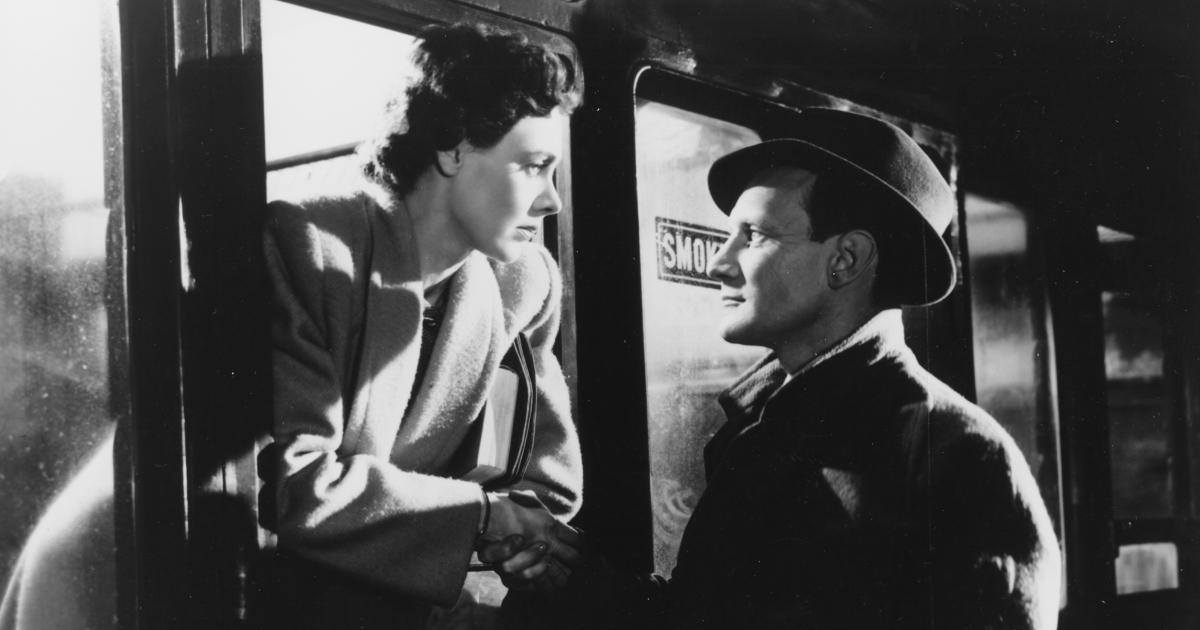
Image context: the cover uses BFI's black-and-white still of Celia Johnson and Trevor Howard beside a train. A real film still is the right image here because this article is about railway space as emotional machinery: the platform, the buffet, and the carriage timetable do as much dramatic work as the lovers themselves.[2][4]
Around 0:00, Neame starts by trying to demystify the film, and that only proves how strongly the ending works
The first half-minute is almost comic in its self-discipline. Neame says that, as the ending approaches, he tells himself it is only a film, only reels in tins, only light coming from the projection box.[1] That self-lecture matters because it identifies the film's real strength. Brief Encounter does not overwhelm the viewer with spectacle and then ask for tears as a reward. It uses embarrassingly ordinary materials and makes them impossible to brush aside.
That choice runs all the way back into Laura's characterization. Shakespeare Theatre's production essay, drawing on Coward's notes, stresses how carefully the film builds her suburban pattern: train into town, library book, lunch, picture house, train home.[3] By the time emotion enters, routine already has a shape. The ending therefore feels less like a shock than like a fracture in a schedule that had seemed safely repeatable. Neame's little attempt to reason himself out of feeling becomes a mirror of Laura's own effort to behave reasonably after the affair has reached its limit.
Around 0:30, the clip jumps to "the last few minutes" because interruption is the film's cruelest device
Neame does not summarize the whole plot. He goes straight to the final stretch, and that is exactly right.[1] The most devastating formal choice in Brief Encounter is not the affair itself but the way the farewell is broken. ACMI's study note still describes the scene cleanly: Laura and Alec spend their last day together, part where they first met in the station buffet, and then their last private moment is shattered by the arrival of Laura's talkative acquaintance.[5] Nothing violent happens. No one is exposed in public. A chatty interruption does the damage.
That is one reason the film remains so unnerving. Melodrama is often imagined as revelation, confession, or a scene of public rupture. Brief Encounter knows that middle-class life can be much crueler than that. It leaves people trapped inside politeness while the decisive moment slides away. The station buffet scene hurts because social small talk enters at exactly the point where language had finally become necessary. The film does not give Laura and Alec a clean tragic consummation. It gives them a stolen ending that another person's chatter makes unusable.[4][5]
Notice how much this depends on environment. The station is full of clocks, movement, smoke, and traffic, but it also enforces etiquette. People arrive, look in, ask a question, sit down, and go on. The setting does not merely host the interruption. It authorizes it. In that sense the clip is really about form. Neame remembers tears, but the film earns them by making interruption feel structural rather than accidental.[1][5]
Around 0:40, the ending returns Laura home without giving anyone clean moral victory
The clip then narrows to the final domestic exchange. Laura comes back shattered, and Fred, who knows enough without knowing everything, responds with an unexpected steadiness.[1] Neame singles out that gentleness because the film's final move is not punishment. It is return without catharsis. The famous line, "thank you for coming back to me," lands because it is neither triumphant nor naive.[1] Fred is not suddenly rewarded with narrative superiority; he is simply present, patient, and more perceptive than Laura has allowed herself to admit.
That aspect of the ending is easy to flatten into conservative moral closure, but the film is more exact than that. BFI's feature on the picture argues that Fred is not as oblivious as Laura imagines and that the surrounding world contains private dramas beyond the central pair.[4] The home Laura returns to is therefore not a cartoon prison built to make romance glow brighter by comparison. It is a real marriage, dulled by habit yet still capable of tenderness. That is why the ending feels heavier than a simple lesson about fidelity. Laura has not discovered that passion was false. She has discovered that two different forms of attachment can be true at the same time, and only one of them is survivable inside her actual life.[3][4]
The film's mature cruelty lies there. It does not let the affair become a sacred alternative world. It remains entangled with children, timetables, suburban habit, and the pressure to continue living. When Fred speaks, the movie does not dissolve contradiction. It makes contradiction livable, which is harder and sadder.
What to watch for after the clip ends
On a rewatch, pay close attention to how often Brief Encounter turns tiny forms of organization into emotional pressure: train departures, buffet tables, borrowed daytime hours, the shift from spoken dialogue to Laura's inward narration, and Rachmaninoff arriving as a kind of sanctioned overflow.[2][3] The clip is short, but it points toward the right question. Why does this ending keep undoing viewers who already know exactly what will happen? Because the film never mistakes restraint for thinness. It fills routine so completely with longing that the smallest interruption can become fatal to a feeling without killing anyone at all.
That is why Neame's embarrassment in the dark remains useful as criticism.[1] He is not defending the film by theory. He is reporting that its final arrangement still works on him. Nearly everything in Brief Encounter is modest in scale. That modesty is the trap. The movie makes commuter life, polite conversation, and a return to the family sitting room carry the weight that other romances assign to duels, departures, or deathbeds. Its ending does not explode. It closes the door softly and leaves the ache behind.
Sources
- CRITERION, "Ronald Neame on Brief Encounter," YouTube clip on the film's final minutes.
- BFI, "Brief Encounter (1945)" - film page on David Lean's adaptation, Robert Krasker's black-and-white cinematography, and the 1945 release context.
- Shakespeare Theatre Company, "Brief Encounter: The Back Story" - Coward's Still Life, Laura's routine, the voice-over structure, and the use of Rachmaninoff.
- BFI, "Brief Encounter - a return ticket to Temptation" - why the station setting, minute gestures, and Fred's quiet intelligence remain moving.
- ACMI, "Brief encounter (study extract)" - the station-buffet farewell, Dolly Messiter's interruption, and the ending's suicidal turn.