
The Criterion trailer for Lola Montès does something smarter than a normal prestige rerelease preview. It does not try to simplify Max Ophuls's last film into a romantic costume-pageant or a scandal biopic with a glamorous center. Instead it keeps returning to rings, curtains, mirrors, balconies, title cards, and frontal displays. The trailer advertises beauty, but it advertises beauty as a structure that has already trapped the woman inside it.[1]
That emphasis matches the film's surviving critical descriptions. Janus presents Lola Montès as both romantic melodrama and a meditation on the lurid fascination of celebrity, while BFI describes it as a film about objectification, patriarchy, spectacle, and storytelling itself.[2][3] Rodney Hill's Senses of Cinema note pushes the point further by treating the film's circus construction as central rather than decorative: Lola's life is not merely remembered, it is staged, narrated, and sold back to an audience.[4] My inference from the trailer and these written sources is that the preview's real promise is not plot. It is a lesson in how Ophuls turns display into judgment.[1][2][3][4]
That is why the trailer is worth an annotated viewing. Max Ophuls is regularly praised for movement, but Tag Gallagher's director essay is useful because it links that movement to show-business assembly, self-conscious narration, and cinema's power to exhibit.[5] The trailer understands the same thing. Its camera and editing do not simply offer gorgeous fragments from a famous restoration. They keep asking what it means for a life to be circulated, arranged, and consumed as public performance.[1][5]
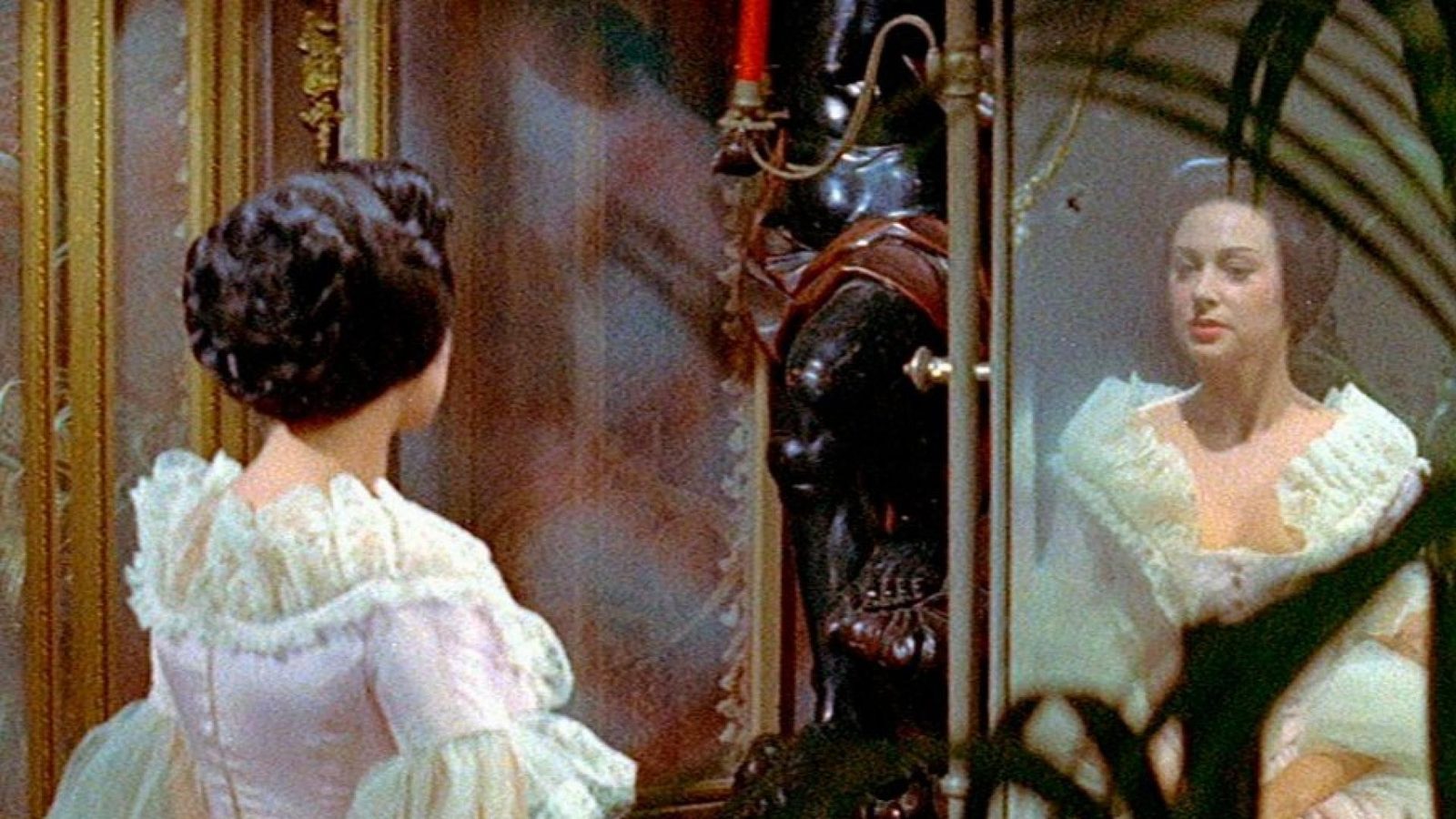
Image context: the cover still comes from BFI's page for the film and shows Martine Carol doubled through a mirror. That choice fits the article because the trailer repeatedly organizes Lola through reflective and theatrical frames. Before it tells us who she loved, it tells us she will be watched.[3]
Around 0:10, the trailer enters through the circus, not through private memory
After the brief Rialto logo, the first substantial image does not present Lola in intimate close-up or place us inside one of her famous affairs. It opens on the circus architecture that has already converted her past into an attraction.[1] We see the ring before we understand the woman. Janus's synopsis says the bombastic ringmaster recounts her scandalous life in the American circus where she has ended up performing, and the trailer immediately commits to that framing rather than saving it as late context.[2]
That decision matters because it changes the emotional contract of the preview. A conventional historical trailer would lead with personality and let spectacle support it. Lola Montès does the reverse. The spectacle comes first, and personality has to appear inside it. BFI's capsule description is exact on this point: the film concerns objectification and storytelling at once.[3] The trailer therefore behaves less like an invitation into a heroine's mind than like an admission ticket to a machine that has learned how to retail her image.
Hill's description of the movie as a sequence of myth-making flashbacks is useful here because the trailer begins with the institution that organizes those flashbacks.[4] The past is not introduced as raw memory. It is already managed, announced, and staged. Even before the title arrives, the film's central wound is visible: Lola's life can only re-enter the present after being routed through public exhibition.[1][4]
Around 0:20, the crowned close-up and handwritten title brand the body they seem to celebrate
At roughly the twenty-second mark, the trailer cuts to Lola in a frontal close-up with a crown, then writes her name across the image in bright script.[1] It is one of the preview's most seductive gestures, and also one of its harshest. The shot promises stardom, but the typography behaves almost like ownership. Her face is not merely revealed; it is labeled, packaged, and fixed into a marquee image.
This is where Ophuls's camera logic matters. Gallagher writes about the director's fascination with cinema's ability to show and exhibit, and Hill stresses the film's interplay between realism and high artifice.[4][5] The trailer condenses both ideas into a few seconds. The close-up is lush and immediate, but the title laid over it prevents the moment from feeling private. Lola appears as a person and as a poster at the same time.[1][4][5]
The crowned image also establishes a pattern the trailer will keep repeating. Costumes, jewels, makeup, and décor do not operate as neutral period detail. They behave like mechanisms that magnify the body while reducing its freedom. The result is not anti-glamour. Ophuls is too intoxicated by surfaces for that. The result is glamour shown under pressure, beauty displayed in a form that already hints at confinement.[1][2][3]
Around 0:30 to 1:05, doorways, dancers, cast cards, and festival laurels keep turning movement back into display
The middle stretch of the trailer looks more expansive at first glance. We get a doorway shot, a burst of dancers, the promise of "breathtaking color," the introduction of Oskar Werner, and then a card noting the 2008 New York Film Festival selection.[1] On paper, this is ordinary trailer business: visual variety, cast credibility, institutional endorsement. In practice, the sequence does something stricter. Every new image of movement is immediately recaptured by a frame, a card, or a proscenium.
The doorway shot around the half-minute mark is a good example.[1] A door normally suggests passage, but here it behaves more like a visual slot in which Lola is placed. The dance imagery that follows could have sold pure release, yet the trailer treats it as programmed performance. Janus's description of the film as a "one-of-a-kind movie spectacle" is accurate, but the spectacle is never innocent.[2] It always arrives with an audience already implied.
The same is true of the festival-laurel card at about a minute in.[1] That card does more than certify the restoration. It folds the movie's own story of exhibition into the contemporary prestige economy that now presents it to us. A circus audience inside the film gives way to a festival audience outside it. The mechanism changes scale, but not logic. Lola remains something arranged for viewing, and the trailer is sharp enough to let that rhyme land instead of hiding it.[1][3][4]
Around 1:10 to the end, mirrors, curtains, balconies, and the final blue close-up make the trailer's argument unmistakable
The last third is the strongest part of the trailer because it stops pretending that spectacle and captivity might be separable. We move through boudoir images, veils, red curtains, balustrades, and one of the film's unforgettable blue-toned frontal images before the preview resolves into Criterion packaging.[1] The transitions are fluid, but the spaces feel increasingly controlled. Lola is always entering a frame that seems to have been waiting for her in advance.
That is why the mirror imagery matters so much, even when it flashes by quickly.[1][3] A mirror can suggest self-knowledge, but in this trailer it more often suggests duplication and surveillance. Lola does not simply see herself. She becomes available as an image that can be reflected, repeated, and managed. BFI's emphasis on objectification and Hill's account of the film's elaborate artifice help clarify what the trailer is doing: it presents celebrity as a hall of surfaces in which the subject survives only by being multiplied.[3][4]
The final blue close-up near 1:30 is especially revealing.[1] Coming after so many decorated interiors and theatrical thresholds, the shot should feel like an arrival at essence. Instead it feels like the most distilled emblem of the movie's trap. Lola is isolated, luminous, and immobilized. The trailer ends not on narrative release but on an image of pure display, then hands her over to product copy and label design.[1] Ophuls's moving camera, so often discussed as freedom, becomes here a more paradoxical instrument: it glides beautifully through systems that sort people into poses, rituals, and hierarchies.[5]
That is why this trailer holds up as more than a restoration advertisement. It understands that Lola Montès is not merely lush; it is diagnostic. It studies how modern spectatorship converts scandal into value, movement into choreography, and a famous woman's life into an endlessly saleable routine.[1][2][3][4][5] The preview sells color, costumes, and camera movement, but it never lets them relax into decorative pleasure alone. It keeps showing that the circus is not only a setting. It is the film's governing sentence.
Sources
- CRITERION, "LOLA MONTES Trailer (1955) - The Criterion Collection," YouTube video.
- Janus Films, "Lola Montès" film page, with synopsis and release context.
- BFI, "Lola Montès (1955)" film page, with capsule description and film metadata.
- Rodney F. Hill, "Lola Montès," Senses of Cinema.
- Tag Gallagher, "Ophuls, Max," Senses of Cinema Great Directors.