Věra Chytilová's Daisies looks at first like a film that refuses seriousness by giggling too much. Two young women, both called Marie, decide that if the world is spoiled, they will be spoiled too; they tease older men into buying meals, cut up food with theatrical boredom, lounge in their apartment as if it were a toy theater, and finally wreck a banquet laid out with official plenty.[1][2] The plot is almost too simple to hold the film. That is the point. Daisies belongs to the Czech New Wave because it takes the movement's appetite for social satire, formal looseness, and institutional insolence, then makes those traits feel edible, decorative, and bodily unstable.
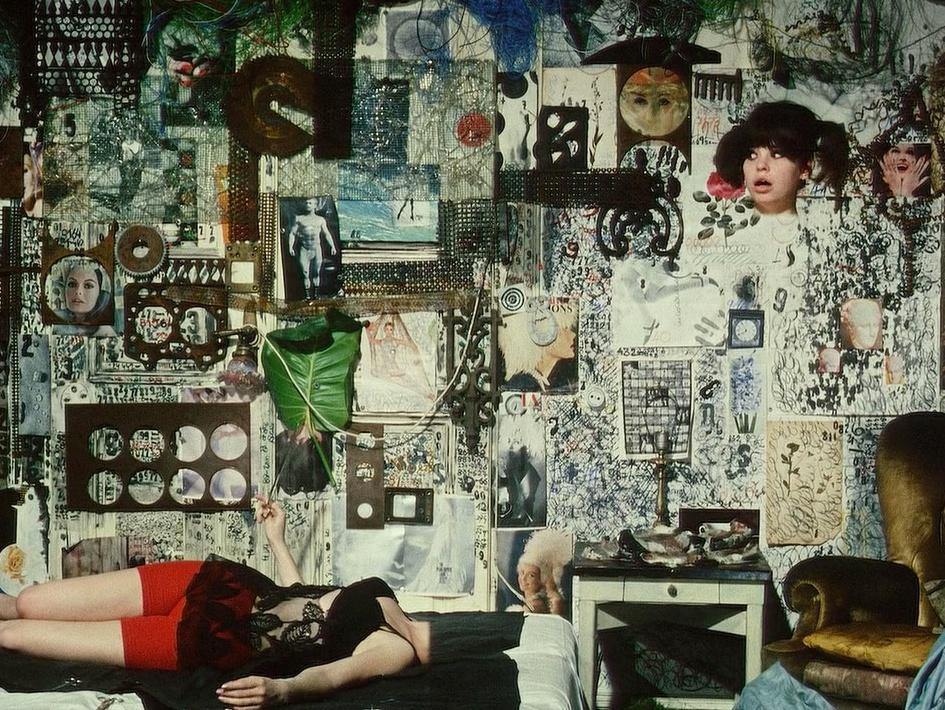
The still used here, sourced from BFI's Chytilová guide, shows the two Maries inside a visual world that already feels overripe: patterned fabric, flowers, posed bodies, and a sense that costume has started to think for the characters.[1] A generic production image would miss the film's method. Daisies needs a still in which surface looks dangerous, because Chytilová's revolt begins by making surface active. Clothes, tableware, color filters, cutouts, food, and girlish gestures do the argumentative work that a more conventional political film would hand to speeches.
The New Wave Turns Mischief Into Method
BFI places Chytilová among the Czech New Wave filmmakers shaped by FAMU, state film culture, Soviet-era constraint, and the liberalizing atmosphere that led toward the Prague Spring.[1] Janus's production history makes the institutional setting more precise: Chytilová was the first woman to study directing at FAMU, entered features after documentary and dual-narrative work, and made Daisies with crucial collaborators including Ester Krumbachová, Jaroslav Kučera, and Miroslav Hájek.[2] That background matters because the film is often remembered as anarchic, while its anarchy is carefully engineered.
The Maries' behavior repeats in recognizable patterns. They perform boredom, target men who confuse payment with entitlement, escape from social situations like pranksters leaving a stage, then return to the apartment to test another pose.[2][3] The scenes feel impulsive, but their recurrence gives the film a comic mechanism. Every small raid asks the same question from a different angle: what happens when young women decline the manners that make them legible to men, officials, spectators, and narrative order itself?
That question makes Daisies a movement film rather than only a cult object. Much of the Czech New Wave found pressure points inside everyday systems: schools, workplaces, villages, bureaucracies, romantic rituals, and public language. Chytilová's difference lies in refusing sober exposure as the only route to critique. She turns unseriousness into evidence. The Maries laugh, pout, chew, pose, clip, snip, and shriek; the style insists that bad behavior can reveal a bad world more sharply than a respectable denunciation would.
Collage as Social Sabotage
The film's form keeps breaking its own container. BFI points to the colored filters, fragmented editing, and psychedelic experimentation that made Daisies one of Chytilová's most formally vibrant works.[1] Janus's notes add the production mechanics: abrupt shifts among black-and-white, color, prismatic and monochrome passages, matte effects, rapid object montages, and costumes designed by Krumbachová that make the Maries resemble renegade dolls or dolls cutting their strings.[2] Senses of Cinema describes this not as looseness alone, but as a productive instability built from disjunctive montage, jump cuts, unstable spatial relations, sound bridges, and repeated structures that keep interpretation active.[3]
That instability is political because it attacks the habits by which films usually discipline women characters. A conventional narrative would explain the Maries: family history, psychology, trauma, romance, class position, moral lesson. Daisies keeps refusing that paperwork. The women remain present as bodies and styles before they become case studies. Their laughter is sometimes charming, sometimes irritating, sometimes cruel; the film does not smooth those contradictions into a single approved meaning.[3]
This is where collage becomes sabotage. A butterfly, a flower, a slice of sausage, a phone call, a bedspread, a color wash, a severed-looking body part, a banquet plate: each fragment interrupts the expectation that cinema should move cleanly from motive to action to consequence.[2][3] The result is not randomness. It is a cinematic environment where appetite and ornament keep exposing the rules beneath ordinary taste. If polite culture wants women to be decorative, the Maries become so decorative that decoration turns destructive.
Appetite, Waste, and the Official Eye
Food is the film's most notorious material because it gives ideology a texture the viewer can almost feel. BFI's guide notes that Czech authorities banned Daisies, citing food waste after the climactic banquet destruction; the same account reads the end-title dedication to those offended by a trampled trifle as a barb at official hypocrisy.[1] Janus's notes similarly describe party leaders condemning the film's avant-garde method and its scenes of waste, while Senses of Cinema connects the ban to the film's refusal to settle into a positive socialist attitude.[2][3]
The banquet works because it is excessive in two directions at once. On screen, the Maries gorge, cut, crawl, swing, smear, and wreck with the glee of children who have found an unattended ceremonial room. In political context, the spectacle makes abundance look obscene precisely because it is staged as official order. The table is arranged, ranked, and prepared; the Maries convert it into motion. They do not debate power. They touch it, eat it, spill it, and ruin its symmetry.
That is why the film's food imagery remains sharper than a simple anti-consumerist lesson. The Maries are not innocent rebels standing outside decadence. They are also consumers, performers, and destroyers.[3][4] Their rebellion is compromised, funny, and ugly. Chytilová's precision lies in leaving that ugliness inside the frame. The film does not ask viewers to admire every act. It asks them to notice why a culture can tolerate larger violences while becoming scandalized by girls making a mess.
Reception as Part of the Film's Afterlife
The archival record helps explain why Daisies kept traveling. ACMI's collection record calls the film a modern fable in a stylized setting and frames its performance, cinematography, sets, and music as a subversion of socialist realism.[4] MoMA's 1967 press release for a Festival of New Czechoslovak Cinema described an exhibition of stills from the selected films and singled out scenes from Daisies, calling it the most original European film of that year, full of visual delights and mordant humor.[5] Those two institutional views, decades apart and continents away, show how quickly the film escaped the category of local scandal.
Yet its afterlife also depends on remaining difficult to summarize. Feminist cinema, Czech New Wave provocation, anti-authoritarian farce, food-waste scandal, collage comedy, morality play: each label catches something and leaves something loose. Senses of Cinema's strongest point is that the film's instability can hold several competing readings without granting any one of them full control.[3] That is not a weakness. It is the film's survival system.
Seen in that light, Daisies is less a film about rebellion as a stable virtue than a film about rebellion as a damaged form of perception. The world is spoiled, the Maries say, and their answer is to spoil themselves until social order can no longer pretend to be clean. Chytilová makes that answer hilarious, exhausting, beautiful, childish, cruel, and formally exact. The Czech New Wave often found freedom by loosening realism from inside. Daisies goes further: it cuts realism into pieces, eats from the plate, laughs with its mouth full, and leaves the censors holding the bill.
Sources
- Carmen Gray, "Vera Chytilová for beginners," BFI (2015), with context on Daisies, the Czech New Wave, the ban, and the BFI still used as the lead image.
- Janus Films, Press Notes: Daisies PDF, with production history, collaborators, formal techniques, release context, and censorship history.
- Dylan Rainforth, "This Film's Going Bad: Collaborative Cutting in Daisies," Senses of Cinema (2007).
- ACMI, "Daisies = Sedmikrasky" collection record, with credits, archival metadata, and interpretive catalogue note.
- Museum of Modern Art, "Exhibition of 85 Stills to be Presented on the Occasion of the Festival of New Czechoslovak Cinema" press release (1967) PDF.