Sergei Eisenstein's Ivan the Terrible is often introduced as a historical epic about the sixteenth-century tsar who consolidated Muscovy, but the films do not really work like ordinary pageant history.[1][2] They work more like a pressure chamber built out of faces, robes, walls, shadows, and ritualized movement. BFI describes the first part as the summit of Eisenstein's late style, with operatic performance and densely symbolic images, while Criterion's edition notes the larger political paradox: Stalin approved Part I, then recoiled from Part II when the portrait of centralized power darkened into assassination and secret-police dread.[1][2] That split is the key to the film's form. Eisenstein is not merely illustrating autocracy. He is turning rule itself into an unstable theatrical machine.
That is why the craft matters more than the plot summary. J. Hoberman calls the two-part work a synthesis of ballet, opera, painting, and cinema, and David Bordwell's Criterion note points to Eisenstein's idea of "expressive movement," staging designed to generate emotion through physical arrangement rather than through psychological realism alone.[3][5] Once you watch Ivan with that in mind, nearly every formal decision sharpens. A face locks into profile instead of relaxing into conversation. A corridor seems to curl around the body rather than merely contain it. A gesture lands like choreography. And in Part II, when the image suddenly blooms into the notorious red banquet, color stops feeling decorative and starts feeling like a political hallucination.[3][4]
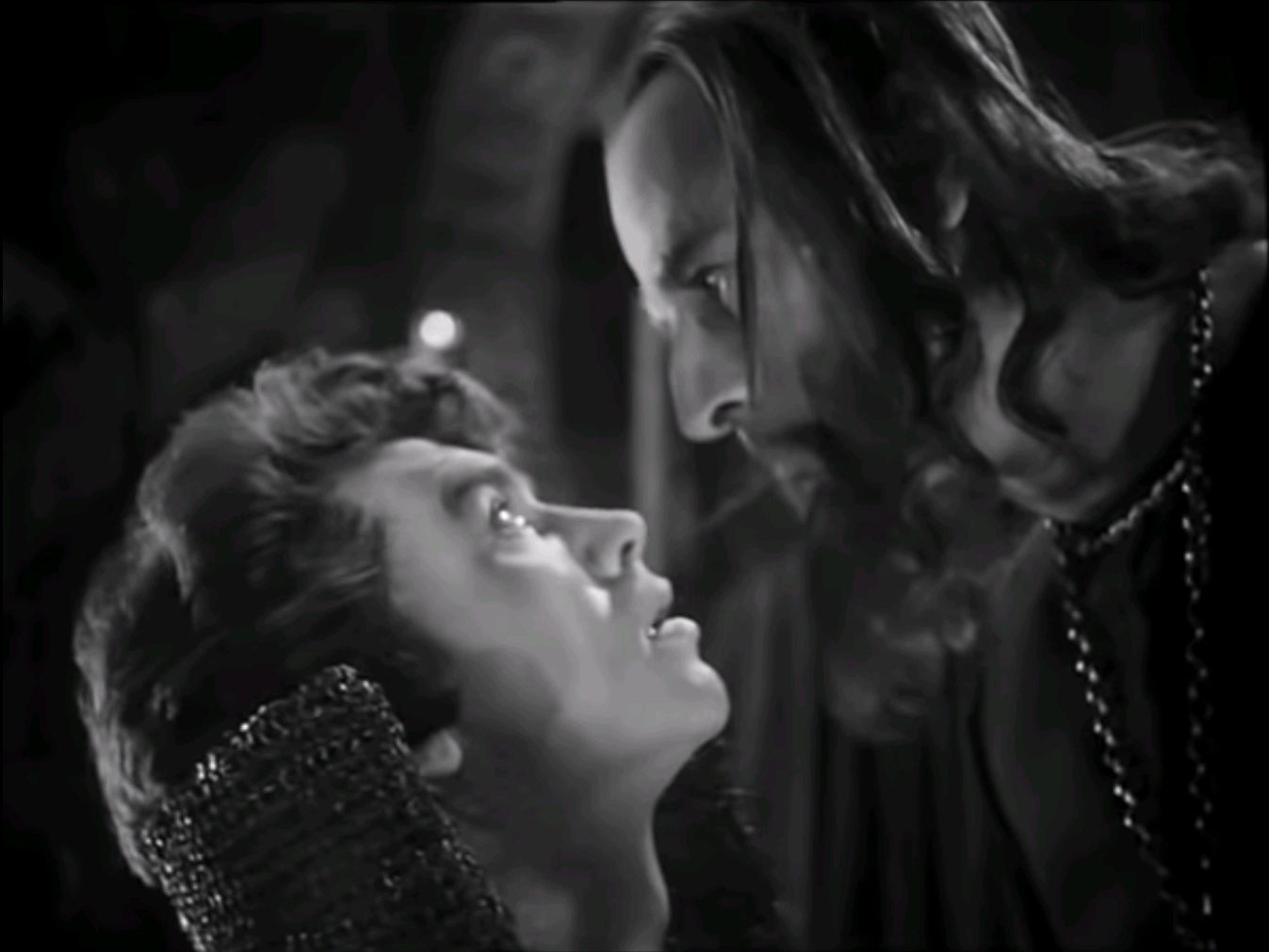
Image context: the lead image is an archival Mosfilm frame preserved on Wikimedia Commons, showing Ivan and Fyodor Basmanov facing one another in tightly controlled profile.[6] It is the right still for this essay because Eisenstein's method depends on turning people into pictorial forces. Even at close range, the image is not intimate in the everyday sense. It feels ceremonial, watchful, and already halfway abstract.
The face stops being natural and becomes an emblem
One of the strangest pleasures of Ivan the Terrible is that it barely pretends to naturalism. Hoberman stresses how telegraphic the performances are and how the film creates its own sign-system, with reaction shots reduced to eye movements and posture changes that intensify the atmosphere of jealousy and surveillance.[3] BFI makes a similar point in different language, describing the performances as highly stylized and almost operatic.[1] That combination is why Nikolai Cherkasov's Ivan does not read like a rounded historical personality first. He reads like a sovereign mask under constant stress.
Eisenstein repeatedly presents heads, beards, hands, and shoulders as if they were already icons or murals. Profiles matter especially. In a conventional historical drama, profile can be a passing angle; in Ivan, profile often feels like doctrine. It flattens the face into a hard, legible contour. The actor is still performing, but the performance is being converted into design. This is one reason the film feels closer to painted history than to biography. Ivan does not simply occupy the frame. He is cut into it.
That design choice also alters power relations within scenes. If a face is treated as an emblem, speech becomes secondary to placement. Who stands above whom, who leans inward, who glances sideways, who freezes first: these carry political information before the dialogue fully lands. Bordwell's emphasis on expressive movement is useful here because the movie does not need large action to stay dynamic.[5] A tilt of the head or a synchronized bow can feel as consequential as a cavalry charge.
Space turns politics into paranoia
Hoberman's best phrase for the film may be "chamber piece."[3] The conception is imperial, but the experience is claustrophobic. Instead of opening history out into a broad civic world, Eisenstein keeps forcing it back into cavernous interiors, twisting passages, and windowless rooms. Hoberman notes that much of the action unfolds in what feels like a subterranean maze, and BFI's page describes images so layered they demand repeated viewing.[1][3] The rooms are never just rooms. They are instruments for concentrating suspicion.
This is where the movie's wartime production context matters. Hoberman notes that much of the filming in Alma-Ata was done at night because electricity was limited during the war.[3] You can feel that pressure in the visual result. Darkness is not used only for mood. It behaves like a building material. Faces emerge from it, robes dissolve into it, and walls absorb it until the court begins to resemble a kingdom built out of accumulated secrecy.
The effect is political as much as aesthetic. BFI remarks that it is easy to see why Stalin initially responded warmly to Part I: Ivan's cruelty is framed as historically necessary for state consolidation.[1] But the same formal language that can monumentalize power also makes it look pathological. Once shadows stretch, corridors tighten, and servants or boyars appear as if they are always overhearing one another, the state stops looking solid. It starts looking hunted from within.
Gesture, music, and cutting make ceremony feel violent
The films contain battles, marches, coronations, and plots, but they often register less as action than as ritual under strain. Hoberman highlights the importance of Sergei Prokofiev's score and the way Eisenstein cuts on music or choreographed gesture rather than relying on ordinary narrative flow.[3] That helps explain why even static scenes feel volatile. Bodies are arranged as if they are about to break into procession, accusation, or liturgy. The court moves with ceremony, yet the ceremony keeps threatening to curdle into terror.
This is also why Ivan can feel unexpectedly modern. The film's politics are not delivered only through speeches about destiny or unity. They are built into timing. A pause can feel punitive. A synchronized turn can look like obedience becoming choreography. A crowd scene can freeze into a tableau so rigid that it resembles an emblem of mass submission rather than a slice of everyday life. Eisenstein had made montage his historical signature, but in Ivan he often gets comparable force from the collision between sculpted gesture and locked-down space.[3][5]
The result is a cinema of rule as performance. Power does not merely command. It stages itself, repeats itself, and watches itself being watched. That is why the movie's gestures feel doubled. They are actions inside the court, but they are also demonstrations about how a court teaches people to move.
The Part II red banquet turns style into accusation
If Part I monumentalizes Ivan, Part II makes monumentality poisonous. Criterion's edition notes that Stalin detested the second installment, especially its summary executions and secret-police atmosphere, and Rosenbaum argues that the later film's sexual and stylistic delirium pushed Eisenstein's project far beyond official comfort.[2][4] The most famous sign of that escalation is the color banquet sequence. Hoberman notes that it was shot on Agfa color stock captured from the Germans, and Rosenbaum describes the switch to color as the instant the film kicks into dizzying high gear.[3][4]
That sequence matters because it does not simply add visual luxury. It changes the moral temperature of the film. After so much black, silver, and shadow, the red-gold feast looks feverish, ceremonial, and rotten at once. Color enters not as release but as contamination. It is as if the court's hidden drives have finally stained the image itself. What had been expressed through line, shadow, and posture now floods outward through pigment.
This is the moment when the article's three terms meet: profile, shadow, banquet. Profiles make faces legible as doctrine; shadows make doctrine feel haunted; the banquet makes haunting spectacular. By the time Part II reaches that zone, the film is no longer balancing easily between glorification and warning. It is exposing how theatrical magnificence can serve cruelty precisely by making cruelty look ordained.[2][3][4]
Why the film still feels dangerous
Rosenbaum writes that Ivan the Terrible is one of the most complexly ambivalent works in cinema, simultaneously celebrating, critiquing, and analyzing Ivan, Stalin, and Eisenstein himself.[4] That ambivalence is why the film has stayed alive. If it were a simple state monument, it would now feel inert. If it were only a coded dissident tract, it might feel too neatly solved. Instead, it remains unstable because its form never stops asking whether political grandeur can be separated from political dread.
Seen now, the movie's real audacity lies in how completely it gives itself to excess. It does not stand above pageantry and mock it. It dives into pageantry until pageantry starts confessing its own violence. The faces are too sharp, the rooms too dark, the gestures too exact, the score too insistent, the banquet too red. Eisenstein keeps intensifying the artifice until artifice becomes evidence. Ivan the Terrible endures not because it offers a safe moral lesson about tyranny, but because it shows how tyranny can make itself beautiful, rhythmic, and almost sacred before the spell curdles into fear.[1][3][4][5]
Sources
- BFI, "Ivan the Terrible (1945)" film page, with notes on operatic performance, symbolic density, and Stalin's different responses to Parts I and II.
- The Criterion Collection, "Ivan the Terrible, Part I" edition page, with production context, credits, and the note that Stalin approved Part I but banned Part II.
- J. Hoberman, "Ivan the Terrible, Parts I and II," The Criterion Collection (2001).
- Jonathan Rosenbaum, "High and Low: Eisenstein's Ivan the Terrible," The Criterion Collection (2009).
- The Criterion Collection, "David Bordwell Shows How Eisenstein Broke the Rules of the Biopic," on expressive movement and the use of painting and dance in Ivan the Terrible, Part II (2018).
- Wikimedia Commons, "File:Ivan the Terrible and Fedor Basmanov.jpg," archival Mosfilm still from Ivan the Terrible used for the article image.