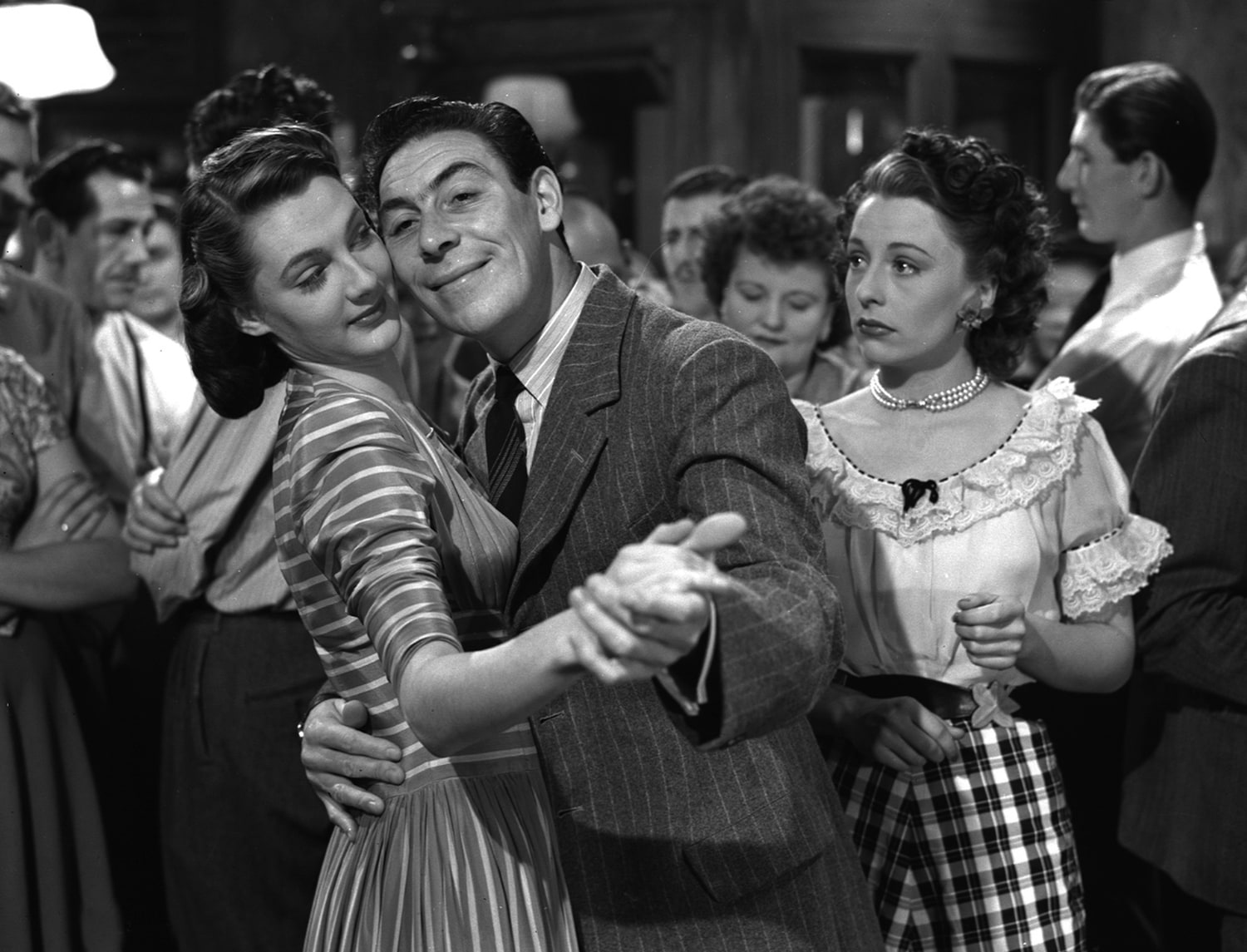
Discusses plot developments in all three films, including the ending of Passport to Pimlico.
A buried bomb goes off, and a London neighbourhood discovers that it belongs to Burgundy. In Passport to Pimlico (1949), the explosion uncovers both treasure and a document that releases a patch of the capital from British law. Henry Cornelius's comedy gives its residents an extraordinary opportunity: they can change countries without moving house.[1][5]
The joke needs a neighbourhood. One person's exemption might become a bureaucratic anecdote; a whole street's exemption becomes a way of life. People can agree, quarrel, trade, and improvise institutions together. That pleasure in collective invention connects Passport to Pimlico with two other Ealing comedies written by T.E.B. Clarke: Charles Crichton's Hue and Cry (1947) and The Lavender Hill Mob (1951).[2][3]
Their conspirators vary considerably. Children pursue criminals; householders pursue freedom; a respectable clerk pursues stolen gold. Across the three films, the excitement comes from watching people discover that everyday knowledge becomes powerful when they pool it.
A comic can be a map
In Hue and Cry, Joe, played by Harry Fowler, discovers that thieves are passing instructions through a children's comic. The police are unconvinced, leaving Joe and his friends to investigate. Reading something adults dismiss as childish gives the children an advantage. Their enthusiasm supplies the detective story with its energy.[4]
The adventure unfolds among London's bombsites and docks. As the BFI's programme notes explain, Crichton and Clarke deliberately sought actual locations; at Covent Garden, Joe must learn to balance a stack of baskets on his head. Work and play occupy the same city. Knowing its passages and routines matters as much as being brave.[2]
The climactic gathering of children also grew from a production idea. Associate producer Henry Cornelius imagined hundreds of boys taking over London, and Clarke built a story that could arrive at that spectacle. The eventual crowd transforms scattered local knowledge into visible strength. Yet the children make mistakes and argue; cooperation has to survive their personalities.[2]
The premise's debt to Emil and the Detectives, noted by the BFI, places this exuberance in a longer tradition of children organizing where adults fail to listen. Ealing gives that tradition a particular setting: a damaged city that its youngest inhabitants can still make adventurous.[4]
Freedom needs a water supply
Passport to Pimlico enlarges the unofficial club into a miniature country. Stanley Holloway's Arthur Pemberton and his neighbours welcome escape from postwar restrictions, including rationing. Their independence soon acquires governing machinery of its own. Mark Duguid's BFI notes point out how quickly the supposed anarchists organize a government, accept a duke, and pursue civic improvement.[5]
This is the film's most productive contradiction. Its residents want room to act, but their shared life requires arrangements that individual refusal cannot supply. A border makes sovereignty tangible; it also makes dependence harder to ignore. Freedom has to work at street level, where people need food and water.
The setting gives that problem physical weight. The film's Pimlico was largely a set built on a real bombsite in Lambeth, with surviving buildings around it. Adam Scovell's location study identifies the streets, railway crossing, and hydrant used in the action. When Londoners throw food to the besieged residents, the surrounding city becomes an active participant in their survival.[6]
The eventual return to Britain preserves the affection generated by rebellion while acknowledging its limits. Duguid reads the episode as a temporary holiday from austerity, followed by a return to the established order.[5] But the neighbours have also made their needs public. The comedy lets them experience the force of acting together, then places that solidarity within a larger community.
A second career in souvenirs
The Lavender Hill Mob gives collaboration a more acquisitive purpose. Alec Guinness's Henry Holland oversees deliveries of gold bullion. His acquaintance Pendlebury, played by Holloway, makes souvenirs. Together they see how one business can conceal the proceeds of robbing another: melt the gold into miniature Eiffel Towers and export it to France. Two professional criminals complete the team.[3]
The scheme makes occupational competence wonderfully disreputable. Holland's familiarity with routine and Pendlebury's equipment become complementary talents. The plan offers Holland a kind of promotion he can award himself, and friendship supplies the missing qualifications. Its appeal lies partly in seeing a disregarded employee become consequential.[3]
Crichton keeps this fantasy close to recognisable streets. The film follows bullion transport through a City of London still bearing bomb damage. Later, the pursuit of a schoolgirl who possesses one of the precious towers takes the conspirators into suburban roads; Scovell shows how the filmmakers used different angles on one location to suggest a larger district.[7]
That change of scale is delicious. A plan involving banks, furnaces, and international transport comes to depend on recovering a small object from a child. The conspirators can calculate the movement of gold more easily than the desires of everyone it passes through. Ordinary life keeps exceeding their organization.
The pleasure of joining in
These films describe a particular current within Ealing, whose output also included war films, thrillers, and horror. Even its comedies range into the murderous worlds of Kind Hearts and Coronets and The Ladykillers. As curator Mark Duguid argues, the studio's familiar genial reputation can obscure its darker work.[8]
The three Clarke comedies offer something more specific than a celebration of eccentricity. Each makes participation exciting. Watching a group assemble, allocate tasks, and find unexpected uses for familiar things invites us to imagine joining it. Their differing purposes keep that invitation morally unsettled: the same delight in ingenuity can serve justice, local independence, or theft.
Perhaps that is why the miniature Eiffel Tower belongs so comfortably beside Pimlico's border and Joe's comic. Each is an ordinary object newly charged with possibility. Someone has looked at the familiar world and seen a way to get other people involved.
Sources
- Rialto Pictures, Passport to Pimlico — distributor synopsis, credits, and official stills.
- Terry Staples and Mark Duguid, Hue and Cry. BFI Southbank programme notes, September 2024 — production history, locations, performances, and the comedy cycle.
- STUDIOCANAL, The Lavender Hill Mob. Vintage Classics — characters, the gold-smuggling scheme, and production credits.
- BFI Player, Hue and Cry — the children's investigation and the influence of Emil and the Detectives.
- Mark Duguid and Monthly Film Bulletin, Passport to Pimlico. BFI Southbank programme notes, March 2024 — austerity, civic organization, and the return to Britain.
- Adam Scovell, “Passport to Pimlico at 70: in search of the locations for the classic Ealing comedy.” BFI, April 2019 — the Lambeth set and the film's public spaces.
- Adam Scovell, “75 years of The Lavender Hill Mob: how the London locations look today.” BFI, June 2026 — bullion routes, bomb-damaged streets, and the schoolgirl pursuit.
- Mark Duguid, “Ealing: Light and Dark — an introduction.” BFI, November 2012 — the studio's wider range and the limits of its genial reputation.