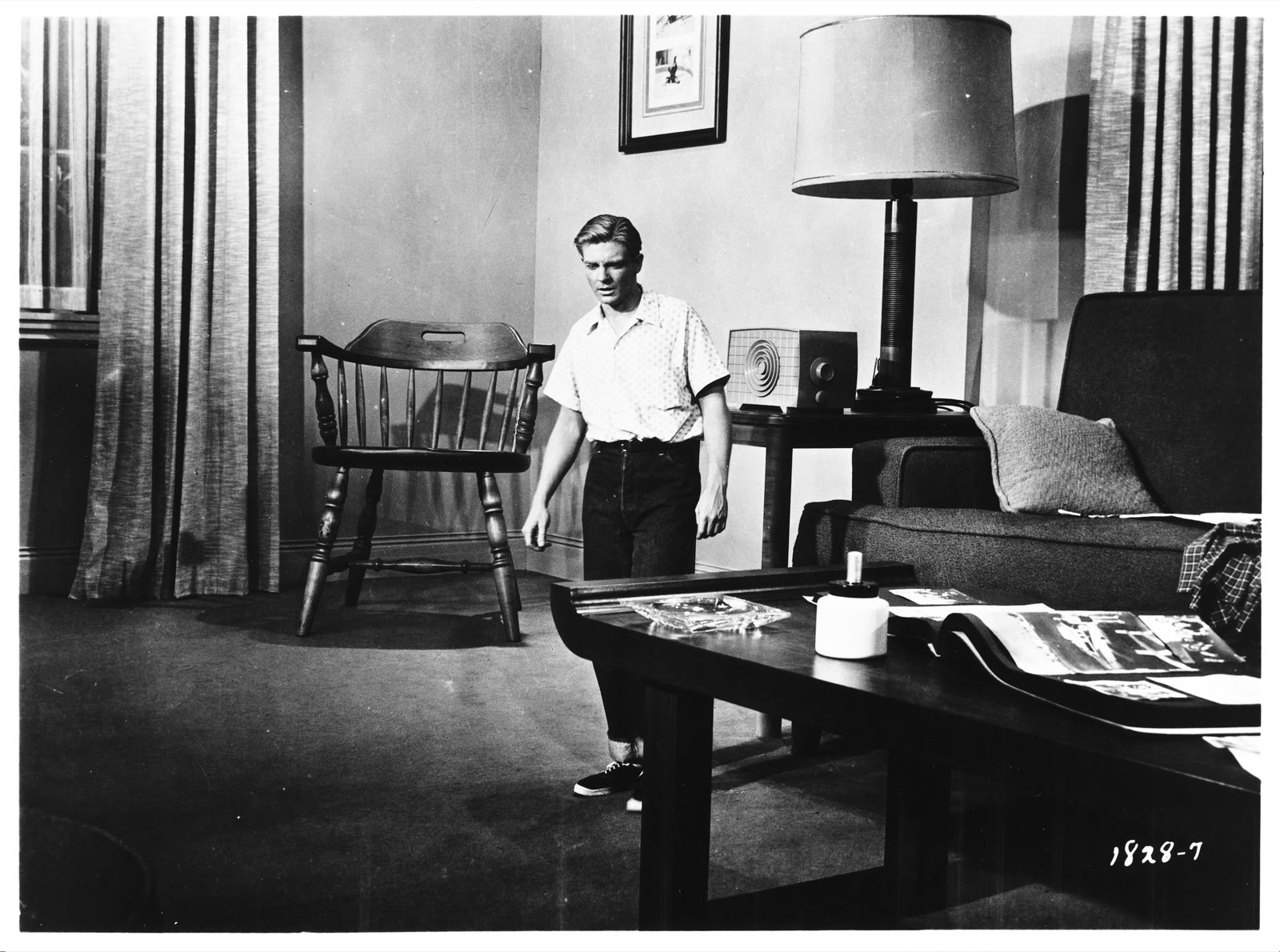
The Incredible Shrinking Man begins by asking how much shorter Scott Carey has become. It ends with a voice insisting that existence needs no measurement at all. Between those points, Jack Arnold's 1957 film makes one unit after another stop working. Clothes no longer fit, medical measurements describe without curing, a wedding ring drops away, furniture dwarfs its owner, a dollhouse counterfeits normality, and a window screen becomes the last border between the measurable world and the universe.[1][2]
That is the deeper purpose of the film's famous scale effects. They do more than make Grant Williams look small: they test the material comparisons that once certified him as husband, provider, homeowner, adult, and human being. Scott's body changes, but the film's real movement is the serial failure of the things used to place that body in a shared world. A person, Arnold suggests, lives inside relations of size. When those relations fail, identity becomes a problem no ruler can solve.
Spoiler note: this close reading discusses the film through its final images.
The first special effect is a bad fit
Arnold opens at sea, with Scott alone on the deck while his wife Louise goes below to fetch him a beer. A glittering mist passes over his body. Six months later, the first sign of catastrophe is almost insultingly modest: his clothes seem too large. The AFI catalog records that Scott has lost two inches before the medical inquiry begins, but the scene's force comes from how little cinema it initially requires. Fabric, a mirror, and the irritated rituals of getting dressed are enough.[2]
The sequence establishes the film's governing rule: scale is meaningful only through a relation. Scott cannot feel himself shrinking directly. He learns it because his trousers no longer testify to the body he thought he had. Soon the medical apparatus supplies measurements and a speculative cause—exposure to both insecticide and radiation—but it cannot restore the old relation between body and world. The white mist belongs to 1950s atomic unease; the terror arrives as tailoring.[1][3]
The wedding ring makes that logic intimate. Louise tells Scott that he remains her husband while he wears it, and then the ring slips from his finger. The shot is blunt enough to resemble a visual pun, yet it does something crueler than symbolize a threatened marriage. A ring is supposed to make an invisible bond materially legible. Here the material sign fails first. Scott's body has moved beyond the size for which the promise was made, and the film asks whether the relationship can survive without its familiar scale.
Furniture stops confirming adulthood
Once Scott is about three feet tall, the film no longer lets the living room behave as neutral background. In one of its sharpest reveals, Scott's brother speaks toward an armchair whose high back hides its occupant. The reverse shot finally exposes Scott sitting deep inside it, his legs barely extending over the seat. Geoffrey O'Brien notes how the gag catches viewers between laughter and shame: the composition makes Scott look ridiculous, then makes our pleasure in the trick resemble the gawking that torments him.[1]
That resemblance matters because Scott has sold his story to support the household. Reporters and strangers gather outside, turning private disaster into an attraction. The title's word “incredible” becomes the language of publicity rather than wonder. Scott is still inside his own home, but the windows and telephone no longer connect him to a social world; they let the crowd press in. The room has become an auditorium, and he is both exhibit and reluctant performer.[1][2]
The dollhouse sequence pushes the same unease further. Arnold first frames Scott at what appears to be normal size, then lets Louise's entrance reorganize the shot: her footsteps shake his room, and her kneeling body reveals that his apparent home is a miniature placed inside the real one. The effect does not merely compare large and small. It withholds the unit of measurement until the composition is already underway. What seemed like a room becomes an object in a room. The dollhouse can imitate walls, windows, and furniture, but it cannot restore the social equality those forms used to imply.
Scott responds to that loss of proportion with anger, especially toward Louise. The film does not excuse his cruelty, but it makes its spatial source visible. He can no longer meet her eye at standing height, move through the same doors, or occupy the furniture without assistance. A Harvard Film Archive program note and a BFI essay both place the film within postwar anxieties about masculinity and domestic authority.[4][5] That reading is persuasive because the house keeps materializing status: provider, husband, homeowner, and adult all turn out to depend on arrangements of height, money, privacy, and access.
The cellar invents local measures
After the family cat drives Scott through the basement door, Louise finds his bloodied clothing and assumes he is dead. For the human world, his story is over. For the film, a more radical story can now begin. Scott wakes in a sewing basket, climbs a ladder made from stacked thimbles, drinks from a leaking pipe, sleeps in an empty matchbox, loses food to a mousetrap, and uses thread with a bent needle to reach bread on a high ledge.[2]
These objects are not a parade of oversized novelties. Arnold gives each one a job, a danger, and a piece of geography. The stairs are not “big”; they are an impassable mountain that cancels the possibility of reunion. A drop of water is not decorative magnification; it must be timed and collected. Thread is first a climbing tool and later a route. The film's scale remains convincing because Scott has to learn the physics of it through labor.
The production effort served that clarity. AFI's history, drawing on studio materials, describes months spent developing the effects and records the use of giant props, including a twelve-foot sewing pin. Process photography could place a small figure against an ordinary room, while fabricated objects allowed Williams to push, climb, fall, and strike with visible weight.[2] The techniques matter less as secrets than as two complementary kinds of evidence: one shows a changed ratio; the other lets a body struggle inside it.
With no person left to observe him, Scott also regains something the upstairs scenes had taken away: action. He is no longer measured against his brother, wife, doctors, journalists, or curious strangers. Instead, he creates local units that answer immediate needs: a thimble is one step, a matchbox is one night's shelter, a pipe leak is one water source, and the thread's length is the difference between hunger and bread. The cellar converts humiliation into procedure. Its dangers do not care whether he fulfills the social role of a 1957 husband. They demand attention rather than authority.
That does not make the basement a simple realm of empowerment. Scott's battle with the spider is staged as miniature epic—rags for clothing, a pin for a spear, a ledge for a battlefield—but victory cannot stop his shrinking. Combat gives him a temporary measure of stature, then loses its authority as well. He defeats a monster and continues toward invisibility.
When every ruler disappears
The film is often described as a story of emasculation, and Scott's wounded command over Louise plainly supports that account.[3][4][5] Yet its form keeps widening beyond a single social diagnosis. If the film only punished threatened male authority, the cellar adventure would restore Scott by letting him become a warrior. Instead, the triumph over the spider proves provisional. Neither domestic command nor physical conquest can supply a permanent definition of the self.
This is why the succession of failed measures is so important. Each system offers Scott a way to understand what he is: the clinic makes him a patient, the ring a husband, the newspaper a public curiosity, and the cellar's improvised tools a survivor. Each identity works only while a set of objects and other people can recognize it. As he grows smaller, the film does not reveal one “true” Scott beneath those roles. It shows how personhood has been sustained by a network that once answered him at the expected size.
The final passage abandons that expectation. Small enough to pass through the mesh of the window screen, Scott enters the yard and looks up. Earlier key frames repeatedly contained a measuring device: cuff, ruler, ring, chair, dollhouse, stair, matchbox, pin. Now the night sky offers no adjacent object that can settle his size. The image moves from the extremely small to the immeasurably large, while the voice-over that has accompanied the story from its opening becomes the last stable trace of Scott.[1][3]
His closing realization is not that size never mattered. The whole film has demonstrated how brutally it matters within marriage, work, architecture, and danger. His realization is that human measurement is not the boundary of existence. “I still exist,” he concludes—not because he has regained the house, defeated scale, or returned to normal, but because the category of normal has finally lost jurisdiction.[1][3]
That ending would be merely grandiose if the film had not earned it object by object. Arnold gets to the cosmos through a trouser seam, a dropped ring, an armchair, a matchbox, and a piece of wire mesh. The Incredible Shrinking Man does not leave the ordinary world for metaphysics. It exhausts every ordinary guarantee of identity until existence itself is the only claim no measurement can cancel.
Sources
- Geoffrey O'Brien, “The Incredible Shrinking Man: Other Dimensions,” The Criterion Collection, October 20, 2021 — close analysis of the film's scale changes, voice-over, effects, spectatorship, and ending.
- AFI Catalog, “The Incredible Shrinking Man” — credits, release and production history, full synopsis, effects preparation, and giant-prop documentation.
- Barry Keith Grant, “The Incredible Shrinking Man,” Library of Congress National Film Registry essay — preservation context, Cold War and domestic readings, effects, and the final narration.
- Harvard Film Archive, “The Incredible Shrinking Man,” June 2003 — program note situating the film within postwar suburban and gender anxiety.
- Matthew Thrift, “10 great American sci-fi films of the 1950s,” BFI, October 30, 2014 — genre context and an interpretation of the film's domestic and masculine unease.
- Park Circus, “The Incredible Shrinking Man” — Universal catalogue record and source page for the promotional still used as the article image.