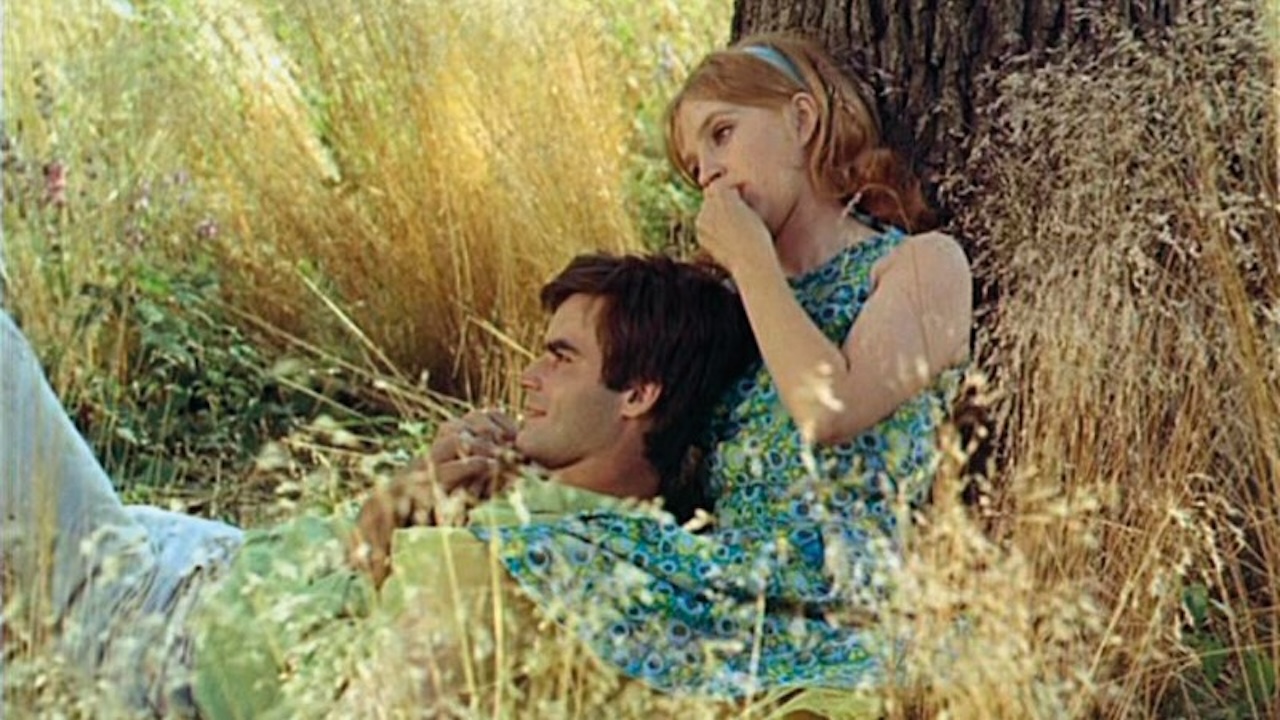
Agnès Varda's Le Bonheur (1965) still has the power to make viewers argue because it understands that beautiful images are easier to trust than beautiful arguments.[1][2] The film arrives wrapped in flowers, summer greenery, blond children, blue sky, and Mozart. Its married couple seem to inhabit an almost offensively complete pastoral life: work is steady, the apartment is orderly, the children are healthy, and the camera keeps returning to parks and picnic grounds that look less like ordinary leisure than like a preassembled ideal.[1][3] Varda does not introduce this world in order to reassure us. She introduces it in order to show how quickly a visual paradise can become an ethical cover.
That is why the film remains more cutting than many louder stories about infidelity. BFI's Varda guide gets to the center of it when it calls the film a depiction of "male utopia" in which women become interchangeable.[2] BFI's list of films about happiness adds another crucial word by treating Le Bonheur as one of cinema's sharpest ironic uses of the idea itself.[3] Those are not two separate readings. They are the same mechanism seen from different angles. The film's scandal is not simply that François cheats on his wife Thérèse. Its scandal is that he experiences his affair as an addition rather than a betrayal, and the surrounding world is arranged so beautifully that his logic can briefly seem frictionless.[2][4]
Varda makes that frictionlessness the true subject. The film's cruelty is not staged as eruption.[2][4] It is staged as continuity. One woman can be replaced by another without the furniture of happiness changing very much. The lawn is still green. The children still need lunch. The husband still smiles as if the world has merely expanded to accommodate his appetite.
Image context: the lead still shows the family stretched into a summer field, looking almost too balanced to disturb. It fits the essay because Varda wants that balance to register first as pleasure and only later as fabrication.[5]
The film's colors do not soften the critique; they industrialize it
The easiest mistake is to treat Le Bonheur as a trap whose sweetness eventually gives way to bitterness, as if the film first seduces and then reveals its real opinion. The harsher truth is that the sweetness is already the opinion.[2][3][4] Varda's famous color design does not decorate a critique that could have been delivered in any other style. It is the critique. BFI points out that she filmed in the lush gardens of Île-de-France, landscapes associated with Impressionist pleasure, and that "catalogue-style visuals" hint at a fabricated happiness.[2] That description matters because catalog imagery is not simply pretty. It is modular. It sells a life by arranging objects and bodies into convincing display.
That display logic is everywhere in the film. François, Thérèse, the children, the flowers, the trees, the meal cloth, the bicycle rides, the postal flirtation: everything appears with a cleanliness that makes life look pre-sorted into agreeable surfaces.[2][4] Senses of Cinema is right to call the film a cognitive-dissonance experiment and to emphasize the opposition between synthetic visual warmth and psychological coldness.[4] Varda is not hiding the coldness beneath the warmth. She is testing how much coldness warmth can carry before the viewer stops calling it happiness.
This is what makes the film's prettiness so unnerving. The colors are not expressive in the usual melodramatic sense. They do not flare up to announce guilt, panic, or breakdown. They keep doing almost the opposite. They insist on calm legibility. The world remains sunlit enough that François can interpret his desires as natural abundance rather than theft.[2][4] Varda thereby shows something uglier than hypocrisy. She shows a man whose self-description is internally consistent because the visual world around him has already been organized to flatter him.
François treats love like arithmetic, and that arithmetic is the film's horror
The central obscenity of Le Bonheur is not passion. It is bookkeeping. François does not behave like a man torn apart by two incompatible loves. He behaves like a man who has persuaded himself that happiness can be enlarged by addition.[4] One wife plus one mistress equals more life, more feeling, more brightness, more self. The idea is childish, selfish, and chillingly serene. Because Varda refuses melodramatic punishment cues for long stretches, the viewer has to sit inside that arithmetic and recognize how ordinary it sounds when spoken by someone who has never been required to imagine the full cost to others.[3][4]
That is where the film's treatment of women becomes decisive. BFI's phrase about women becoming interchangeable is not rhetorical exaggeration.[2] It is structural description. The film's terror lies in how substitution can occur without a corresponding collapse in domestic form. If happiness is defined through the continued centrality of François's needs, then the system can survive immense emotional damage as long as a woman remains available to absorb childcare, tenderness, listening, erotic validation, and the labor of making daily life appear coherent.[2][4][5]
Senses of Cinema names this mercilessly when it describes the pageant of male happiness and the film's alchemical conversion of mistress into wife and surrogate mother.[4] That is one of the coldest insights Varda ever put on screen. The film is not just about betrayal within a marriage. It is about a social fantasy in which women are asked to rotate through positions while male continuity remains the axis of meaning. The domestic machine does not break because, from François's point of view, it was never built around mutuality in the first place.
Mozart matters because the film refuses to make selfishness look vulgar
The Mozart score is essential for the same reason the summer fields are essential.[1][4] Varda does not want male entitlement to look brutish, because brutishness would make the moral problem too easy. She wants it to look cultivated, lyrical, and almost reasonable inside its own frame. That is how privilege often experiences itself. Not as domination, but as the pleasant extension of what already feels good.
This is why Le Bonheur can look anti-feminist to viewers who take François's world at face value.[2] Varda anticipated that risk and used it. The film does not keep interrupting him with external correction. It lets his worldview flower until the shape of the arrangement becomes unbearable. Beauty keeps returning, but each return makes the system look more merciless, not less. By the end, the film has not merely exposed a bad husband. It has exposed a whole visual culture of reassurance: the dream that enough grace, light, taste, and composure can turn asymmetry into innocence.[2][3][5]
That is why Le Bonheur remains so modern.[1][2][4] It understands that domination does not always announce itself through noise or grotesquerie. Sometimes it appears as atmosphere. Sometimes it arrives as a family photograph, a tasteful garden, a well-managed day, a man speaking gently about his increased happiness. Varda's achievement is to make that atmosphere legible without destroying its seduction. She shows how paradise can be manufactured, how quickly one woman's disappearance can be absorbed by the frame, and how devastating it is when a social ideal turns out to have been organized as a display case for one person's comfort all along.
Sources
- BFI, "Le Bonheur (1965)" film page with credits, running time, and poll context.
- Katherine McLaughlin, "Where to begin with Agnès Varda," BFI.
- David Morrison, "10 great films about happiness," BFI.
- Carloss James Chamberlin, "Drought de Seigneur: Le Bonheur," Senses of Cinema.
- BFI Southbank program still used for the cover image.