
The official Sony trailer for Lawrence of Arabia is useful because it sells the film almost exactly the way the film thinks: with distance first, explanation second.[1] It does not need to summarize every political turn in T. E. Lawrence's wartime story. Instead, it keeps returning to three cinematic facts: a human figure can become tiny against the desert, a face can suddenly fill the frame with theatrical force, and a cut can turn one small gesture into an entire landscape. That is why the trailer belongs in annotated-viewing form. It is not just a sales reel for a restored classic. It is a compact demonstration of David Lean's grammar.
The basic production facts are familiar but still worth keeping in view. Sony's film page identifies Lawrence of Arabia as David Lean's 1962 restored version, and Sony's restoration release calls it one of the crown jewels of the Columbia Pictures legacy.[2][5] BFI describes it as an epic in every sense, built around an eccentric English officer who helps inspire Arab revolt against the Turks during the First World War.[4] Panavision's historical account adds the crucial format anchor: Lean and cinematographer Freddie Young photographed the film in Super Panavision 70, a spherical large-format system that gave the desert both width and clarity.[3]
That format matters because Lawrence of Arabia is not simply large. It is large in a way that makes looking behave like risk. The desert is not background. It is a scale test. A rider can be visible and unreadable at once. A horizon can promise arrival while withholding it. A body can cross the frame and still feel nowhere near safety. The trailer's value is that it lets a viewer feel that pressure without requiring the whole nearly four-hour roadshow experience. It shows how the film converts geography into suspense, status, and self-invention.
The trailer starts with monumentality, but the film's subject is instability
The opening promise is grandeur: a legendary title, widescreen desert space, cavalry movement, military stakes, and Maurice Jarre's swelling score.[1] That surface is real. Sony notes the film won seven Academy Awards, including Best Picture, Best Director, Best Cinematography, Best Film Editing, Best Music, and Best Sound.[2] If one only listed those honors, though, the movie would sound like a sealed monument, a prestige object to admire from a distance.
The trailer shows something less settled. Its images keep forcing a question: is scale making Lawrence more powerful, or is it revealing how fragile his power is? Peter O'Toole's performance, which BFI singles out as strange and fascinating, is central to that uncertainty.[4] He does not move through the trailer like a stable hero who already knows what history needs from him. He appears theatrical, exhilarated, isolated, and watched. The white robes are not only costume; they are a screen on which other characters, empires, and Lawrence himself project meaning.
That is why the desert matters as more than spectacle. In a smaller format, the viewer might read the journey as a sequence of plot points. In Super Panavision 70, the journey becomes a contest between desire and distance.[3] The frame can make Lawrence seem chosen in one shot and absurdly exposed in the next. The trailer's quick shifts between mass movement and solitary figures preserve that contradiction. It says, in effect: this is an epic, but its epic form is not reassurance. It is the mechanism that makes identity unstable.
Watch for the match cut as a theory of cinema
The trailer includes the film's most famous formal idea: the cut from a blown-out match to sunrise over the desert.[1] The moment is often praised as one of the great edits in cinema, but its force is not only elegance. It makes the film's central scale jump in an instant. A private gesture becomes planetary light. A tiny flame becomes a horizon. A room gives way to heat, time, and danger.
That cut also explains why Lean's cinema is not just "beautiful." Beauty here has a job. The edit tells the viewer that the film will move between inner drama and vast exterior space without treating them as separate zones. Lawrence's self-image, imperial command, Arab revolt, military logistics, and desert travel are all going to touch each other through form. The cut is not decoration. It is an argument about proportion.
The restoration history sharpens the point. Sony's 2013 note says the 4K restoration was completed under Grover Crisp's direction and received FOCAL recognition for archive restoration and preservation.[5] Restoration is not merely a home-video upgrade in this case. A film built on tiny gradations of heat, dust, white cloth, shadow, and horizon needs clarity because its meanings live in scale relationships. If the desert becomes mush, the argument weakens. If faces lose texture, the theatricality becomes flatter. If the wide shots lose depth, the journey becomes postcard grandeur instead of lived risk.
Faces keep interrupting the landscape
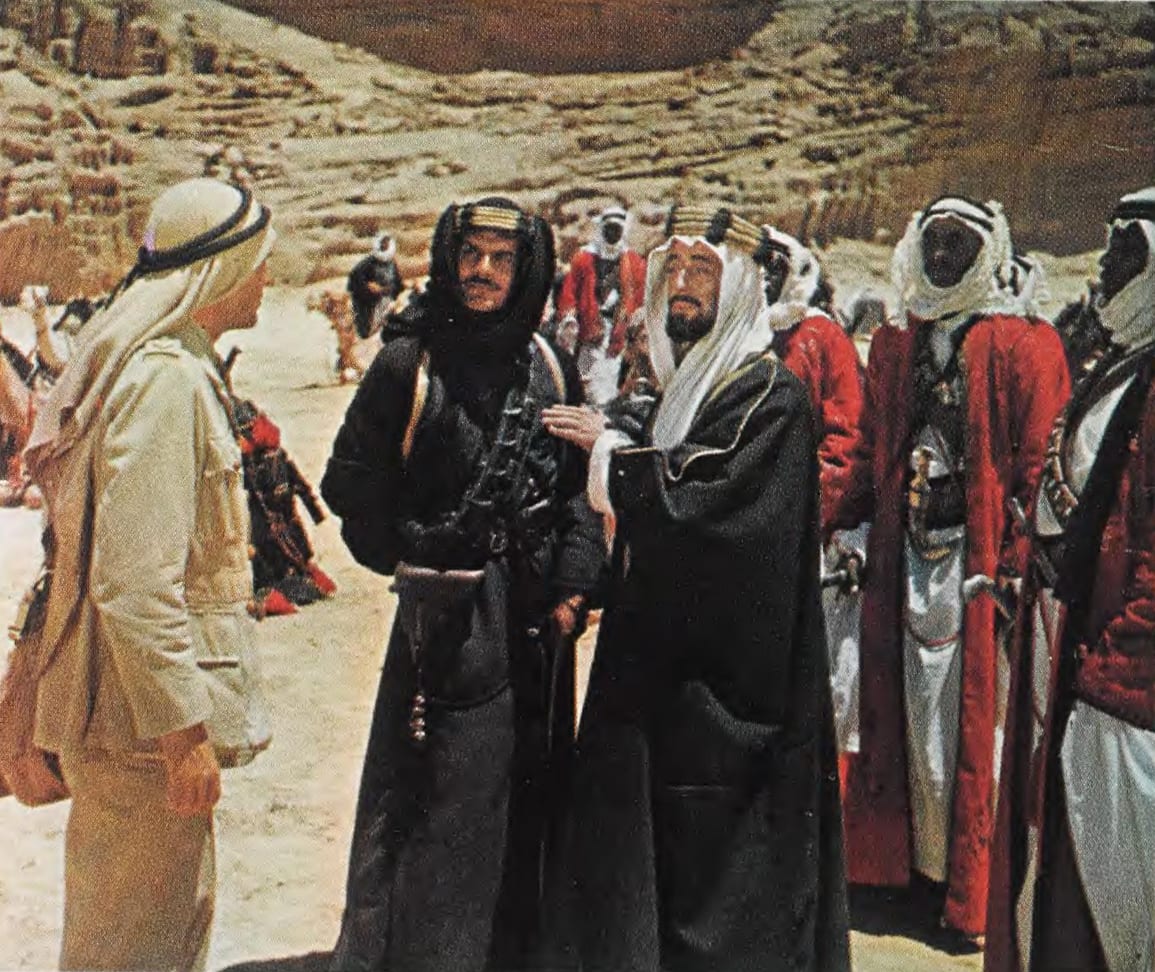
The lead image for this article, a real 1962 film-publicity still from Movie Pictorial, shows Alec Guinness and Omar Sharif in costume rather than the film's most famous desert vista.[6] That choice is deliberate. Lawrence of Arabia is often remembered through its horizons, but the trailer keeps interrupting horizons with faces. The film needs both. The desert makes people small; close-ups make them politically and psychologically dangerous again.
Sharif's entrance, suggested in trailer fragments and famous in the full film, depends on this oscillation. A far-off figure slowly becomes a person, then a social force, then an ethical challenge. The viewer is trained to wait for information to cross space. Guinness's Prince Faisal works differently. His face and voice bring courtly calculation into a film that might otherwise be swallowed by movement. The still captures that counterweight: costume, gaze, and posture turn spectacle back into negotiation.[6]
This is the trailer's strongest lesson for modern viewers who know the film mainly by reputation. The movie is not great because it is long, expensive, or panoramic. It is great because its panoramic method changes the value of a face. After the desert has taught us how small a person can be, a close-up becomes charged with command, vanity, doubt, and strategy. Space and performance keep correcting each other.
Roadshow scale makes time part of the image
BFI's film page calls the work epic in every sense, and that wording matters.[4] The original roadshow culture around films like Lawrence of Arabia asked audiences to give a movie an evening, not just a slot. Overture, intermission, and large-format projection were part of the experience. The trailer can only hint at that pacing, but it still carries the residue: long approach, processional movement, ceremonial composition, and the sense that decisions take time because space must be crossed before they become real.
That is different from mere slowness. The film's time is logistical. Camels, trains, armies, messengers, and desert crossings turn duration into pressure. The trailer's rapid montage cannot reproduce the full weight of that duration, but it does show the materials: sand, sun, bodies, weapons, robes, rail lines, and the repeated contrast between command language and physical exposure.[1] Watching the trailer closely, one can see how the feature's grandeur is built from delays. The film makes us wait because waiting is the cost of distance.
The official trailer is therefore best read as a miniature map of the whole work. It tells us to look for the way form thinks: large format as moral scale, editing as transformation, faces as political interruption, restoration as preservation of spatial meaning, and roadshow pacing as dramatic pressure.[1][3][5] Lawrence of Arabia still feels dangerous because it refuses to let distance stay neutral. Every horizon asks who has the right to cross it, who will be changed by crossing it, and who will be left exposed when the image finally arrives.
Sources
- Sony Pictures Entertainment, "LAWRENCE OF ARABIA 1962 - Original Trailer (HD) | Now on 4K Ultra HD," YouTube video.
- Sony Pictures Entertainment, "Lawrence of Arabia" official movie page.
- Panavision, "History & Awards" - notes on Lawrence of Arabia being photographed by Freddie Young in Super Panavision 70.
- BFI, "Lawrence of Arabia (1962)" film page.
- Sony Pictures Entertainment, "Restored Lawrence Of Arabia Wins Focal International Award," May 6, 2013.
- Wikimedia Commons, "File:Lawrence-of-Arabia-2.png" - 1962 Lawrence of Arabia image source from Movie Pictorial / Eiga Joho.