Spoiler note: this essay discusses the film's central threat, the stalking sequences, and the ending of Cat People.
Jacques Tourneur's Cat People begins with a title that sounds almost impossible to rescue. RKO wanted a marketable horror picture; Val Lewton was given the title, a small budget, and the task of making something that could compete with more explicit monster movies.[1][2] The result, released in 1942 and running about 73 minutes, is still startling because it does not behave like a film trying to prove that its monster exists.[1][3] It behaves like a film trying to prove that fear can become stronger when the image withholds proof.
That is the craft achievement. Cat People does not merely save money by hiding the panther. It turns hiding into form. Irena Dubrovna, the Serbian-born fashion designer played by Simone Simon, believes that sexual desire or jealousy may transform her into a killing cat.[2][3] A crude version of the premise would stage transformation as spectacle. Tourneur, Lewton, cinematographer Nicholas Musuraca, editor Mark Robson, and writer DeWitt Bodeen do something more precise: they make the spectator complete the transformation through shadow, silence, off-screen space, and abrupt sound.[1][2] The film's monster is not absent. It is distributed across technique.
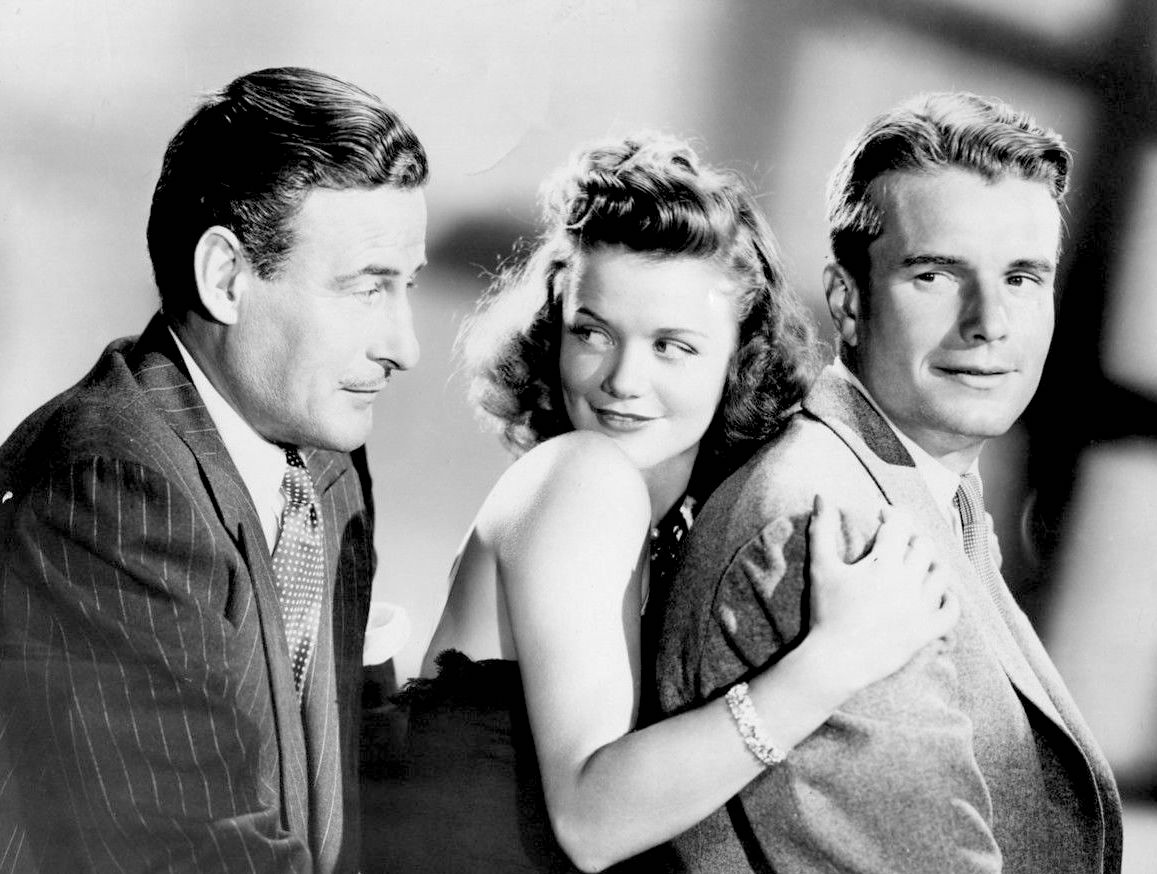
The B-picture limit becomes the governing rule
The production circumstances matter because the film's style is often romanticized as pure elegance. AFI records Cat People as Lewton's first production for RKO's low-budget horror unit and notes the studio's $150,000-per-film allotment.[1] BFI gives the same budget figure and emphasizes that RKO supplied Lewton with the title and left him to make the rest.[2] Those facts explain the pressure but not the solution. Low budgets can produce flatness, corner-cutting, or overcompensation. Cat People instead builds an aesthetic in which every expensive thing not shown becomes an active pressure on the frame.
This is why the film does not feel like a monster movie that lacks a monster. It feels like a movie about the conditions under which a monster might be imagined. The zoo panther, Irena's apartment, the drafting room, the Central Park walk, and the swimming pool all work as controlled spaces where a viewer is asked to read edges. Doorways, stairwells, trees, and water reflections become suspicious because the film teaches us that the visible world is incomplete.[2][4]
Lewton's method was not only thrift. BFI describes his horror as built around fear of the unseen, with much of the action displaced off-screen and made suggestive rather than showy.[2] That sentence is almost a production manual for Cat People. The film's restraint is not polite. It is coercive. It forces the audience into collaboration, and then makes that collaboration feel morally uncomfortable. We are not just watching Irena be suspected; we are supplying some of the images that condemn her.
Shadow does not decorate fear; it delegates it
Britannica's compact summary names the film's "shadows and low lighting" as central to its suspense, and that is the right starting point.[3] But the key is how little the shadows settle. A shadow in Cat People rarely operates as a simple clue. It is an invitation to misrecognize. Is it foliage, a passing shape, the panther, Irena's body, or the viewer's expectation returning as image?
ValLewton.org preserves a useful production anecdote: Tourneur could create some shadow effects by placing his hand in front of arc lamps, letting a vague shape enter the scene and letting the story's pressure teach the viewer what to see there.[4] Whether one treats the anecdote as technical lore or exact production memory, it describes the film's principle with unusual clarity. The shadow is not the monster; the shadow is a prompt. It gives the audience just enough material to project the monster into place.
That projection matters because Irena is caught between incompatible readings. Oliver wants a wife who can be folded into ordinary American domestic life. Dr. Judd wants a patient he can analyze and, finally, possess. Alice becomes both rival and victim, but also the character whose terror makes the film's sound-and-shadow system most legible.[1][2] Irena's fear may be delusion, curse, trauma, erotic panic, immigrant loneliness, or some unstable mixture of all of them. The film's craft refuses to flatten those meanings into a single answer.
The low-key look also keeps Irena from becoming merely exoticized spectacle. Simone Simon's performance is stylized, but the film often protects her by letting her fear remain partly private. When she stands near the panther cage or moves through apartment interiors, the lighting makes her appear both exposed and unreadable. The horror does not come from seeing too much of her. It comes from realizing how many people in the film believe they have the right to interpret her.
Sound becomes the cut that proves the shadow worked
If the shadows ask the audience to imagine, the sound design punishes that imagination. The Central Park stalking sequence is the film's most famous example. BFI identifies it as the source of the "Lewton Bus": a character believes she is being followed, silence and tension mount, and then a bus arrives with a sudden hiss that converts expectation into shock.[2] The scene's importance is sometimes reduced to the history of the jump scare, but its deeper lesson is structural. The sound cue works because the film has already trained the eye to distrust empty space.
The bus is not a cheap interruption. It is a proof of method. For several minutes, the viewer scans darkness, trees, street edges, and negative space for a shape that may not be there. When the bus erupts, the shock is partly auditory and partly ethical. We are startled by the bus, but also by our own readiness to believe in the unseen animal. Tourneur and Lewton make the audience's interpretive hunger audible.
The swimming pool sequence extends the same system in another register. Water throws broken light onto walls. Alice is isolated, nearly undressed, and surrounded by echoes. The film withholds the animal again, but sound and reflection create a space where a panther can seem present without becoming fully visible. The danger is not just that something may leap into frame. The danger is that the room itself has started behaving like an organism: breathing, shimmering, answering Alice's fear back to her.
This is why the film still feels modern. Many later horror films borrow the false alarm without borrowing the discipline that makes it work. In Cat People, sudden sound is effective because silence has been given narrative weight. A hiss, a growl, a splash, or an animal cry does not simply punctuate suspense. It completes a chain that began with withheld sight.
The monster is a social arrangement
The film's supernatural ambiguity would be thinner if the surrounding human world were neutral. It is not. BFI notes that the film remains credible because it anchors its outlandish premise in ordinary working life and complex characters, while putting Irena's mental state at the center of an early psychological-horror structure.[2] That is why the drafting office, therapy room, restaurant, and apartment matter as much as the zoo. Horror emerges from social handling: how Oliver explains Irena, how Alice fears and competes with her, how Judd turns care into control.
Britannica summarizes the premise as Irena's fear that intimacy will trigger transformation, and also notes that the film avoids showing her in cat form, relying instead on suggestion and the viewer's imagination.[3] The two points belong together. Intimacy is the trigger inside the story; suggestion is the trigger inside the form. The film is built so that desire and spectatorship mirror each other. The closer the characters press for certainty, the more dangerous the image becomes.
That is the reason Cat People outlasts its title. It is not a joke accidentally improved by atmosphere. It is a rigorous lesson in how genre can be made from limits. RKO's title demanded a creature; Lewton and Tourneur answered with a system. Low-key lighting made the frame incomplete. Off-screen space made absence active. Silence turned waiting into dread. Sudden sound exposed the audience's complicity in filling the dark. The panther remains frightening because the film understands that a monster shown too clearly belongs to the screen, while a monster half-built by the viewer can leave the theater with you.[2][3][4]
Sources
- AFI Catalog, "Cat People (1942)" - credits, release data, production history, Lewton unit context, and low-key horror notes.
- Alex Barrett, "Where to begin with Val Lewton," BFI, 2017 - overview of Lewton's RKO horror cycle, Cat People budget, psychological-horror framing, and the Lewton Bus.
- Lee Pfeiffer and Britannica Editors, "Cat People," Encyclopaedia Britannica - film summary, credits, and note on shadows, low lighting, and suggestion.
- ValLewton.org, "Cat People 1942" - production dates, release notes, and discussion of Tourneur and Lewton's suggestive lighting-and-shadow strategy.
- Wikimedia Commons, "File:Cat People promotional still - Tom Conway, Simone Simon, and Kent Smith.jpg" - 1942 promotional still used as the article image.