Alfred Hitchcock is one of those directors who gets made smaller by his own fame. "Master of suspense" is not wrong, but it is too neat.[1][2] It makes him sound like a specialist in shocks, reversals, and branded nervousness, as though the main question were simply how cleverly he could hide a killer behind a door. A better way to read him is through the mechanics he keeps returning to across decades. Hitchcock builds windows that turn viewers into accomplices, props that carry the pressure of an entire scene in one hand, and domestic spaces that become dangerous without ever ceasing to look ordinary.[1][3]
That is why his films still feel modern even when their plots are famous in advance.[1][2][3] The surprise is never the whole point. Hitchcock's stronger gift is audience direction. He keeps deciding where we look, how long we look, what we know before the character knows it, and what tiny material detail will suddenly start carrying moral weather. A courtyard, a key, a staircase, a teacup, a shower curtain, a pair of binoculars: in his cinema, these are never background. They are the routing system through which fear travels.[1][4][6]
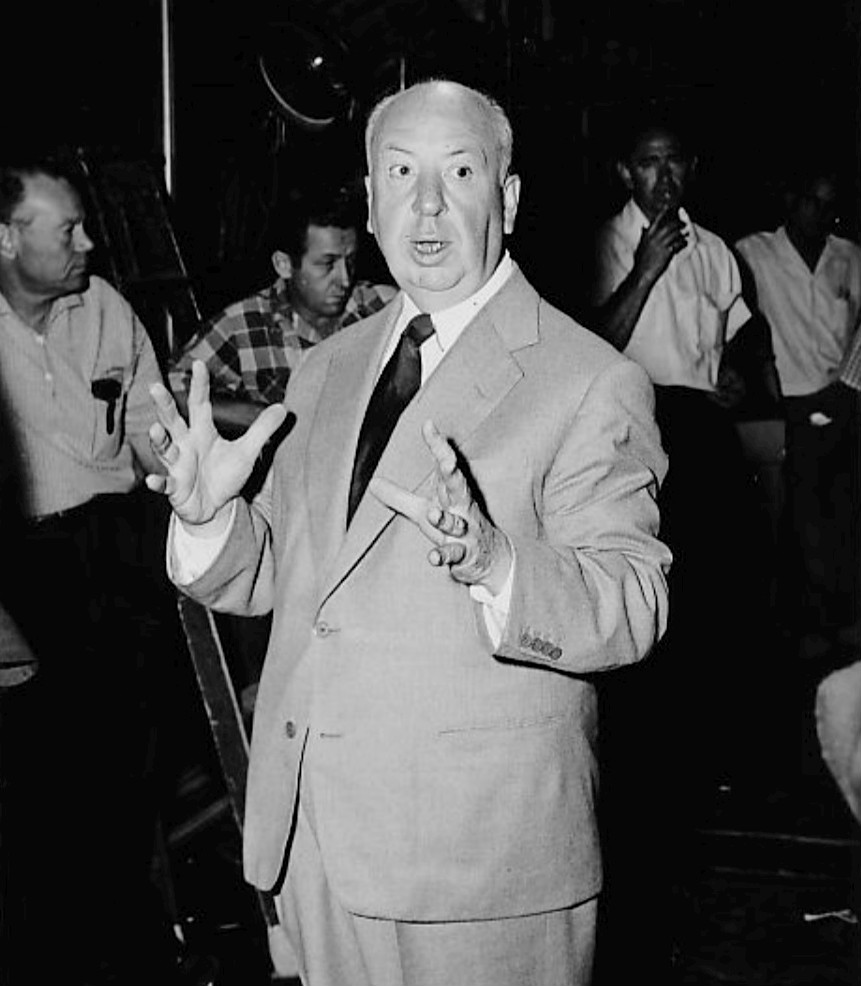
Image context: the lead image uses a real 1955 archival photograph of Hitchcock preserved on Wikimedia Commons.[10] It fits this essay because the argument is about his method across multiple films rather than one title. The raised hands make him look like he is measuring invisible volume in the air, which is close to what his best scenes do: they measure exactly how much room anxiety needs before it can harden into suspense.
1. Hitchcock directs the audience before he directs the scene
The cleanest starting point is Hitchcock's own writing. In his 1937 essay "My Own Methods," he describes cinema as a medium built from planning, visual fragmentation, and controlled point of emphasis rather than loose theatrical coverage.[1] That matters because it clarifies what his reputation often blurs. Hitchcock is not simply a director who liked thrillers. He is a director who keeps breaking dramatic situations into pieces the camera can ration with precision: what the audience sees, what it withholds, what it receives a beat early, and what it is forced to notice too late.[1][2]
The BFI profile and archival production feature help place that method in a long career rather than a few canonical late films.[2][3] From the silent British thrillers onward, Hitchcock keeps treating cinema as an instrument for shaping mental attention. Sets, stairways, miniatures, rear projection, storyboards, and special effects are not decorative supplements in his work. They are ways of turning feeling into spatial design.[2][3] Even when he later became a television celebrity with a highly recognizable silhouette and voice, the real signature remained technical: he wanted the audience's nerves to be produced by arrangement, not by vague atmosphere alone.[1][3]
This is why Hitchcock's brand can be misleading. The familiar cameo, the macabre wit, the blondes, the murders, the public image of the puppeteer: all of that is real. None of it explains enough. What lasts is the rigor with which he converts ordinary cinematic information into a system of pressure. He wants us to inhabit an angle, a route, a delay, a partial view. Suspense in Hitchcock is less a genre than a way of distributing access.
2. Windows make spectatorship feel guilty
Rear Window is still the clearest demonstration of Hitchcock's belief that looking is never innocent.[4][5] The premise is disarmingly simple: a photographer with a broken leg sits in his apartment and watches the neighboring block. Yet the film does not treat that window as a neutral opening onto reality. It turns the courtyard into a field of framed lives, each apartment a little theater, each glimpse a temptation. BFI's film note is right to emphasize obsession, image-sizing, and the danger of the gaze, while John Belton's National Film Registry essay pushes the idea further by tying Jeff's voyeurism to the film's romantic conflict, not just the murder puzzle.[4][5]
That connection is the real Hitchcock move. The camera does not merely show Jeff watching others; it makes the audience feel the seduction of detached looking and then exposes the cost.[4][5] Jeff prefers distance, lenses, and inference. Lisa keeps asking for reciprocal attention in the same room. The thriller works because Hitchcock turns this emotional failure into a visual structure. The apartment across the way becomes easier for Jeff to read than the woman beside him. When Lisa finally crosses the courtyard and enters the danger herself, the murder mystery and the love story stop being separate tracks.[5]
This pattern runs far beyond one film. Hitchcock repeatedly asks the audience to enjoy surveillance before making that enjoyment embarrassing. His camera courts curiosity and then stains it. That is one reason the films stay sharp after the plots become cultural common property. Even when you know what happens, the scenes still make you experience the pull of looking where you should not.
3. Keys, staircases, and heights turn desire into logistics
If Rear Window shows Hitchcock's method at the level of spectatorship, Notorious and Vertigo show how he can condense whole dramas into one prop or one vertical route.[6][7] The BFI note on Notorious describes the film's party sequence with admirable clarity: champagne dwindles upstairs while Alicia and Devlin try to search the cellar below, and a single key becomes the object that governs the entire house.[6] Hitchcock's genius here is scale conversion. A grand party exists so that one tiny piece of metal in one woman's hand can feel catastrophic. Romance, espionage, and household etiquette are all routed through the same object.
Vertigo works by a related but harsher logic.[7] Thomas Leitch's National Film Registry essay treats the film as Hitchcock's most ambitious and autobiographical work, a story of possession, remaking, and dreamlike control.[7] What matters for this profile is how insistently the film turns vertical movement into psychic design. Towers, stairs, slopes, and falls are never simply locations. They are machines for converting desire into panic. Scottie's fear of heights is not an isolated trait pasted onto a detective story. It is the formal principle that makes pursuit, rescue, fantasy, and failure occupy the same line of movement.[7]
Hitchcock is often discussed as a master of plot mechanics, and he is one. But these films show something deeper. He understands that objects and routes can do emotional work that dialogue cannot. A key can carry betrayal, erotic trust, and mortal risk all at once. A staircase can become ambition, weakness, recurrence, and doom in a single image. Instead of announcing meaning, Hitchcock lets material things bear it.
4. The household is where his cinema stops pretending to be safe
Psycho feels like a rupture in Hitchcock's career because it strips away prestige surface and reveals how little he actually needed in order to produce terror.[3][8][9] The National Film Registry essay notes the film's shocking release strategy and the way its two great surprises altered the audience's contract with the thriller.[8] The BFI shower-scene feature adds a more practical lesson: the sequence becomes legendary not because it literally shows everything, but because editing, sound design, viewpoint shifts, and layered voyeurism convince the mind that it has seen more than the camera provides.[9]
This is Hitchcock at his most mercilessly efficient. A cheap motel office, a peephole hidden behind a painting, a bathroom, a curtain, a drain, a staircase up to the house: none of these spaces are grand, and none need to be.[8][9] He has spent an entire career proving that suspense intensifies when danger enters rooms designed for routine. The home, the hotel, the parlor, the kitchen, the stair landing, the dining table, the bedroom door, the cup in a guest's hand: Hitchcock keeps returning to these spaces because they carry trust in advance. Once that trust is poisoned, the room does not stop being recognizable. It becomes worse because it remains recognizable.[6][8][9]
That is why Hitchcock's violence rarely needs spectacle on the scale later thrillers chase. He is stronger when fear arrives through procedure. Marion Crane checks in, speaks politely, eats with Norman Bates, returns to her room, and begins an ordinary private act. The scene does not need a gothic castle because the bathroom already contains everything he needs: enclosure, exposure, plumbing noise, white surfaces, and one curtain that can stop being a boundary in an instant.[8][9]
5. Why Hitchcock still teaches
Hitchcock remains inexhaustible because he makes formal intelligence feel physical.[1][2][7] Many directors can stage suspenseful events. Fewer can make the audience feel that suspense is embedded in how a room is built, how an object changes hands, how a sightline opens, or how a staircase rises out of the frame. His films teach that emotion does not float free of material arrangement. Fear, desire, guilt, curiosity, and shame are all routed through concrete things.
That is the thread connecting the window in Rear Window, the key in Notorious, the vertical pull of Vertigo, and the bathroom in Psycho.[4][5][6][7][8][9] Hitchcock keeps making us discover that looking is active, that props are never innocent, and that domestic space is only a temporary truce with danger. Once you see that, "master of suspense" starts to sound like the trailer version. The fuller truth is harder and more interesting. Hitchcock was a director of audience complicity. He knew how to turn ordinary habits of seeing into moral exposure, and he built a cinema where the smallest room could suddenly feel like a trap.[1][3][9]
Sources
- Alfred Hitchcock, "Alfred Hitchcock: my own methods," Sight and Sound / BFI.
- BFI, "Alfred Hitchcock" profile page.
- Josephine Botting, "On set with Alfred Hitchcock," BFI.
- BFI, "Rear Window (1954)" film page.
- John Belton, "Rear Window" essay PDF, National Film Registry / Library of Congress.
- BFI, "Notorious (1946)" film page.
- Thomas Leitch, "Vertigo" essay PDF, National Film Registry / Library of Congress.
- Charles Taylor, "Psycho" essay PDF, National Film Registry / Library of Congress.
- BFI, "10 things you (probably) never knew about the shower scene in Psycho."
- Wikimedia Commons, "File: Alfred Hitchcock 1955.jpg."