Spoiler note: this essay discusses major scenes and the ending of the film, including Juliette's departure for Paris and Jean's underwater vision of her.
People often remember L'Atalante (1934) through its most lyrical fragments first: the bride in white gliding down the deck, Michel Simon's marvelous chaos as Pere Jules, the floating dream of Juliette beneath the water, the sense that a freight barge has somehow become a vessel for cinema itself.[1][2][4] All of that is real, but the film's deepest achievement is more structural. Jean Vigo never treats marriage as a stable home newly acquired. He treats it as a moving medium. The barge is where Jean and Juliette are supposed to become a couple, yet it never stops reminding them that intimacy is subject to current, routine, jealousy, labor, weather, and boredom. In L'Atalante, love does not begin with settled domesticity and then suffer disruption. It is born inside motion, and that motion keeps testing whether tenderness can survive being carried downstream.[1][2][5]
That is why the film feels both earthy and enchanted at once.[1][3][4] Janus calls it an "achingly romantic reverie" and also a clear-eyed meditation on conjugal love; the Gaumont and BFI notes place the young couple in a world of barge labor, routine, and working waterways even as Vigo opens space for fantasy, erotic longing, and surreal image-play.[1][2][3][5] The result is not a neat balance between realism and dream. It is a cinema where the physical facts of barge life create the pressure that makes dream necessary. Juliette's restlessness, Jean's possessiveness, Pere Jules's anarchic warmth, and the river's strange magnetism all belong to one emotional geography. The movie's poetry is persuasive because Vigo anchors it in material conditions before he lets it drift into desire.[2][4][5]
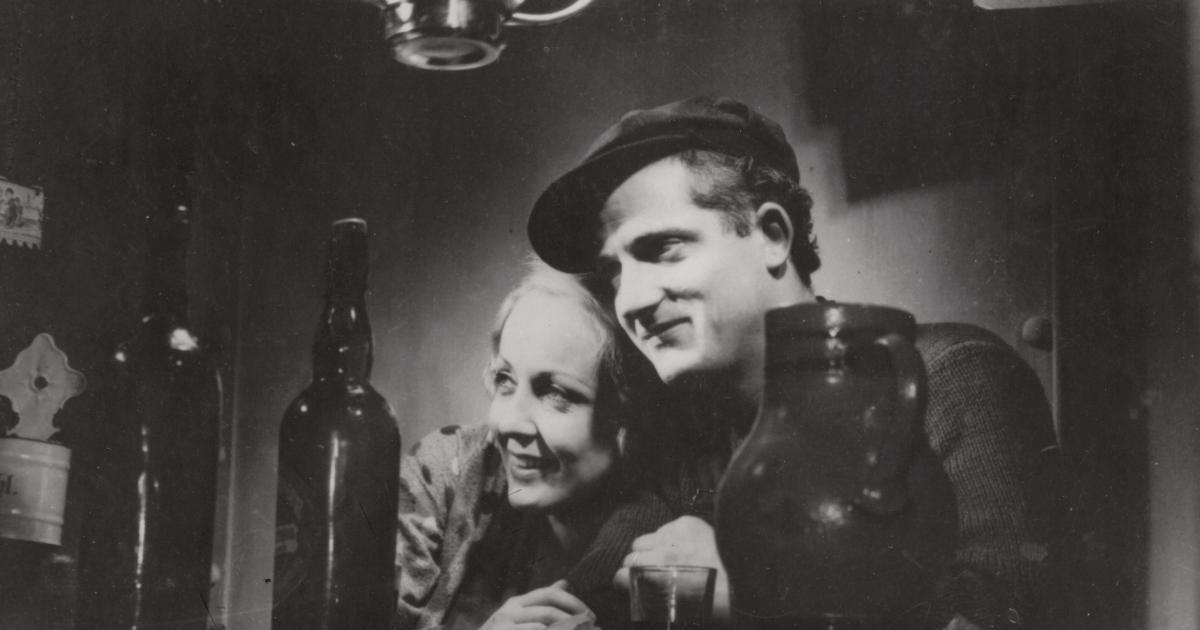
Image context: the lead image uses a real BFI still from the film showing Dita Parlo and Jean Daste aboard the barge.[2] It fits this essay because the movie's romantic promise is always framed by transit. Even when the couple seem briefly synchronized, Vigo places them inside railings, deck lines, and a working vessel whose forward motion keeps intimacy provisional rather than secure.
The wedding puts Juliette on a route before it gives her a home
The opening wedding procession is quietly severe.[2][4] A marriage should inaugurate belonging, but Vigo stages the transition as a removal. Juliette is led away from the village and toward a floating workplace that already has its own habits, hierarchies, and irritations. When she is swung aboard and then begins that famous walk along the deck in her white dress, the shot is lovely precisely because it is unsettled.[2][4] She is not entering a finished domestic interior. She is learning the dimensions of a long, narrow corridor that will also be her bedroom, street, kitchen, and horizon. The barge turns married life into an elongated passageway.
That spatial choice matters more than plot summary can capture.[1][2][5] Jean thinks of the barge as the obvious site of shared life because it is his world already. Juliette sees it with fresher eyes and therefore registers what Jean cannot: that this "home" is also a discipline. Work determines the route. Water determines the speed. Narrow quarters determine how quickly affection becomes irritation and how quickly curiosity can look like disobedience. Vigo's camera keeps the deck, the hatch, the railings, and the cabin entrance legible as repeated thresholds, so that the marriage is always being staged as a problem of passage. The couple are together, but togetherness keeps needing to move through constricted space rather than opening outward into comfort.[2][4]
The movie's tenderness starts here, because Vigo refuses to blame Juliette for noticing the constriction.[2][4] Her dissatisfaction does not read as simple frivolity or betrayal. It grows from the mismatch between the wedding's promise and the vessel's reality. The barge gives her contact with Jean, but it also gives her monotony, surveillance, and a life whose horizons have been chosen in advance. Vigo does not need melodramatic dialogue to make that visible. He lets the deck and cabin keep repeating themselves until repetition itself becomes the emotional fact.
Pere Jules's cabin offers a different model of life than Jean's orderly jealousy
If the couple's cabin reduces marriage to compressed routine, Pere Jules's quarters open a rival world inside the same vessel.[2][4] This is one of the film's great formal strokes. Vigo does not send Juliette's imagination to a grand urban palace or to some abstract elsewhere first. He lets it awaken in the old sailor's cluttered room of tattoos, gramophone relics, framed photographs, curios, cats, and accumulated objects from elsewhere.[2][4] The cabin is cramped, but it is not narrow in the same way. It suggests experience, accident, travel, sensuality, and memory piled together without apology.
That is why Juliette comes alive there.[4] Jean wants order because order protects possession. Pere Jules lives inside a mess that cannot be fully possessed, only explored. The distinction matters for the marriage plot. Juliette is not simply choosing between husband and city, or fidelity and temptation. She is discovering that Jean's version of married life is too thin for her appetite. Pere Jules's cabin teaches her that the world can exceed the route, that objects can carry stories, that bodies can bear history, that adulthood need not mean shrinking life down to usefulness. The room is almost a counter-home: still enclosed, still on the boat, but charged with curiosity instead of management.[2][4]
Vigo films the space accordingly.[2][4] Close-ups brighten with tactile fascination; the room stops feeling like storage and starts feeling like psychic overflow. Juliette's delight in the objects is not decorative character business. It is the clearest expression of what she wants from life, which is not luxury by itself but density, surprise, and permission to touch the unknown. Jean mistakes that hunger for disloyalty because he understands marriage as a bounded unit. Vigo understands it as a relation that will fail if it cannot admit alterity.
The river turns desire into image before the characters can explain themselves
The movie's most famous lyrical device, Jean diving into the water in hopes of seeing Juliette, works because Vigo has prepared the river as more than scenery.[1][3][4] Water already carries the boat, sets the rhythm of labor, and separates shore life from barge life. By the time Jean plunges under, the river has become the film's emotional unconscious. It is where yearning can take visible form once ordinary speech and ordinary authority have failed. The superimposed vision of Juliette beneath the water is dreamlike, but it does not feel imported from another movie. It feels latent in the barge world from the beginning.[2][4]
This is the sequence that reveals how exact Vigo is about the relation between realism and fantasy.[1][2][4] Jean's jealousy has damaged the marriage in fully material ways: he has misread Juliette's longing for the city, reduced her curiosity to threat, and answered restlessness with command. The underwater apparition does not erase those facts. It translates them. Jean cannot reason his way back to Juliette because his failure is not intellectual; it is imaginative. He has not understood what kind of life she needs. Only when longing becomes an image that undoes ordinary logic does he begin to feel the scale of what he has lost.[4]
The same is true of the film's parallel desire montage, where separation makes the lovers most intensely present to each other.[4] Vigo does not propose fantasy as escape from reality. He proposes it as the form reality takes once desire becomes too strong for the route, the cabin, the lock, and the workday to contain. That is why the film's lyricism still feels so bodily. It is never a refined overlay on top of the narrative. It is the river's answer to emotional blockage.
Paris and the return expose what kind of marriage the film can finally imagine
Juliette's trip to Paris is often described as a temptation plot, but Vigo makes the city less glamorous than hungry.[2][4][5] She goes ashore because she wants amplitude, fashion, spectacle, and movement beyond the barge's daily cycle. What she finds is theft, risk, and the cold edges of urban modernity. The point is not that Jean was right to fear the city. The point is that neither the boat nor the city offers a whole answer. One gives enclosure without enough oxygen; the other gives stimulation without care. Juliette is forced to learn that curiosity cannot live on surfaces alone, while Jean is forced to learn that devotion without imaginative room curdles into imprisonment.[2][4]
The ending matters because the reunion is tender without pretending the boat has been magically transformed into a fixed paradise.[1][3][4] What changes is not the vessel but Jean's relation to experience. He becomes less rigid, less convinced that love can be secured by command. Pere Jules, who has all along represented a rougher and freer way of inhabiting the world, becomes the practical agent of restoration. That is exactly right for this film. The marriage survives not by purifying itself into respectable order, but by accepting the disorder of desire, memory, and wandering knowledge that Pere Jules embodies.[2][4]
This is why L'Atalante remains so modern.[1][2][4] Vigo does not ask whether marriage should choose between stability and adventure. He shows that the choice is false. A relationship built only on route, duty, and possession will suffocate; a life built only on glittering escape will scatter. The barge, the cabin, and the river together make a more difficult proposition. Love has to move. It has to carry work, boredom, fantasy, jealousy, and astonishment in the same frame. L'Atalante endures because it finds a film form for that unstable truth, and lets the instability remain beautiful.
Sources
- Janus Films, "L'Atalante" film page.
- BFI, "L'Atalante (1934)" film page.
- The Criterion Collection, "A Feast of Vigo, Newly Restored."
- Graham Fuller, "Artist of the floating world: what makes Jean Vigo's L'Atalante great," Sight and Sound / BFI.
- Gaumont, "L'Atalante" film page.