The Earrings of Madame de... is often praised for grace, flow, elegance, and movement.[1][2][3][4] Those words are accurate, but they can make the film sound daintier than it is. Max Ophuls is not using camera movement as a luxury finish laid over a tragic love story. He is building tragedy out of movement itself. A pair of earrings leaves Madame de's jewelry box, passes through a jeweler, a husband, a mistress, a diplomat, and then back into Louise's life with a completely altered charge.[1][3][4][5] The film's great formal idea is that feelings travel the same way objects do. Desire does not arrive from some private interior untouched by society. It is circulated, delayed, redirected, and priced.
That is why the movie hurts so much by the end.[2][3][4] BFI's capsule rightly emphasizes circular patterns, ornate decor, and sinuous tracking shots, while Molly Haskell's Criterion essay frames the film as a drama in which material value and emotional value keep contaminating one another.[2][3] Ophuls makes those insights visible at the level of rhythm. The camera glides because the characters live in a world where stopping cleanly has become almost impossible. Everyone is being carried by etiquette, gossip, duty, money, and performance. The tragedy is not that Louise suddenly feels too much. It is that feeling has to move through a system built for exchange.[1][2][3][4]
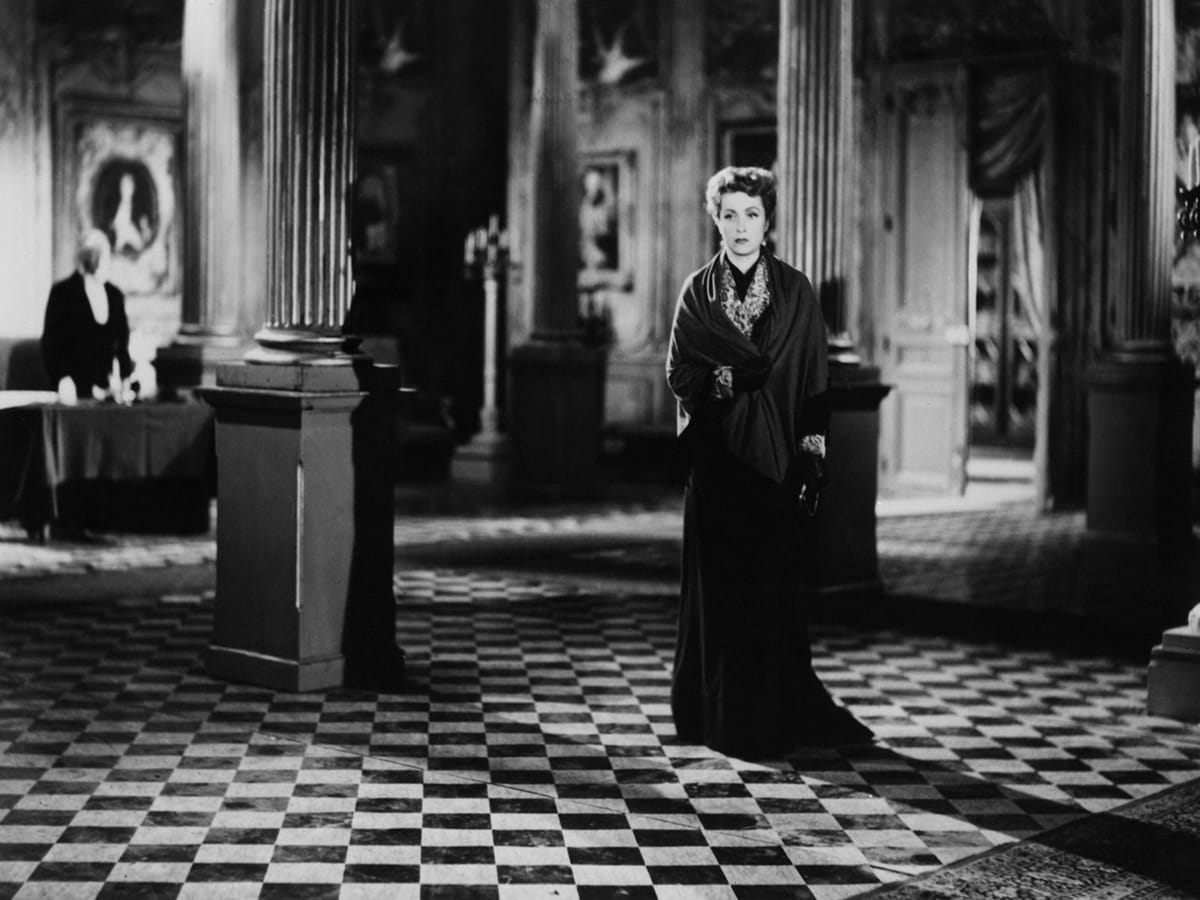
Image context: the lead still, sourced from Criterion, shows Danielle Darrieux's Louise isolated inside a grand interior from the film.[6] It fits this piece because Ophuls keeps treating rooms less as backgrounds than as routing devices. Floors, columns, mirrors, and thresholds tell you how people may move, what they may display, and how long they can pretend those movements mean nothing.
The opening turns luxury into inventory before it turns inventory into fate
The first extraordinary thing about The Earrings of Madame de... is how coolly it begins.[1][4][5] Louise is not introduced through a grand declaration of romantic hunger. She is introduced sorting through possessions, searching for something she can quietly convert into cash. TCM notes that the plot is almost classically framed by the earrings at the beginning and the end, and that structural observation matters because Ophuls starts by treating the jewels as part of a larger field of objects, fabrics, cases, and surfaces.[4] The camera does not merely admire the room. It behaves like an intelligence moving through a storage system.
That choice does two things at once.[1][2][4] First, it gives the film its ironic lightness. Louise's problem appears small, almost frivolous, one more aristocratic inconvenience solved through sale and concealment. Second, it establishes the movie's harshest law: in this world, objects already know more about the truth than people are willing to say. The earrings are a wedding gift, then a lie, then a parting gift to a mistress, then a love token from Donati, and finally something close to a relic.[4][5] They keep changing meaning without changing form. Ophuls uses that stability of the object against the instability of language. Everyone can rename the earrings. No one can stop the route they record.
That is why the film never treats the jewels as a mere Hitchcockian MacGuffin.[2][3][4] They are not empty bait designed to keep the plot in motion while the "real" drama happens elsewhere. The passing itself is the drama. Every transfer leaves a moral residue. Every sale or gift is also a revision of feeling. By the time Louise receives the earrings back from Donati, the object has already traveled through enough hands to make innocence impossible.[1][4][5]
The waltz sequence does not decorate the love story; it manufactures it
Ophuls's most famous stroke in the film is the run of dances that charts Louise and Donati falling in love.[1][2][3] A lesser director might have built this passage around private confessions or explanatory letters. Ophuls does almost the opposite. He lets the romance emerge in public, during repeated waltzes, under chandeliers, in rooms crowded by other people, while the camera and the dissolves keep carrying one dance into the next. Time passes, but it passes as rotation.
This is the deepest reason the sequence feels both ecstatic and doomed.[2][3][4] The lovers do not step outside society in order to discover authentic feeling. They discover feeling by moving more perfectly inside society's prescribed forms. The dance offers touch, repetition, and proximity, yet it also keeps them within choreography, costume, and spectatorship. The camera joins the waltz without ever pretending the couple has escaped the room. Love appears as an acceleration inside ritual.
Haskell's argument about cost is useful here.[2] Ophuls keeps showing that value is never singular in this world. The same movement can be sensual, financial, ceremonial, and fatal at once. The waltzes crystallize that four-way pressure. What looks like pure romantic lift is also a form of social exposure. Each return to the dance floor intensifies intimacy, but it also makes the affair more legible within the aristocratic circuit that produced it. The sequence is beautiful because it seems to suspend time. It is devastating because it is really compressing time, carrying the relationship toward consequence with every turn.
The craft is so exact that the viewer almost feels the film editing on the basis of motion rather than event.[1][2][3] A turn completes itself in one party and seems to continue in another; a look that would normally need a close-up gets stretched across repeated meetings; the romance becomes memorable less through isolated declarations than through accumulated orbit. Ophuls turns courtship into a machine of ellipsis. What is omitted is precisely what gives the sequence its force. He does not show us every decisive conversation. He makes us feel that the decisive thing has been happening in the movement all along.
Mirrors and exits keep turning feeling into social geometry
The other great technical achievement of The Earrings of Madame de... is the way Ophuls refuses to let interiors settle into static prestige.[1][3][4] TCM describes his tracking shots as moving portraits that comment on character, and the film's rooms justify that phrase.[4] Mirrors double the characters not to provide simple symbolism but to delay certainty. Doorways hold back or release information by fractions of a second. Staircases, carriages, opera passages, and salon entrances keep converting emotional states into trajectories.
That matters because Louise is never allowed a purely private frame.[1][2][3] Even when she seems briefly alone, the built world around her suggests routes already laid down by class and marriage. Mirrors offer self-recognition in a damaged form: she can see herself, but as part of decor, etiquette, and performance. Doorways do something related. People in this film are constantly arriving just after someone has left, or leaving just before someone else can fully speak. Desire is organized as a problem of timing and passage. The camera does not chase that fact; it lives inside it.
This is where Ophuls's elegance becomes cruel.[2][3][4] If the movie were less mobile, the lovers might seem freer. Instead, the fluidity keeps revealing the opposite. Grace is the operating style of a society that can absorb scandal for a while, route it through whispers and rituals, and then finally punish it with full seriousness. Even the husband's composure belongs to this geometry. He understands circulation as well as anyone in the film. He can buy back the earrings, pass them on, retrieve them again, and maintain public form long after private damage has become obvious.[4][5]
The ending stops the orbit, and that is why it feels so severe
By the close, Ophuls has taken an object that began as one more saleable ornament and turned it into a record of irrecoverable time.[2][3][4] The final movement is not devastating because it suddenly becomes solemn. The film has been severe from the start. What changes is that circulation can no longer disguise its cost. TCM notes that Ophuls cut an additional coda from release prints because it weakened the film.[4] That decision makes formal sense. The finished movie knows exactly where to stop: at the moment when worldly circulation hardens into memorial.
The earrings finally appear in church as a donation marked by Louise's name, and the shift is brutal precisely because the object has not changed while everything around it has.[4] Earlier, the jewels could pass as gift, flirtation, excuse, or proof. At the end they sit still. Social motion has spent itself. What remains is an object no longer circulating through pleasure but fixed inside remembrance. Ophuls does not need a speech to explain the transformation. The whole film has prepared us to read it.
That is why The Earrings of Madame de... keeps feeling more radical than its surface reputation for elegance might suggest.[1][2][3] It is a movie about aristocratic style, but it does not worship style as insulation. It shows style functioning like a transport system. The earrings, the waltzes, the mirrors, and the exits all belong to one design: a world where love can become visible only by entering circulation, and where that same circulation guarantees loss. Ophuls does not photograph romance and then add movement. He turns movement into romance's most exact and merciless form.[1][2][3][4]
Sources
- The Criterion Collection, "The Earrings of Madame de..." film page, with synopsis, credits, restoration notes, and stills.
- Molly Haskell, "The Earrings of Madame de . . . : The Cost of Living," The Criterion Collection.
- BFI, "Madame de... (1953)" film page.
- Frank Miller, "The Earrings of Madame De...," Turner Classic Movies.
- Gaumont, "The earrings of Madame de" official film page.
- Criterion still image used for the cover, from The Earrings of Madame de....