French poetic realism is usually introduced through atmosphere first: fog at the docks, rain on cobblestones, cigarette smoke, cheap hotel rooms, doomed lovers, Jean Gabin looking as if he already knows happiness will be brief.[1][2][3] That memory is not wrong. It is only incomplete. The movement mattered because it did more than style despair beautifully. It gave despair a social address. Streets, bars, boarding houses, quays, courtyards, factory districts, cramped apartments, and theater galleries became places where class, desire, fatigue, and bad timing could share the same air.[1][2][3]
That is why poetic realism still feels heavier than a mere mood board. The films are romantic, but they are never floating free of the world. Britannica's broad definition is useful here: the movement joins stylization to everyday settings and unhappy destinies.[1] The better question is what that combination achieves. In the major Carné-Prévert films especially, realism does not mean documentary neutrality. It means that even the most lyrical image remains tied to work, weather, money, crowd pressure, police attention, or social rank.[2][3][4]
Seen that way, poetic realism becomes one of cinema's sharpest ways of showing how a public world can shape private feeling. It gives characters one brief pocket of tenderness, then reminds them that the pocket was never sealed. Someone is listening from the next room. A gangster or a godfather or a jealous rival is still around the corner. A whole city continues to exist outside the embrace.[2][3][5]
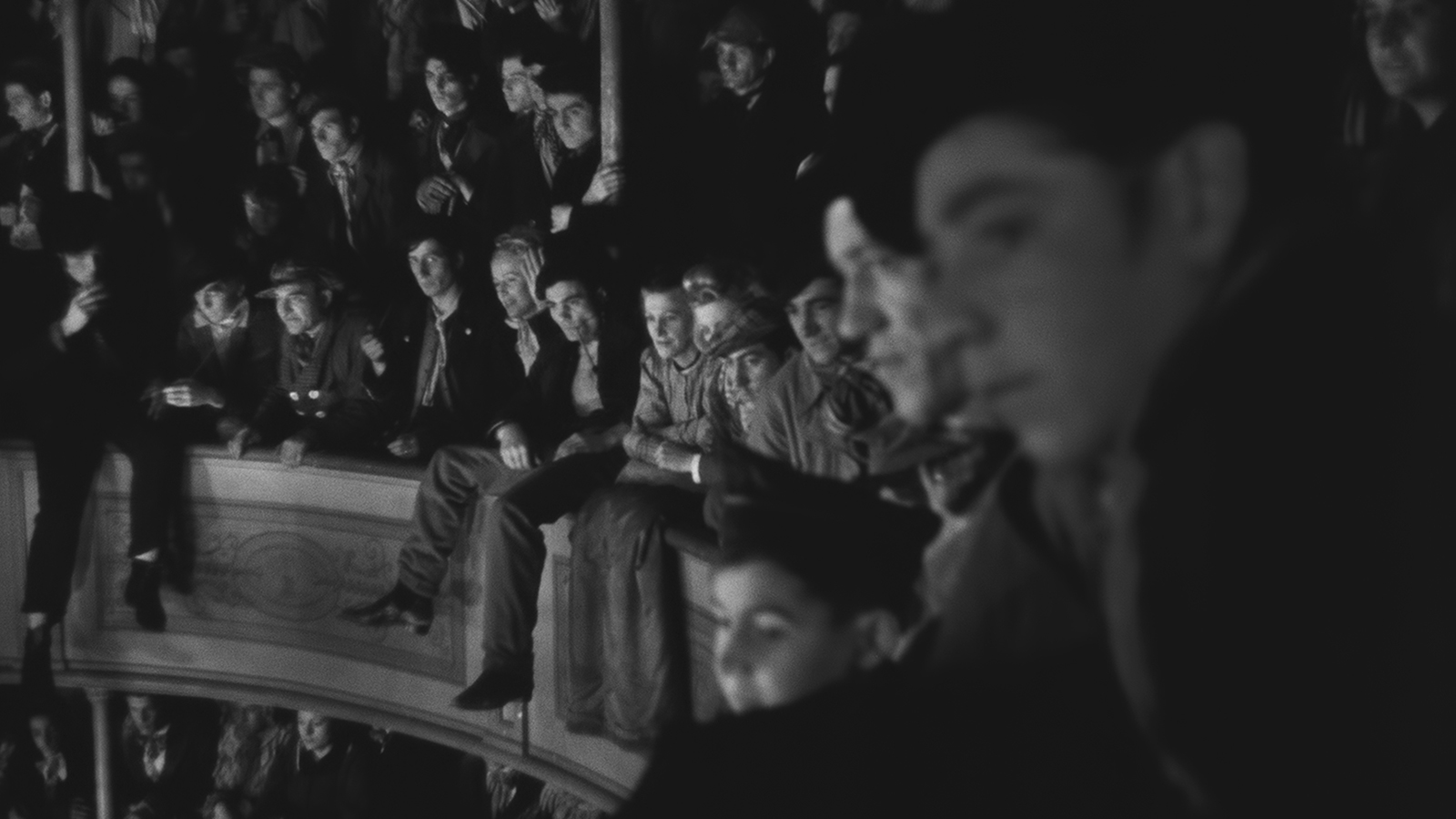
Image context: the lead image uses an official Janus still from Children of Paradise. It belongs in a movement essay because poetic realism is not only about lone faces in mist. It is also about social depth: audiences watching from above, bodies passing in front of one another, and feeling made visible inside a shared public frame.[7]
The movement made public space emotionally active
Lucy Sante's essay on Port of Shadows is one of the clearest descriptions of the movement's grammar.[2] She treats the film as archetypal because the pieces arrive together there: lowdown settings, romantic fatalism, rough-edged lives, and a narrative motion that rises toward one possible moment of happiness and then drops toward doom.[2] What matters is that none of those elements can be detached from place. Le Havre is not backdrop in Port of Shadows; it is the medium through which Jean and Nelly can meet, hide, drift, and fail to escape.[2]
This is the movement's first great trick. It makes public space feel intimate without ever making it private. The bar at the edge of town, the road lined with poplars, the wet street, the harbor, the rented room, the cheap table where two people finally talk as if they might outrun the rest of the world: all of them carry the promise of shelter, but only provisionally.[2] Poetic realism keeps discovering tenderness in exposed places. That exposure is why the tenderness hurts.
The same logic darkens in Le jour se lève.[3] Michael Joshua Rowin describes the film as one of the defining works of prewar poetic realism and links its bleakness to the waning of Popular Front optimism as fascism spread across Europe.[3] That political pressure is not staged through speeches. It is felt through enclosure. François is a working-class man trapped in an apartment after murder, and the film turns walls, staircases, windows, and flashback structure into signs that the social world has already narrowed around him.[3] In poetic realism, doom arrives less like thunder than like the realization that every exit has been there all along and still will not open.
Its realism was built, not found
One reason poetic realism lasts is that its "realism" is never naive. These films do not merely point a camera at ordinary life. They design ordinary life until it becomes emotionally legible.[1][2][3][5] The harbor in Port of Shadows is partly documentary insert, partly stylized dream-space. François's room in Le jour se lève feels worn and physically convincing, yet it is also a psychological trap shaped by production design. Dudley Andrew's essay on Children of Paradise extends the point from another direction: theater architecture, curtains, wings, galleries, and boulevards organize feeling before any character speaks it aloud.[5]
This is where Alexandre Trauner becomes central to the movement's afterlife.[3][4][5] Rowin notes how his work on Le jour se lève makes environment carry mental pressure, while BFI's Les Enfants du paradis page stresses the grandeur of the recreated Boulevard du Crime and the wartime ingenuity behind its world-building.[3][4] Poetic realism often looks spontaneous because it understands clutter, dampness, and crowd flow so well. But that effect depends on exact design. The realism is persuasive because the artifice is disciplined.
That discipline matters aesthetically and politically. It means the films can show a society that feels lived-in without pretending that it is transparent. A poetic-realist street always looks like a place with prior history. People work there, loiter there, hide there, gossip there, fall in love there, and get cornered there. The frame is rarely empty enough for innocence.[2][3][4]
Working-class fatalism is the movement's moral engine
The movement's protagonists are often described as doomed romantics, which is true but too literary on its own. They are also workers, drifters, deserters, petty criminals, performers, women under male surveillance, and ordinary people whose room for error is small.[1][2][3] Rowin's emphasis on François as a working-class hero is useful because it shows how Gabin's screen persona anchored sympathy inside social pressure rather than abstract existential misery.[3] Likewise, Sante's reading of Port of Shadows makes clear that the style's realism comes from its closeness to working-class lives and its refusal of sunny resolution.[2]
That is why the movement does not simply "prefer sad endings." Its endings feel earned by the worlds the films have built. In poetic realism, a brief interval of happiness can appear with shocking force precisely because the surrounding environment is so unstable. Two people at a table, a glance across a room, a walk along a road, a cramped apartment that holds still for one minute: these moments matter because they are temporary shelters inside a harder public order.[2][3]
The form is almost musical in that sense. A refrain of happiness returns, but each time with more knowledge that it cannot last. The lyrical element does not cancel realism. It makes the realism crueler, because the films let viewers experience exactly what will be lost.[2]
Children of Paradise shows the movement at heroic scale
If Port of Shadows and Le jour se lève give poetic realism its prewar fatal grammar, Children of Paradise shows what that grammar can do when expanded into epic form.[4][5] The BFI description of the film as a life-affirming tribute to love, Paris, and the stage is accurate, but only part of the story.[4] Andrew's Criterion essay is sharper on the mechanism: boulevards, theaters, wings, and galleries create a whole architecture of spectatorship in which private feeling must cross crowds and performance before it can even announce itself.[5]
That expansion matters for genre history. Poetic realism does not disappear in Children of Paradise; it becomes more layered. The movement's old ingredients remain visible: stylized environments, class texture, theatrical language, precarious love, and a sense that public life will eventually swallow private hope.[4][5] What changes is scale. The boulevard becomes a machine for multiplying witnesses. The gallery gives the movement its classed perspective from above. The final carnival crowd turns fatalism into pure circulation.
This also helps explain the bridge to noir. Michael Atkinson's Criterion essay on the French roots of noir argues that films like Pépé le moko, Port of Shadows, and Le jour se lève are among the earliest full harvests of the mood later called noir: fatalistic, shadowed, morally bruised, and organized around compromised desire.[6] Poetic realism did not become noir in any simple linear way, but it proved that romantic pessimism, urban texture, and social damage could be made cinematically irresistible. Noir inherited that knowledge.
French poetic realism still matters because it understood that tragedy lands harder when the world around it feels shared. It did not isolate fate inside grand individuals. It put fate in bars, stairwells, alleys, boarding houses, dressing rooms, and cheap seats. The films remain beautiful, but their beauty is never detached from use, class, or weather. That is why their sadness still breathes. It has somewhere to live.
Sources
- Encyclopaedia Britannica, "Poetic realism" (movement definition, French context, and key traits).
- Lucy Sante, "Port of Shadows," The Criterion Collection.
- Michael Joshua Rowin, "Le jour se lève: Working-Class Hero," The Criterion Collection.
- BFI, "Les Enfants du paradis (1945)" film page.
- Dudley Andrew, "The Romance of Children of Paradise," The Criterion Collection.
- Michael Atkinson, "What's in a Name," The Criterion Collection (on the French roots of noir and poetic realism's afterlife).
- Janus Films, official still from Children of Paradise, still 683id_427.