Spoiler note: this close reading discusses the film's ending.
Kiss Me Deadly begins as if the movie itself has been damaged before the story can stabilize. A woman runs barefoot at night, breath tearing through the soundtrack, while headlights keep missing or nearly striking her. When Mike Hammer finally stops, the encounter does not feel like a rescue. It feels like a collision between panic and vanity. Robert Aldrich's 1955 film takes the private-eye plot and makes it breathe wrong: too loud, too close, too physical, as though noir's usual atmosphere has become a malfunctioning body.[3][5]
That opening is the key to the whole film. AFI notes the unusual credit design: after Hammer picks up Christina, Nat King Cole's "Rather Have the Blues" plays and the credits scroll downward, as if they belong to the highway rather than to a stable title page.[3] The effect is not only stylish. It tells the viewer that direction has already become unreliable. Credits, road, song, breathing, windshield, and desire all share the same tilted field. Before the mystery has a name, the movie has made perception feel compromised.
The plot can be summarized neatly enough: Hammer follows the death of Christina into a Los Angeles conspiracy built around a hot, glowing box that several people want and few understand.[1][4] But neatness is the wrong way to watch it. Criterion frames the film as an atomic adaptation of Mickey Spillane, a noir masterwork and Cold War paranoia object with one of American cinema's most nervous endings.[1] Hoberman's Criterion essay goes further, arguing that Aldrich turns noir toward apocalyptic science fiction and makes Hammer's own brutality part of the film's indictment rather than its moral solution.[2] The story matters because it keeps exposing the detective form's worst assumption: that a violent man can force hidden systems to yield truth without becoming one more instrument of damage.
The Hero Is A Bad Listening Device
Hammer is a private investigator, but the film repeatedly shows that investigation and listening are not the same thing. He hears Christina's breathing before he understands her fear. Later he hears screams without being able to intervene. He receives messages through a wall-mounted answering machine, a futuristic gadget that makes his apartment look modern while making his relationships feel mechanized.[2] He questions people as if answers can be beaten, bought, or cornered into usefulness.
That is why Ralph Meeker's performance is so unsettling. Hammer is not a weary professional with a code. He is a man who mistakes appetite for method. The TCM account describes him as unusually violent and unsympathetic, a detective who uses tactics close to those of the criminals around him.[4] Hoberman sharpens the point by reading Hammer as a hustler whose sadism becomes a criticism of itself.[2] The film does not simply ask whether Hammer can solve the case. It asks what kind of world treats him as a useful instrument.
The sound design keeps answering: a sick one. The opening breath is not an isolated flourish. Voices, songs, screams, phones, radios, and whispered warnings keep slipping away from secure ownership. Someone is always talking through a device, behind a door, from a car radio, or from a position of partial knowledge. The film's most frightening noises often arrive before the image can explain them. In ordinary detective fiction, clues become clearer as the hero gathers them. In Kiss Me Deadly, clues often become louder before they become clearer, and loudness is not the same as knowledge.
Los Angeles As A Surface That Will Not Confess
Aldrich's Los Angeles is not the glamorous city of arrival. It is a field of rooms, garages, apartments, clubs, stairways, beach houses, lockers, roads, and offices where every surface seems to be hiding another use. AFI's production notes preserve several concrete anchors: the film shifts Spillane's material away from the novel's narcotics and Mafia frame toward atomic material and an unspecified political conspiracy, while also stressing the film's troubled path through censorship bodies.[3] That shift matters because the movie's Los Angeles becomes less a local crime map than a Cold War pressure chamber.
Alain Silver's Library of Congress essay reads the opening as a sensory explosion and emphasizes how Christina pierces Hammer's self-regard almost immediately.[5] The observation matters because Christina, supposedly the unstable figure, is the first person to understand Hammer clearly. She sees the car, the clothes, the body culture, the self-absorption. Her terror does not make her less perceptive. It makes the movie's moral alignment sharper: the person running in panic sees more than the man driving with confidence.
This reverses a familiar noir contract. Usually the detective enters corrupt space with some reserve of interpretive privilege. Hammer has motion, money, a car, an apartment, sexual leverage, and a professional license, but he does not have interpretive grace. The city keeps offering him signs that his normal methods cannot read: a poem swallowed into the plot, a key hidden through bodily horror, a record broken for information, a locker that turns curiosity into injury. He keeps moving forward, but forward motion is not progress. It is propulsion toward a force he is too crude to imagine.
The Box Is Not A MacGuffin So Much As A Punishment
The glowing box is famous because it helped give later cinema a reusable image of dangerous mystery. But in Kiss Me Deadly, the box is not merely a stylish object. It is the point at which the detective story's hunger for revelation becomes catastrophic. Everyone wants the secret. Nobody has the moral or technical capacity to hold it. The "Great Whatsit" sounds like a joke until it becomes an accusation against curiosity itself.[2][4]
The film's ending works because the box turns looking into harm. A conventional mystery promises that opening the hidden thing will solve the disorder. Aldrich makes opening the hidden thing intensify the disorder past human scale. The light does not clarify; it burns. The sound does not explain; it overwhelms. The beach house becomes less a crime location than a terminal chamber where pulp appetite meets atomic consequence.[1][2]
This is where the restored ending matters historically. AFI details the film's release context and later attention to alternate or altered endings, while Criterion's edition foregrounds the controversial altered ending among its features.[1][3] Whether the emphasis falls on escape, annihilation, or ambiguity, the essential pressure remains: the film pushes Hammer to the edge of a mystery that cannot be mastered by masculine force, sexual blackmail, street contacts, or clever intimidation. He has been trained by genre to believe that the case is something to crack. The case turns out to be something that cracks the genre back.
Why The Film Still Feels Contaminated
The Library of Congress National Film Registry listed Kiss Me Deadly in 1999, fixing its institutional importance decades after its first scandalous reception.[6] That afterlife can make the film sound safely canonical, but the movie itself resists safety. It remains abrasive because it does not ask viewers to admire its hero from a protected distance. It asks them to recognize the thrill of his momentum and then notice how diseased that thrill is.
Rahul Hamid's Senses of Cinema note is useful here because it places the film near the end of classic-period noir while arguing that Aldrich twists noir conventions toward the new fears of the 1950s.[7] That is the most precise way to read its force. Kiss Me Deadly is not simply late noir, not simply atomic allegory, and not simply a critique of Mickey Spillane. It is a movie about a form becoming unsafe for itself. The private-eye story still moves, but every part of it has been poisoned: the hero, the clue, the city, the woman in danger, the seductive room, the final revelation.
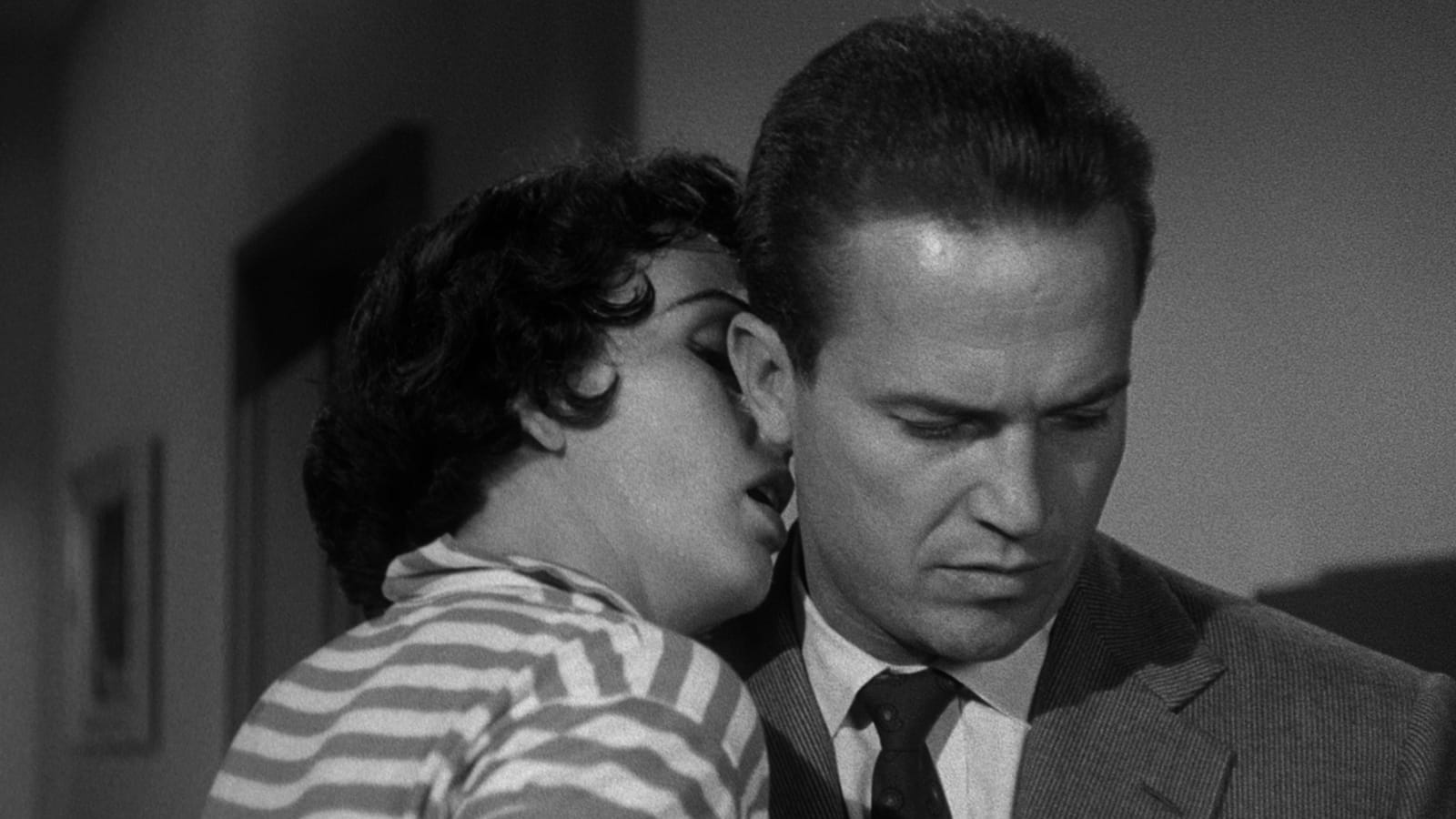
The cover still catches that contamination in miniature. Hammer's face is close to another body, but closeness gives no comfort. His eyes drop, his jaw tightens, and the frame feels less intimate than trapped.[8] That is Aldrich's film in one compressed gesture. Contact does not heal the world. It carries pressure from one person to another.
The opening breath never really leaves the movie. It returns as scream, whisper, song, static, threat, and radioactive roar. Kiss Me Deadly endures because it understands that noir's darkness is not only visual. It is acoustic, bodily, and moral. The detective story has lungs, and by 1955 Aldrich could hear them failing.
Sources
- The Criterion Collection, "Kiss Me Deadly" film page with credits, format notes, restoration details, special features, and synopsis.
- J. Hoberman, "Kiss Me Deadly: The Thriller of Tomorrow," The Criterion Collection, June 20, 2011.
- AFI Catalog, "Kiss Me Deadly (1955)" with release data, credits, opening-credit notes, censorship history, and production context.
- Turner Classic Movies, "Kiss Me Deadly (1955)" overview and production article.
- Alain Silver, "Kiss Me Deadly," Library of Congress National Film Registry essay.
- Library of Congress, "Complete National Film Registry Listing," including Kiss Me Deadly listed for 1999.
- Rahul Hamid, "Kiss Me Deadly (Robert Aldrich, 1955)," Senses of Cinema, March 2019.
- The Criterion Collection production still JPEG used as this article's cover image.