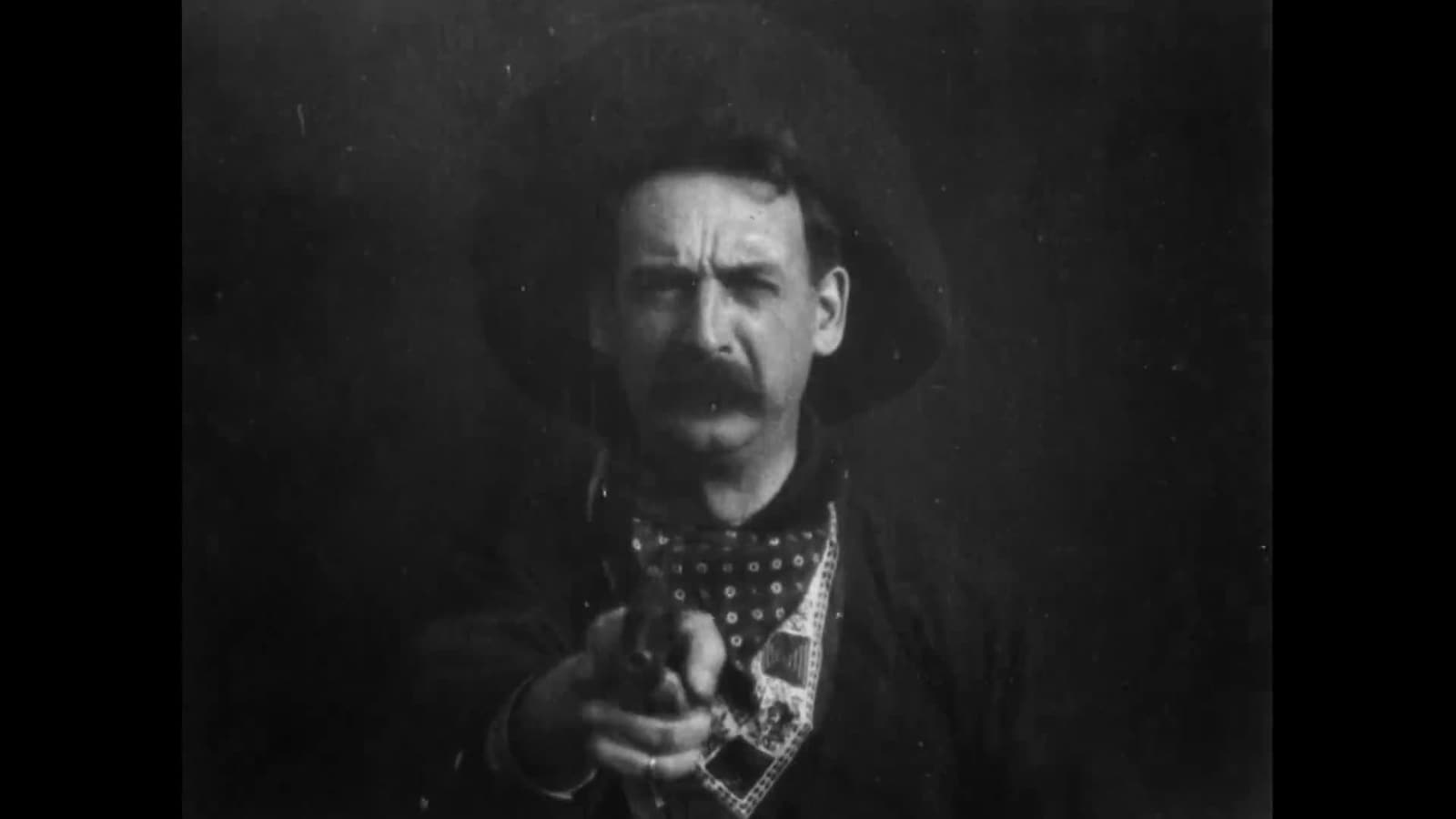
The Great Train Robbery is often introduced as a first: first narrative film, first Western, first screen gunshot aimed at the audience. Those labels are useful only if they stay a little unstable. Edwin S. Porter's 1903 Edison short did not invent story cinema from nothing, and it did not create the Western as a finished genre in twelve minutes. Its importance is sharper than that. It gathered several moving parts that early audiences already knew - trains, crime, outdoor chase, stage melodrama, newspaper-style violence, and direct theatrical shock - and made them feel like one clean movie machine.[1][2][3]
That is why the film still matters after more than a century of later Westerns, heist films, and action editing. The Library of Congress item records it as an Edison Manufacturing Company film copyrighted on December 1, 1903, with a viewing duration just under twelve minutes at 18 frames per second.[1] The National Film Registry description summarizes its fourteen-scene action structure, New Jersey locations standing in for the American West, Broncho Billy Anderson playing several roles, and the famous medium close-up in which a gunman fires toward the viewer.[2] Those facts point to the central achievement: the film made movement itself into genre.
A Western Built Far From The West
The joke hidden in the film's reputation is geographical. The Great Train Robbery became a foundation stone for screen Western memory, yet the Library of Congress registry description places its filming in New Jersey locations rather than a Western landscape.[2] Britannica gives the production frame more specifically: November 1903, Edison's New York studio, Essex County parks in New Jersey, and the Lackawanna Railroad, likely between Denville and Dover.[4] The "West" here is not a documented place. It is an arrangement of signs: railroad, telegraph office, outlaws, guns, horses, posse, woods, escape, pursuit, punishment.
That artificiality is not a weakness. It shows how early cinema learned to manufacture a genre through readable motion. A train enters and stops. Robbers climb, threaten, fight, and flee. The telegraph operator becomes the damaged information system that must be restored. A posse forms because the story has to convert news into pursuit. The landscape need only be plausible enough to carry the action from one unit to the next. The film's West is less a region than a set of kinetic instructions.
That helps explain why the short can feel both primitive and modern. The acting belongs to melodramatic display. The staging often plays frontally, as if the camera has inherited the position of a theater spectator. But the story keeps moving across locations, and the viewer is asked to understand continuity between spaces. The film is not just showing attractions one after another. It is training the audience to infer cause: a robbery here means a chase there; a tied-up operator matters because he delays rescue; a dance hall can become a mobilization point once news arrives.
Crime Plot As Editing Lesson
Porter's film is easiest to overpraise when it is described as if every technique were unprecedented. Britannica is more careful, noting that cross-cutting, panning, and the final close-up were not individually new, while still emphasizing the film's historical importance in joining such devices into a single motion picture.[4] That distinction matters. The film's force lies not in solitary invention but in consolidation. It made a whole package of early techniques commercially legible.
The crime plot is the package's engine. A robbery gives the film a clean chain of needs: enter, overpower, steal, escape, chase, retaliate. The American Film Institute catalog frames The Great Train Robbery as one of several Porter films that helped establish a new narrative standard, and it also preserves the Edison catalog's scene-by-scene sales logic.[3] That sales logic is revealing. The film could be advertised as a sequence of vivid incidents, yet the incidents hang together tightly enough for an audience to follow without dialogue.
The train makes this possible. It is vehicle, target, modern machine, moving set, and symbol of public order. It carries the film from industrial modernity into outlaw fantasy. A robbery on foot would be smaller. A saloon brawl would be more static. A train robbery gives cinema exactly what it needs: lines, direction, speed, compartments, thresholds, smoke, passengers, and a visible reason for cutting between separated spaces. The outlaws attack a network, not just a safe.
That network logic is the film's overlooked modernity. The telegraph office is as important as the gunfight because it represents communication under attack. The operator's revival turns narrative delay into infrastructure repair. Once the message can move again, bodies can move in response. The posse is not only moral order returning; it is the human consequence of restored communication. In that sense, the film is already thinking like a medium built on relays.
The Shot That Breaks The Frame
The most famous image comes at the end, though Porter reportedly allowed exhibitors to place it at either the beginning or the end.[2] A bandit faces the camera and fires directly toward the audience. The shot is not necessary for plot resolution. It is an exhibition gesture, a reminder that early cinema was still close to fairground shock, vaudeville timing, and the pleasure of a projected image that seemed to reach into the room.
Placed at the end, the shot changes the film's aftertaste. The robbers have been defeated, order has been restored, and then the outlaw returns as pure address. He is no longer in the story world in the ordinary way. He is in a relation with the viewer. That is why the frame used for this article is so apt: a plain black-and-white film image, a hat, a revolver, a stare, a body squared to the lens.[5] It compresses the movie's larger trick. Genre is not only what happens on screen. It is also the contract that tells the audience how close danger is allowed to feel.
This direct-address ending also separates The Great Train Robbery from a simple progress story about narrative cinema becoming more invisible and refined. The film wants continuity, but it also wants confrontation. It asks viewers to follow a plot, then jolts them back into awareness that they are sitting before a spectacle. Later classical Hollywood would often hide the apparatus more smoothly. Porter still lets the showman's hand remain visible.
Why The "First Western" Label Is Too Small
Calling the film the first Western is tempting because so many later elements are present: armed outlaws, railroad violence, pursuit, horses, frontier costume, rough justice. But the label can flatten the film's hybrid energy. It is also a crime film, a train film, an action short, a chase picture, a display of Edison production capability, and an adaptation shaped partly by stage melodrama.[1][3] The Western emerges here not as a pure genre but as a crossing point where several attractions become compatible.
That compatibility became immensely important. Once cinema learned that a railroad could organize space, a robbery could organize time, and a posse could organize moral response, the screen had a durable action grammar. The point was not just cowboys. The point was sequencing: danger introduced, information interrupted, pursuit triggered, bodies routed through landscape, violence returned to the audience as spectacle.
The National Film Registry added the film in 1990, marking its cultural, historical, and aesthetic significance.[3][4] That preservation status is not an award for technical innocence. It is a recognition that this short made a future visible. Early viewers did not need a feature-length plot or psychological depth to feel a new kind of movie pleasure. They needed a chain of images that moved quickly enough to make space feel connected and danger feel exportable.
The Machine Still Runs
The film now looks small because later cinema became vast. Westerns moved to Monument Valley, heist films acquired elaborate planning mechanics, action editing learned velocity beyond Porter's imagination, and direct-to-camera violence became quotation, parody, and homage. But the little machine inside The Great Train Robbery still runs. A system is attacked. A message is delayed. A chase organizes space. A weapon breaks the boundary between fiction and audience.
That is why the film is best understood as movement-and-genre context rather than as a trophy case of firsts. Its achievement is not that it was pure origin. Its achievement is that it made several early-cinema pleasures cooperate. Train spectacle became crime story. Crime story became pursuit. Pursuit became Western iconography. Western iconography became audience shock. In twelve minutes, Porter did not finish the Western. He made a set of moving parts fit tightly enough that later movies could keep rebuilding the machine.
Sources
- Library of Congress, "The Great Train Robbery" item JSON - Edison Manufacturing Company film record with copyright date, duration, holdings notes, source notes, credits, and cast details.
- Library of Congress National Film Preservation Board, "Brief Descriptions and Expanded Essays of National Film Registry Titles" - registry description of The Great Train Robbery, including fourteen scenes, New Jersey locations, Broncho Billy Anderson roles, and the direct-to-camera gunshot.
- AFI Catalog, "The Great Train Robbery" - film record with production context, Edison catalog summary, narrative-standard framing, and National Film Registry recognition.
- Encyclopaedia Britannica, "The Great Train Robbery" - overview of release, Porter, production locations, cross-cutting/panning/close-up context, and registry status.
- Library of Congress storage-services JPEG, preserved frame image from The Great Train Robbery viewing copy used as this article's cover image.