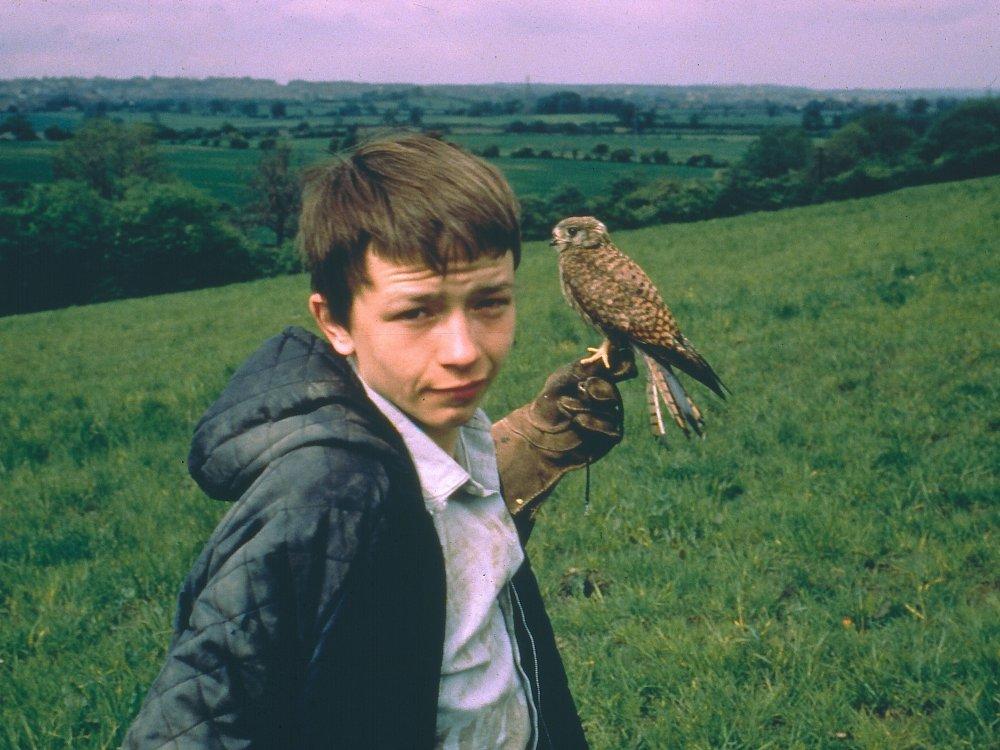
Billy Casper learns to train a kestrel in the fields around a Yorkshire mining town. The task gives him something school has struggled to recognize: a capacity for patient, exacting attention. Ken Loach's Kes (1969), adapted from Barry Hines's A Kestrel for a Knave, makes that discovery its emotional center.[1][5] Its filmmaking asks a related question. What conditions allow someone to show what they can do?
Cinematographer Chris Menges answered partly by changing where the crew stood. He and Loach agreed to keep the camera outside the space occupied by the performance and to keep lighting equipment out of the actors' rooms. Longer lenses followed from that decision.[2] The intimacy of Kes begins with a practical concession: give the people in front of the camera some room.
Standing back takes work
A longer lens lets a camera farther away retain a relatively tight view. Physical distance from an actor therefore need not mean a distant-looking image. In Menges's account, the choice grew out of the arrangement of bodies on set: the camera would observe from beyond their working space.[2]
That distinction changes how we understand an unobtrusive camera. A face can still fill the screen. What changes is the equipment's relationship to the person making the expression. The actor has fewer immediate reminders that every movement belongs to an apparatus.
Menges described the companion lighting principle in a later interview with Film and Digital Times: illuminate the room, and let performers move within it without requiring them to land on prescribed marks. Window light was central to the approach.[3] A mark is a practical agreement between actor, camera, and lighting crew; loosening that agreement lets a gesture find its own destination.
The technical responsibility goes somewhere else. A camera team must remain ready for a movement whose precise endpoint has not been fixed. My reading is that Kes makes this redistribution of effort felt as ease. The scene appears to have time for Billy because the filmmaking has organized itself to accommodate him.
Menges's phrase for the lighting was “democratic.”[3] It is an unusually useful description: the room remains available to the performance, instead of having one privileged spot where an actor must stand to become photographable.
Color prepared to stay quiet
The image's restraint also began before anyone stepped in front of the lens. Menges recalled that the studio required color, and that he asked producer Tony Garnett to have the entire negative pre-flashed before production. He wanted to temper the prominence of color so it would serve Hines's story.[2]
Flashing gives film a small, even exposure to light before processing. Kodak describes it as a way to reduce contrast and open shadow areas; pre-flashing applies that exposure before the scene is photographed.[4] It changes the recording material's response. This part of the look was already built into the film going through the camera.
Menges remembered using slow, 100 ASA tungsten-balanced stock, which made the lighting approach demanding. He also acknowledged the risk of committing the negative to a laboratory treatment before the shoot.[2] The apparently modest image depended on confident preparation.
There is a useful distinction here between a subdued image and an indifferent one. Subduing color can keep one bright surface from taking over a scene. Our attention has more room to follow a hand, a hesitation, or the exchange between two people. The craft shapes what becomes noticeable without constantly announcing its presence.
A believable place is still assembled
The same deliberate construction operates at the scale of the landscape. Adam Scovell's BFI location study identifies Billy's town as a screen geography assembled from places around Barnsley, including Lundwood and Hoyland. The sequence in which Mr. Farthing visits Billy flying the bird combines material from Hoyland Common with shots made behind Hawshaw Lane.[1]
For a viewer, that geography can feel continuous: here is the boy, here is the ground he knows, here is the space the kestrel can cross. Editing makes separate pieces of actual terrain function as one place. Location shooting supplies particular textures; selection and arrangement give those textures a dramatic relationship.
This is why “real locations” alone cannot explain the film's realism. A place has to become legible through the film. Kes lets the fields belong to Billy's knowledge of the world, rather than presenting them as scenery briefly visited by the plot.
Freedom has paperwork behind it
The BFI's account of Loach's archive provides a wonderfully material counterpart to this apparent freedom. Script supervisor Penny Eyles's annotated continuity script for Kes survives with notes, Polaroids, and strips of negatives attached. The collection also contains typed research on hawk training.[5]
Those records matter because the film's responsiveness required things to be remembered. A performance could remain open while a script supervisor preserved the information needed to connect shots. Research could give the filmmakers a basis for recognizing whether the details of falconry rang true.
The archive's limits matter too. The BFI explicitly says it is unknown whether the hawk-training notes were simply research or formed a basis for Billy's classroom explanation.[5] They demonstrate preparation; they do not establish the origin of every word he speaks.
That balance gives Kes its particular force. The longer lens, the usable room, the treated negative, and the continuity record all help make space for a performance. Billy's competence becomes visible when someone attends to it. The film's craft makes that attention possible.
Sources
- Adam Scovell, “Kes: in search of the locations for Ken Loach’s classic.” BFI, 13 April 2018 — film context, location geography, and the accompanying film still.
- Chris Menges, interview with Paul Frith and Keith Johnston, 10 May 2019. British Entertainment History Project — transcript, especially the passages around 00:10:32 and 00:20:14 on lenses, lighting, negative flashing, and color.
- “Chris Menges, ASC, BSC.” Film and Digital Times, issue 107, March 2021, p. 18 — Menges on lighting rooms, natural sources, and leaving performers free of marks.
- Eastman Kodak, The Essential Reference Guide for Filmmakers, pp. 146 and 197 — flashing, contrast, shadow detail, and the glossary definition.
- Wendy Russell, “Delving into the Ken Loach archive.” BFI, 18 July 2012 — Penny Eyles’s continuity script, production research, and the uncertainty over how the falconry notes were used.