Spoiler note: this essay discusses the investigation and ending of Blow Out (1981).
Scissors, printed photographs, a strip of film, a recorded noise: the materials of discovery in Blow Out fit on a workbench. Jack, a sound-effects technician played by John Travolta, reconstructs a car crash by bringing separately recorded images and sounds into alignment.[1][3] The pleasure is immediate. Something that happened too quickly to understand can be slowed, handled, and examined.
Brian De Palma's thriller gives that pleasure a terrible limit. Jack's equipment can help him know what happened. It cannot guarantee that anyone will believe him, or keep Sally, the woman he rescued from the car, alive. The film gradually separates three things that an investigation story can make feel almost interchangeable: accurate observation, persuasive evidence, and effective action.
The satisfaction of getting it right
The accident becomes suspicious because of a sequence: a sharp report precedes the tire's failure. Jack hears a possible cause where others accept a mishap. Later, his assembled picture and sound reveal a flash coinciding with the gunshot. Yet the reconstruction's poor visual quality means he still needs the photographer's original footage to make his case.[2]
That qualification matters. Jack has not simply failed to press the right button. His work has advanced his understanding without settling the question of how that understanding will travel. A discovery can be convincing to the person who made it and remain vulnerable in another room, before another pair of eyes.
The work itself has unusual physical credibility. Editor Paul Hirsch told CineMontage that he taught Travolta to locate a sound's beginning precisely and mark picture and sound for synchronization. He then found himself editing shots of the actor performing the operations he was doing at his own bench.[3] The screen offers a small, satisfying equivalence between a hand movement and a result. Find the point. Make the mark. Bring the elements together.
This is why the film's distrust of technology never feels like indifference to skill. It takes competence seriously enough to make its limits hurt. Jack's attention deserves our confidence within the task he knows how to perform. The danger comes when that confidence spreads beyond the bench.
Hearing becomes a form of proximity
Travolta makes listening visible. In her contemporary review, Pauline Kael singled out the way Jack directs his microphone while collecting nighttime sounds, then gestures toward their remembered locations during playback.[5] His body responds to the recording as though it could put him back inside the space he has left.
There is tenderness in that responsiveness. Sound reaches him; he does not merely check whether the machine is running. But the same absorption can make a mediated connection feel more complete than it is. To hear someone clearly is to possess one kind of access to them. Their surroundings, choices, and immediate danger may still lie beyond reach.
The filmmaking encourages our confidence in the ear, too. In a later interview, Hirsch explained that Dan Sable recorded effects whose placement Hirsch coordinated with the picture. Certain cuts depended so closely on the sounds that moving an effect disrupted the edit.[4] What feels like spontaneous attention has been carefully timed. A noise gives the eye its next instruction.
My reading is that this creates a trap shared by character and audience. We become good at following signals. Because the film makes that activity so rewarding, we are inclined to overestimate what following a signal can accomplish. The soundtrack can keep us connected to an event while leaving us powerless to alter it.
Sally has to cross the distance
The unequal arrangement becomes explicit when Sally carries the evidence to what she believes will be a meeting with a television reporter. Jack agrees on condition that she wear a wire. The supposed reporter is a deception arranged by Burke, the killer.[2] Jack's precaution preserves a channel of information while Sally undertakes the journey.
Critic Michael Sragow draws attention to this division of labor: she takes the bodily risks while he follows through equipment.[7] It complicates the apparent generosity of Jack's concern. He wants her safe, but his way of securing that safety repeats the working arrangement he understands best. He can monitor.
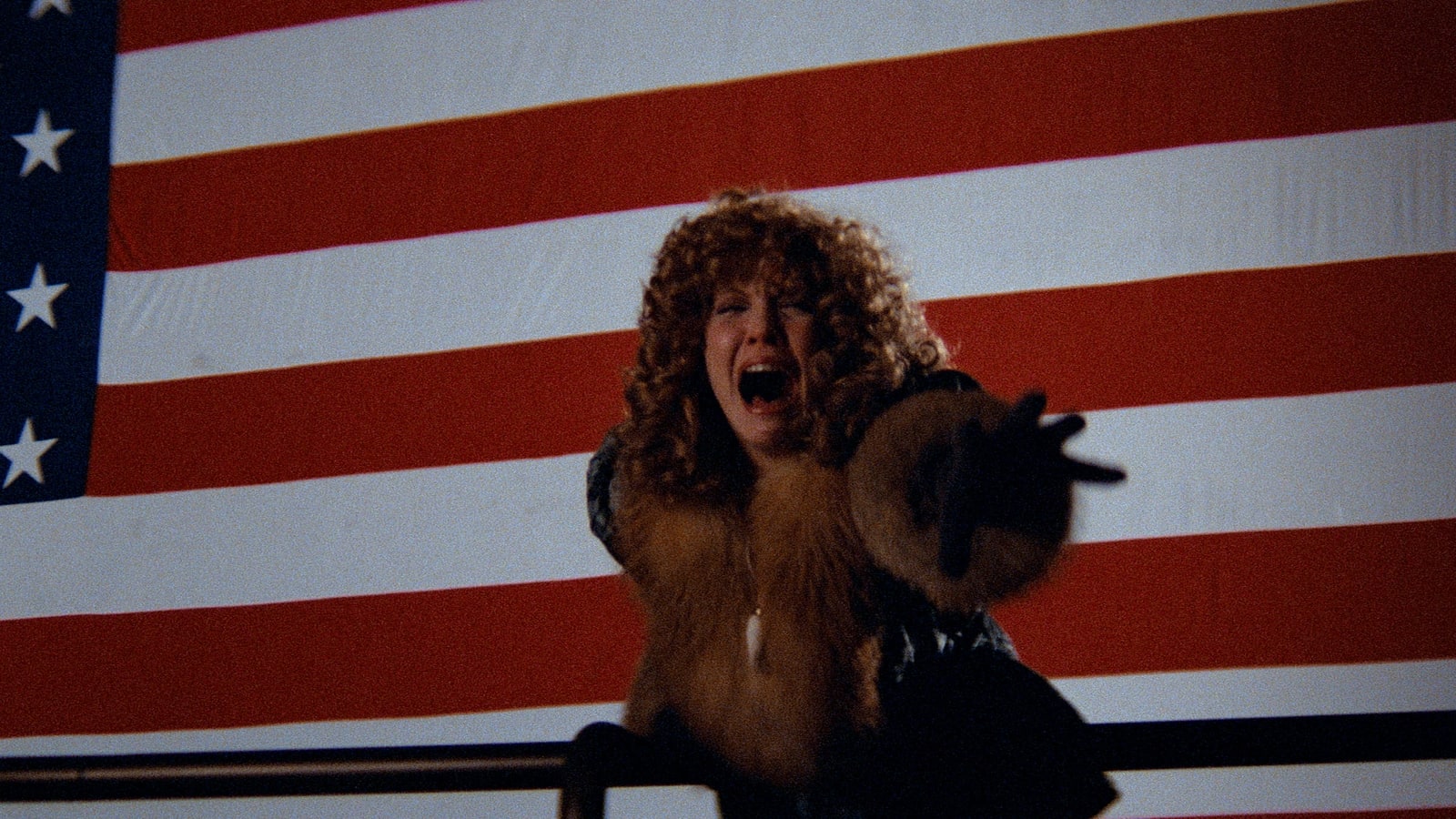
The final pursuit forces him to leave that arrangement behind. Against Philadelphia's Liberty Day celebrations, his effort to reach Sally becomes a desperate run. The BFI's account emphasizes the slow motion and the circling image beneath the fireworks when rescue has failed.[6] The city's public spectacle continues at a scale that makes private catastrophe look almost absorbed into the entertainment.
The transition from listening to running is the film's cruelest change of tempo. Playback allowed Jack to revisit a moment until it yielded a useful relation between sound and image. Here he gets only the time an event takes. He cannot rewind the distance between himself and Sally.
A sound finds another use
The ending returns to Jack's ordinary employment. Sally's death scream supplies the sound for a horror-film scene; his boss welcomes the result. Sragow describes the closing attention to Jack's face as he hears that recording in its new setting.[7]
The sound has survived with enough force to do its job. That is the obscenity. A voice can retain the intensity of an experience while losing its public connection to the person who underwent it. For the production that receives it, the recording solves a practical problem. For Jack, it contains the event he could not prevent.
There is a disturbing symmetry with the reconstruction at his bench. There, he joined a sound to an image to recover a concealed relationship. Here, sound is attached to a different image, and the relationship to its source disappears. The operation remains professionally useful in both cases. Its moral meaning depends on what the combination asks an audience to recognize.
Blow Out leaves Jack with a recording he can replay and a person he cannot recover. The equipment has preserved something exact. Every repetition measures what that exactness cannot give back.
Sources
- The Criterion Collection, “Blow Out” — film identification, 1981 release, cast, and creative credits.
- American Film Institute, “Blow Out,” AFI Catalog — synopsis, the limits of Jack's reconstruction, and Sally's journey with the evidence.
- Peter Tonguette, “Paul Hirsch on ‘Blow Out’,” CineMontage, September 1, 2014 — Hirsch's account of teaching Travolta synchronization and editing the reconstruction sequence.
- Patrick Z. McGavin, “Conversations with Paul Hirsch,” Shadows and Dreams, November 28, 2022 — primary interview on sound placement and picture editing.
- Pauline Kael, “Blow Out: Portrait of the Artist as a Young Gadgeteer,” Criterion — review originally published in The New Yorker, July 27, 1981; Travolta's listening performance and the relation between sound and action.
- Manuela Lazic and Matthew Thrift, “12 masterful Brian De Palma set-pieces,” BFI, September 23, 2016 — the Blow Out section on the final pursuit and fireworks sequence.
- Michael Sragow, “Blow Out: American Scream,” Criterion, April 25, 2011 — Sally's physical risk, the closing scream, and the distributor-published film image accompanying this article.