Kenji Mizoguchi is often introduced through reverence: one of the great Japanese directors, a master of long takes, an artist prized by critics and filmmakers from Kurosawa to Godard.[2][3][5] All of that is true, but it does not yet say what makes a Mizoguchi film feel distinct once the camera starts moving. The movement is the first clue. His tracking shots do not glide in order to flatter decor or prove technical elegance. They keep people attached to the worlds that are wounding them. Streets, riverbanks, brothels, noble houses, backstage corridors, and crowded interiors remain present as active forces. A character in a Mizoguchi film is rarely allowed the luxury of becoming pure psychology detached from surroundings. The room, the class order, the labor system, the war, or the patriarchal custom keeps pressing back into the frame.[1][2][5]
That is why his cinema can feel at once graceful and merciless.[1][2][4][5] BFI's overview is right to describe him as a director of exquisitely choreographed travelling shots and fierce critiques of patriarchal inequality.[1] The two parts belong together. Mizoguchi's signature is not "style plus subject." It is a single method in which camera movement, staging, and social argument are inseparable. His films ask what history looks like when one does not treat suffering as an isolated event, but as an arrangement of people in space, money, law, family, and habit. Again and again, women are the ones forced to hold that arrangement together while men chase prestige, safety, art, military glory, or sexual entitlement.[1][2][3][4]
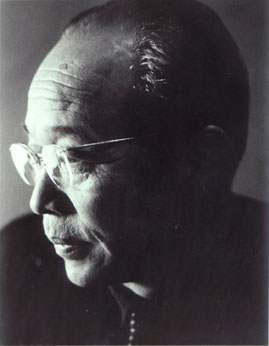
Image context: the lead image uses a real early-1950s portrait from Wikimedia Commons rather than a film still.[6] That choice suits a director profile because the article is about a durable method carried across dozens of films, from the 1930s breakthroughs to the late masterpieces. A public portrait keeps the attention on the filmmaker whose style turned motion into historical pressure.
The camera moves so history cannot be treated as backdrop
One of the most useful descriptions of Mizoguchi's mature style comes from Criterion's essay on Ugetsu, which notes how his long takes and flowing camera movement carry viewers through a world where war, fantasy, male vanity, and female sacrifice are inseparable.[2] This is not only a description of one film. It is a description of the director's whole mature method. His camera does not dart in to rescue a face from its context. It tends to keep enough distance for bodies, walls, doorways, and pathways to stay in relation. The result is that feeling becomes environmental. Grief, ambition, humiliation, and desire have to move through architecture and custom before they reach language.[2][5]
Criterion's older essay on Ugetsu makes the point even more sharply by locating Mizoguchi's breakthrough in a long-form visual logic that kept the camera back, resisted easy close-up emphasis, and let the surrounding world gather psychological density around the characters.[5] That strategy is central to why his films never reduce oppression to speechifying. A woman crossing a room, pausing on a threshold, or being kept at the edge of a conversation can tell us as much as a declarative scene would. Motion becomes diagnosis.
This helps explain why so many critics reach for metaphors of flow, scrolls, or currents when they write about him.[1][5] The images do flow, but not toward freedom. They flow in order to reveal entanglement. A tracking shot along a street or through a household often shows that nobody in the frame occupies private space in a modern, protected sense. Servants overhear, relatives intervene, customers bargain, men watch, and economic need keeps leaking into family feeling. Mizoguchi's beauty comes from refusing to lie about how shared these pressures are.
Women in Mizoguchi are not symbols of virtue; they are where the system shows its cost
BFI's ten-film guide puts the matter plainly: Mizoguchi returned again and again to the unfair burden placed on women in Japanese society across eras.[1] That recurring concern is visible as early as the 1936 pair Osaka Elegy and Sisters of the Gion, which both BFI and Criterion treat as decisive stages in his development.[1][5] Those films do more than announce a social conscience. They establish the emotional geometry that his later work keeps refining: men act, bargain, fantasize, fail, or flee; women absorb the delayed consequences in the form of debt, stigma, sexual vulnerability, domestic labor, or plain endurance.
What matters is that Mizoguchi does not film that burden as inert nobility.[2][3][4] In Ugetsu, as Criterion notes, the men pursue worldly advancement and leave their wives to hold the real cost of war and ambition.[2] In Street of Shame, Criterion points to a late film built during a live Japanese debate over prostitution, where the visual field itself, through layered compositions and choreographed movement, reinforces the drama's cultural critique.[4] The continuity between a sixteenth-century ghost story and a postwar Tokyo brothel is the director's real achievement. The settings are different, but the pressure system is recognizably the same. Institutions translate themselves into daily humiliation through rooms, money, and traffic.
Senses of Cinema is especially valuable here because it reminds readers that Mizoguchi's emphasis on women was not sentimental simplification.[3] His films are full of contradiction, compromise, anger, and compromised agency. They are not about idealized victims. They are about people trying to maneuver inside structures that were designed without their flourishing in mind. This is why the films stay alive. The women in them are not there to decorate a thesis about injustice. They are where history becomes legible.
He preferred sideways pressure to frontal declaration
One of the most perceptive critical observations collected in the Senses essay is that Mizoguchi often lets violence, domination, and moral violation register from the side rather than from the most explicit possible angle.[3] The camera may track laterally, remain partially obstructed, or hold back from the decisive act while making its consequences impossible to ignore. This is not coyness. It is a way of refusing the false mastery that comes from pretending the camera can simply conquer pain by getting closer to it.
That sidelong method deepens the social force of the films. A beating hidden by a wall, a humiliation staged through spatial exclusion, or a sacrifice measured by the route a woman must walk can hit harder than emphatic directness. Mizoguchi trusts arrangement. He knows that where a character stands, who is allowed through a doorway, who has to wait, and which body carries the weight of time are already political facts.[1][3][4]
It also keeps the films from collapsing into pure melodramatic release. Mizoguchi certainly understood melodrama, but he gives it a disciplined visual ethic. Emotional peaks are earned through accumulation: patterned movement, deep-focus staging, repeated acts of service, and a patient attention to how institutions are reproduced in ordinary behavior.[1][3][5] By the time a tragedy declares itself, the viewer has already been made to feel the corridor that led there.
Why Mizoguchi still feels modern
Mizoguchi still feels modern because he grasped something many later filmmakers keep rediscovering: power is easiest to see when one stops imagining individuals as sealed units.[1][2][3] His characters are always being arranged by something larger than temperament alone. A wage, a family obligation, a military crisis, a legal regime, a sex market, a rank structure, a theatrical tradition, a household code: these are not background notes. They are the mediums through which emotion moves.
That is why his long takes do not age into museum polish.[2][4][5] They remain investigative. They ask where the pressure is coming from, who is paying for the arrangement, and how beauty can coexist with coercion in the same image. A director profile built on only one claim would undersell him. Mizoguchi's greatness lies in how three claims become one: the camera flows, women carry history, and social cruelty becomes visible through placement, motion, and delay rather than abstract explanation.
Seen that way, the reputation makes sense.[2][5] Critics praise the elegance because the elegance is real. But elegance is not the destination in Mizoguchi. It is the vehicle for a harder vision. His cinema keeps discovering that historical violence rarely arrives as one isolated blow. More often it arrives as a room one cannot leave, a debt one did not create, a task that never stops, a journey that benefits the wrong person, or a gesture of patience that the world mistakes for natural duty. Mizoguchi made those pressures move across the screen with extraordinary calm, which is why the films continue to cut so deep.
Sources
- Jasper Sharp, "Kenji Mizoguchi: 10 essential films," BFI.
- The Criterion Collection, "The Thin Line Between Reality and Fantasy in Ugetsu."
- Alexander Jacoby, "Mizoguchi, Kenji," Senses of Cinema.
- The Criterion Collection, "Games of Vision in Street of Shame."
- Phillip Lopate, "Ugetsu: From the Other Shore," The Criterion Collection.
- Wikimedia Commons, "File:Kenji Mizoguchi 1.jpg" archival portrait page.