Spoiler note: this essay discusses major scenes from Forty Guns, including the opening ride, the storm sequence, Brockie's attack on the wedding, and the ending.
Samuel Fuller's Forty Guns does not enter the western quietly.[1][2][3][5] It explodes onto the screen with a thunder of riders, a whip of dust, and Barbara Stanwyck elevated above the whole formation as Jessica Drummond, land baron, employer, and the real sovereign presence in the territory.[2][3] That opening is so commanding that it can make the rest of the film sound simpler than it is, as if Forty Guns were merely a novelty western in which a woman gets the biggest entrance. Fuller's actual achievement runs deeper. He uses that entrance to push the genre off its usual balance. The western is still there, with a marshal, bad brothers, a frontier town, and a final reckoning. But the emotional voltage is no longer organized around the clean self-possession of a male gunman. It is organized around excess, spectacle, and public instability.
That is why the movie matters in movement-and-genre terms.[1][2][4][5] Criterion's program note calls it a boldly feminist spin on the western, and the phrase is useful so long as one keeps Fuller's aggressiveness in view.[1] Forty Guns is not simply a corrective in which female authority is inserted into a familiar male template. It is a western whose whole physical grammar changes once Jessica rides into it. Harry Stradling's CinemaScope photography stretches domination sideways across the frame; men gather in clusters, doorways, and barrooms as if they were reacting to weather rather than governing space themselves; and desire keeps leaking into law.[1][2][3] Fuller turns the western baroque by making power visible everywhere at once.
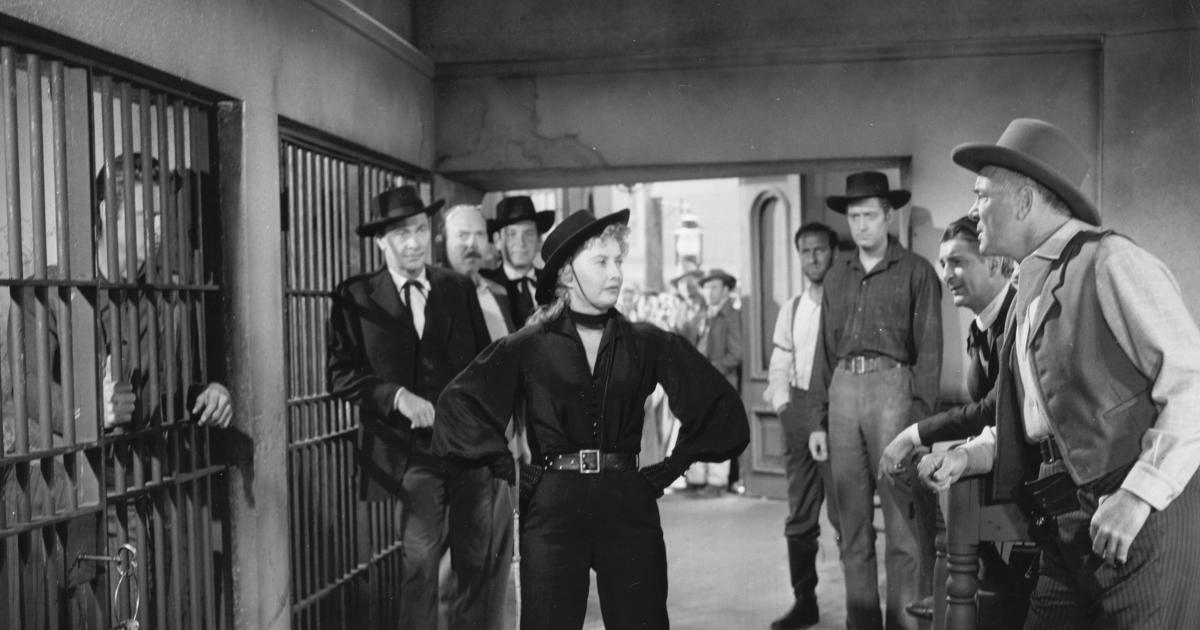
Image context: the lead image uses an official BFI still from the film rather than a poster or a modern promotional collage.[6] That choice matters because this article is about spatial command. The still shows exactly what the movie does over and over: Jessica occupies the center while bars, men, and open sightlines arrange themselves around her like proof that territory in Forty Guns is always being staged in public.
The opening ride transfers western scale to a woman before the plot can settle
Lisa Dombrowski's Criterion essay is especially sharp on the film's audacity because it begins with a cavalry-scale image usually reserved for the settling force of male frontier legend.[2] Forty horsemen tear across the landscape, but the point is not the count alone. The point is that Jessica is at the front, in black, commanding the horizon before the Bonnell brothers have even had time to test the town.[2][3] Fuller is announcing a change in genre ownership. This county has already been claimed, and it has been claimed by someone the western usually treats as secondary, decorative, or endangered.
That transfer of scale matters more than the film's plot mechanics.[1][2][3] Griff Bonnell, the federal lawman played by Barry Sullivan, arrives with the authority that a classical western hero is supposed to carry. He is competent, dry, and visibly hard to impress.[1][3] In another film, his presence would stabilize the world on contact. In Forty Guns, he walks into a world whose spectacle is already occupied. Jessica's rule is excessive, but it is not vague. It has payroll, riders, siblings, fear, and theatrical habits. Her power reaches into the town before Griff can decide what counts as law.
This is one reason the film feels closer to a psychological western than to a frontier procedural.[3][4][5] The opening does not simply set up a conflict over jurisdiction. It unsettles the viewer's default alignment. The marshal is not the figure who first makes the landscape legible. Jessica does. Fuller therefore makes the western start from displacement. Masculine genre competence arrives second.
CinemaScope turns rooms, streets, and tables into power diagrams
The movie's widescreen format is not decorative flourish.[1][2][5] Fuller and Stradling use CinemaScope to keep power horizontal, exposed, and difficult to hide. Long tables, saloon interiors, jail corridors, porches, and street fronts all become testing grounds where allegiance has to show itself in public. Dombrowski notes that Fuller liked to think architecturally, and Forty Guns makes that visible in nearly every confrontation.[2] A character does not merely enter a room. A character redistributes pressure across it.
That spatial pressure is part of what makes Jessica's authority so strange.[2][3][5] She is not only a woman occupying a role coded masculine. She is a woman whom the frame keeps treating as an organizing line. Men lean toward her, report to her, fear her, and define themselves against her. The bars and doorways in the image architecture matter because they let Fuller constantly pose the same question: who is actually contained here?[2][6] The legal apparatus looks masculine and official, yet the social field often bends around Jessica's will instead.
CinemaScope also enlarges contradiction.[1][2] Griff Bonnell is one of Fuller's sturdier men, but he rarely gets the solitary composure that classical western framing would normally grant him. He has to stand inside crowded frames, answer theatrical force with a flatter moral code, and negotiate a county in which the spectacle of authority has already been claimed by someone else. That is what makes the film baroque rather than merely revisionist. The wide frame does not simplify who holds power. It keeps multiplying the evidence.
Mob energy and violent weather make the frontier feel hysterical, not balanced
BFI's film page captures something central when it describes Forty Guns as a psychosexual western built from rivalry, dominance, and destabilizing force.[3] Fuller does not treat the frontier as a zone waiting patiently for order. He treats it as a field already overcharged by family loyalty, erotic command, and public fear. Jessica's bond with her brother Brockie is not a side plot. It is the film's proof that private pathology can rule a county just as effectively as a badge can.[2][3]
This is where the film joins the psychological-western line identified in BFI's genre overview.[4] The western after World War II increasingly allowed neurosis, obsession, and damaged authority to move from the margins toward the center.[4][5] Forty Guns belongs in that shift, but with a distinctive twist: Fuller lets emotional derangement ride in on glamour and command rather than on male weakness alone. Jessica is magnificent, but magnificence in this movie does not equal stability.
The storm sequence is the purest expression of that method.[2][3] Wind in a Fuller film is never just weather. Here it turns the frontier itself into an instrument of emotional coercion. Horses panic, bodies are exposed, and the landscape behaves as if it has taken sides. The western's supposed openness becomes a force that can humiliate and strip people into melodrama. Fuller does not oppose western action to melodrama. He shows that the two were always closer than the genre liked to admit.
The ending restores some male order, but the disturbance remains the point
The film's last movement is often discussed as a compromise, and that judgment has some force.[2] Griff ultimately has to confront Brockie, and Jessica's own position cannot survive unchanged. Dombrowski notes that Fuller himself was unhappy about the degree to which the ending reins the film back toward a more conventional shape.[2] One can feel that recoil. The western mechanism of cleanup begins to reassert itself.
But the movie's lasting interest lies in the fact that the cleanup never fully cancels what came before.[1][2][3] No final gesture can erase the opening ride, the widescreen submission of male space to Jessica's presence, or the storm-driven hysterics that made the county look already sick. Griff may carry away the last procedural burden, yet the film the viewer remembers belongs to Stanwyck's force-field. Forty Guns does not just add a powerful woman to the western. It proves how unstable the genre becomes once a woman seizes its spectacle, its horizon line, and its right to command fear in public.
That is why the film still feels so alive inside the western tradition.[1][2][4][5] It stands at the point where classical form begins to admit that frontier order was always theatrical, gendered, and vulnerable to emotional excess. Fuller does not destroy the genre from the outside. He drives it harder from within until its hidden melodrama shows. The result is not a side road in western history. It is one of the places where the genre learns how strange it can be.
Sources
- The Criterion Collection, "Forty Guns" film page.
- Lisa Dombrowski, "Forty Guns: High-Riding Woman," The Criterion Collection.
- BFI, "Forty Guns (1957)" film page.
- BFI, "Where to begin with psychological westerns."
- Turner Classic Movies, "TCM Spotlight: The Defining Frontier" - genre overview noting Forty Guns as a western marked by toxic masculinity and phallic symbolism within a more character-driven 1950s field.
- BFI still image, "Forty Guns_courtesy BFI (1).jpg" - official film still used for the cover image.