Spoiler note: this essay discusses major plot turns in The Crowd, including the family tragedy and the film's final amusement-hall ending.
King Vidor's The Crowd (1928) is often remembered through one image first: the camera climbing a Manhattan skyscraper, slipping through a window, and finding John Sims at one tiny desk inside a vast sea of clerks.[1][3][4] That shot deserves its fame, but the film's lasting force is broader than one technical triumph. Vidor makes modern city life feel public all the way down. Ambition is public. Courtship is public. Humiliation is public. Even grief, when it comes, has to happen under the pressure of sidewalks, queues, traffic, and other people who have places to be.[2][4][5]
That is why The Crowd still feels sharper than many later films about urban disappointment.[1][2][4] It does not frame John Sims as an exceptional man crushed by unusually bad luck. It frames him as ordinary on purpose. BFI's film page places the movie among the greatest films ever made, and Britannica's summary is useful for a simpler reason: both treat it as a story about a young couple struggling inside the callous scale of modern big-city life.[1][2] Vidor's real achievement is to show that "callous scale" not as abstract sociology but as daily form. The city keeps turning feeling into proportion. It keeps asking how much space any one life can really take up.
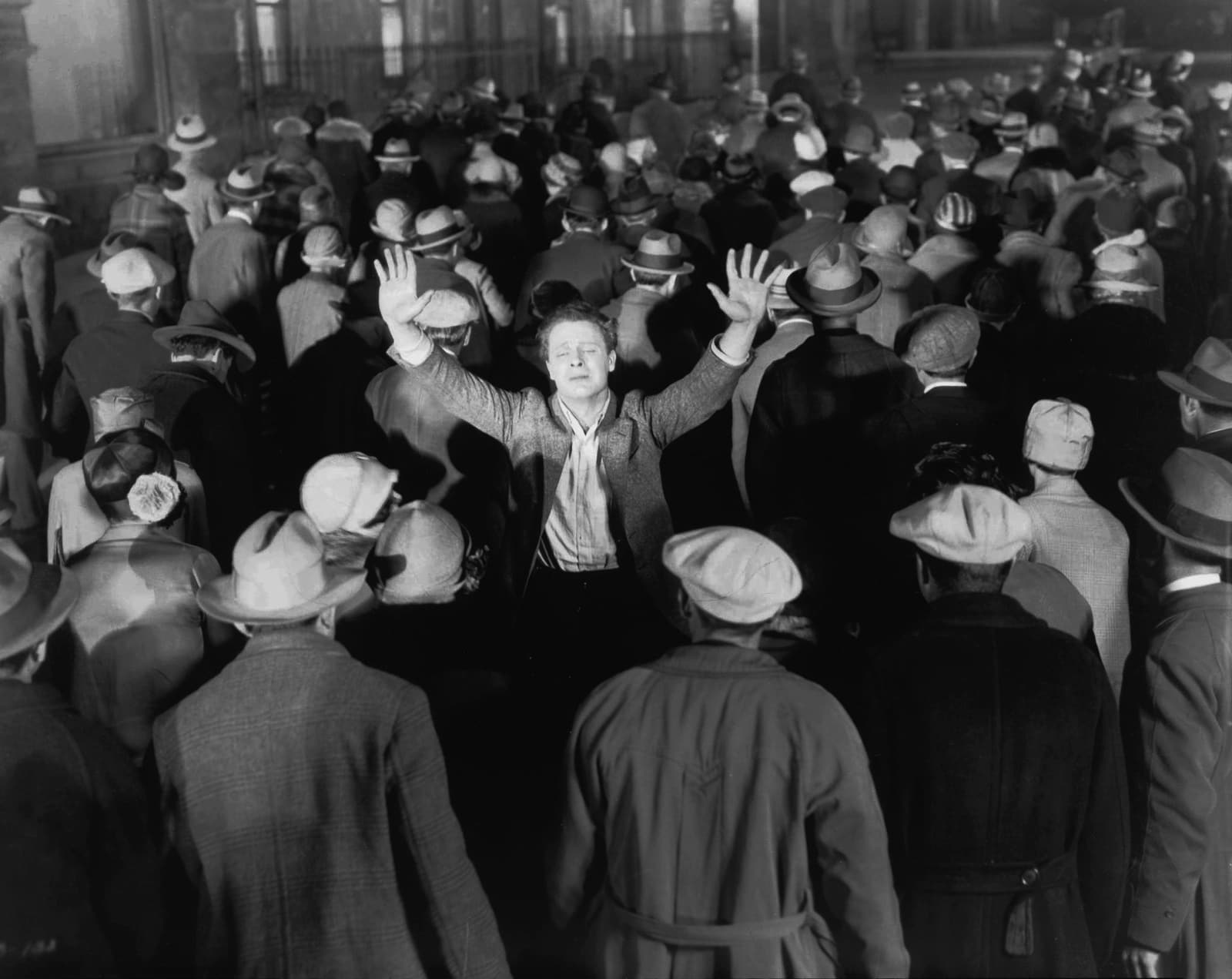
Image context: the lead image uses a real 1928 publicity still preserved on Wikimedia Commons, showing James Murray's John Sims held against a crowd rather than isolated from it.[6] That matters for this essay because the film's subject is never only one man's inner life. It is the unstable ratio between one face and a mass world.
The office grid turns ambition into arithmetic
The movie begins with a cruelly American promise.[2][4] John is born on the Fourth of July, and his father announces that the world will hear from the child.[4] Vidor does not mock that promise right away. He lets it travel with John into New York, where ambition still seems like a natural civic language. But once the famous office shot arrives, ambition changes its shape. It is no longer a dream with clear upward direction. It becomes arithmetic: one desk among hundreds, one clerk among rows, one body inserted into a machine that can absorb personality without ever needing to notice it.[3][4]
TCM's production history helps explain why the shot matters beyond spectacle.[3] Vidor described building it through dissolves, a scale model, and a studio interior rigged to imitate a camera descent before modern crane technology existed.[3] The invention is impressive, but the moral point is more impressive. The shot is not there to say, "Look how big the set is." It says: this is what the city does to private aspiration. It translates "I will become someone" into a visual problem of scale.
Senses of Cinema makes the same point from another angle when it calls John one of the mob on an office assembly line and links the film to a wider current of screen populism between the wars.[4] That phrase matters because The Crowd is not interested in aristocratic tragedy or gangster exceptionalism. John is not a magnified hero. He is a representative case. Criterion's retrospective note on Vidor calls the film one of the boldest departures in American silent cinema after the success of The Big Parade.[5] That boldness lies partly here: MGM resources are being spent not to glorify conquest, wealth, or romance, but to make ordinary employment look spiritually enormous and spiritually diminishing at once.
The office therefore becomes the film's first great emotional instrument.[3][4] It is funny, frightening, and sad in the same frame. John still has his vanity, his jokes, his optimism, his belief that a break will come. Yet the room has already rendered him legible as replaceable. Vidor does not need a speech about capitalism or modern alienation. The desks do the work. The grid does the work.
The sidewalks make feeling visible and thin
What happens outside the office is not liberation. It is exposure.[2][3][4] TCM notes that Vidor wanted real New York whenever possible and even hid a camera inside what looked like a pushcart so he could film the sidewalks without people performing for the lens.[3] That decision gives the street scenes a jagged, unstable life. The city does not wait for John and Mary. It keeps flowing around them, which is exactly the point.
Senses of Cinema is especially strong on what the crowd means in these passages.[4] The film's mass public is not presented as melodramatically evil. It is worse than evil in a more ordinary way: fleetingly curious, then indifferent. When John's life breaks open, he cannot secure lasting exemption from the general movement around him.[4] The street, the line for work, the traffic, the policeman, the strangers who look and then continue, all belong to one civic pattern. A city of this size can briefly witness your suffering without reorganizing itself around it.
That is why the movie's romantic early passages matter too.[2][4] John and Mary do get real pleasure: flirtation, marriage, honeymoon brightness, comic energy. Vidor is not arguing that urban life contains no joy. He is arguing that joy in such a world is always taking place against a background of numerical pressure. The same city that can offer amusement, speed, and spectacle can also make a family emergency feel like an inconvenience to surrounding strangers. One reason the film still hurts is that it never pretends private love builds a full shelter from public scale.
Britannica's broad description of the film as the struggle of a young couple works because Mary matters just as much as John's dreams do.[2] She is not only the wife who absorbs his disappointments. She is the film's measure of endurance. John's ambition keeps colliding with the city's indifference; Mary's steadiness keeps colliding with the costs of that collision. The marriage is moving because Vidor does not sentimentalize either partner's strain. He lets embarrassment, blame, tenderness, and exhaustion circulate through cramped rooms and crowded streets until domestic life itself feels socially overexposed.
The last laugh is not a happy ending but a civic compromise
The movie's ending is famous because it refuses clean verdicts.[4] Senses of Cinema notes that multiple endings were tested and that the version Vidor preferred survives as an ambivalent one, neither triumphal nor annihilating.[4] That ambivalence is the key to the whole film. If The Crowd ended in total destruction, it would become a pure social nightmare. If it ended in uncomplicated uplift, it would betray everything the office and sidewalk scenes have taught us. Instead, Vidor chooses something harsher and more truthful: temporary relief inside a system that has not changed.
The final amusement-hall laughter matters because the film has already taught us how unstable shared feeling can be.[4] Earlier, the crowd watches, judges, presses, or passes by. At the end, John and Mary laugh within that same public field. The laugh is real. It is also conditional. Senses of Cinema highlights the film's governing idea through one of its intertitles: the crowd laughs with you readily, but it does not stay long with your sorrow.[4] Vidor does not contradict that thought in the finale. He stages it. The couple's survival takes the form of rejoining mass entertainment, not transcending mass life.
Seen that way, the ending becomes more daring, not less.[4][5] Vidor grants his characters a breathing space, but not a false redemption narrative in which the city finally recognizes John's uniqueness. It does not. It never will. What the couple achieves is smaller and perhaps more durable: a capacity to remain together without the illusion that modern public life is secretly waiting to reward sincerity. Criterion's note on the film's later influence, from De Sica to Wilder, makes sense here.[5] The Crowd leaves behind not merely a visual template but a moral one. It understands that ordinary people rarely win by escaping the crowd; they win, when they can, by finding a livable rhythm inside its indifference.
That is what keeps the film modern.[1][2][4][5] Its celebrated office shot gives us the geometry of mass society, but the sidewalks and the ending give us the emotional afterlife of that geometry. Vidor turns scale into feeling and feeling back into scale. John Sims remains only one man. The movie never lets him become larger than that. Its greatness lies in seeing that one ordinary life, filmed exactly enough, can be large enough.
Sources
- BFI, "The Crowd (1928)" film page.
- Encyclopaedia Britannica, "The Crowd (film, 1928)".
- Rod Hollimon, "The Crowd (1928)." Turner Classic Movies.
- Adrian Martin, "The Crowd." Senses of Cinema.
- The Criterion Collection, "King Vidor, the Versatile Messenger."
- Wikimedia Commons, "File:The Crowd - 1928 film still.jpg" - source page for the lead image.