
The BFI trailer for Jeanne Dielman, 23, quai du Commerce, 1080 Bruxelles is only ninety-six seconds long, yet it understands a difficult thing about Chantal Akerman's film: the right way to advertise it is to leave the rhythm intact.[1] Many rerelease trailers try to rescue severe canonical films from their own reputations. They cut faster, explain more, and translate patience into prestige language. This trailer does use prestige language, but it never lets the endorsements outrun the images. The first pressure comes from a kitchen, a table, and repeated work.[1][2]
That choice matters because the film's greatness has always depended on a strange balance between exactness and dread. BFI's release page describes a three-day routine followed in hypnotic detail, while Janus stresses the film's sense of impending doom inside enormous spareness.[2][3] The trailer keeps those two claims together. It does not pretend the movie is secretly plotty. It shows the routine so steadily that plot begins to feel like a disturbance waiting at the edge of the frame.[1][2][3]
This is why the trailer is worth an annotated viewing instead of a generic recommendation. Akerman's cinema, as Janet Bergstrom argues in Sight and Sound, keeps a deliberate distance while still making female experience newly visible on screen.[4] The trailer respects that distance. It does not invade Jeanne's mind with explanatory voice-over. It lets labor, rooms, corridors, and posture do the work. By the end, the preview has built a pressure chamber out of household repetition and a few carefully chosen thresholds.[1][4]
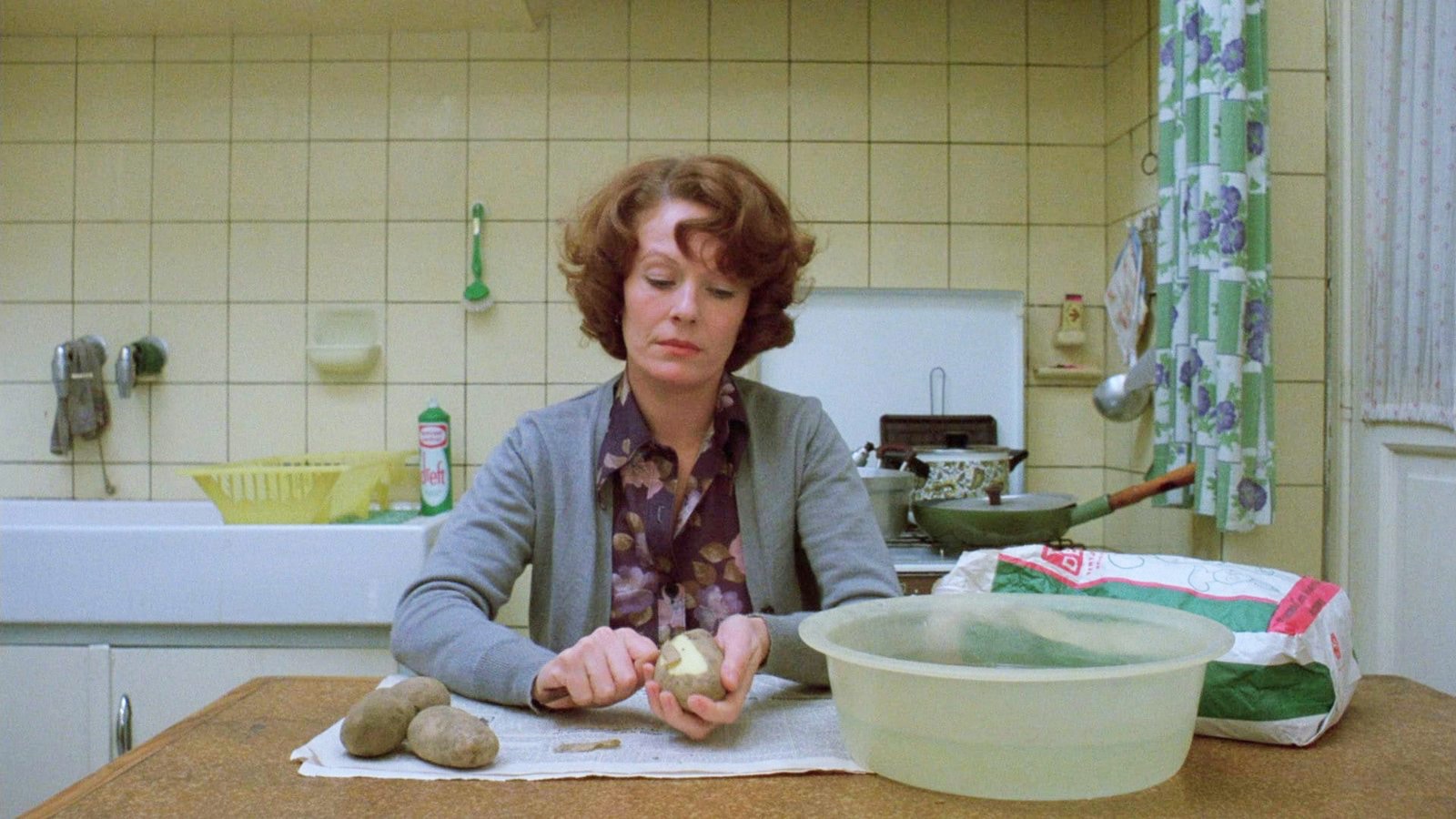
Image context: the cover uses BFI's official still of Jeanne peeling potatoes at her kitchen table. It is the right image here because the trailer's formal wager begins with domestic procedure in full view: task before confession, rhythm before climax, and a face that stays legible while refusing melodramatic display.[2]
Around 0:00, the trailer opens with work before character, and that decision sets the terms of suspense
The first images stay in the kitchen: Jeanne at the stove, Jeanne at the sink, Jeanne handling utensils, Jeanne at the table.[1] That sequencing is unusually stubborn for a trailer. There is no quick plot hook, no clarifying synopsis card, no effort to establish "what kind" of woman she is through biography. Instead the preview lets activity come first. On BFI's release page, the film is introduced through meticulous daily routine across three days, and the trailer takes that description literally by making labor itself the opening spectacle.[2]
That opening also teaches the viewer how to read duration. A conventional suspense trailer wants the early seconds to generate questions of danger. Here the danger is structural. The kitchen table, tiled wall, sink, and curtained window return so insistently that the room starts to behave like a measuring device.[1][2] Janus calls the film one of cinema's most complete depictions of space and time, and the trailer compresses that idea into a miniature method lesson: watch how the body repeats, watch how the room receives the body, then wait for something tiny to land wrong.[3]
This is also where the trailer announces its confidence in Jeanne as a filmed surface rather than a decoded psyche. Bergstrom's essay on Akerman's work stresses the importance of representation and distance in films that keep asking who gets to speak and how women appear on screen.[4] The trailer follows that logic. Jeanne is not introduced through testimony. She is introduced through peeling, washing, carrying, and placing. The viewer is asked to attend to behavior with the same seriousness most trailers reserve for revelation.[1][4]
Around 0:24, the quotation cards do not interrupt the routine; they intensify it
By the twenty-four-second mark, the trailer begins laying critical endorsements over continued images of Jeanne dressing, turning, and moving through the apartment.[1] The phrases are familiar enough, "a tour de force of cinematic modernism" and later "a mesmerising piece of rhythmical film-making," yet their placement is smart.[1] They do not replace the domestic images with an abstract claim of importance. They sit on top of those images, as if to say that the modernism under discussion is exactly this repetition of dressing, cleaning, preparing, and pausing.
That matters because prestige language can flatten a film like Jeanne Dielman into a museum object. The trailer avoids that trap by keeping the labor in view. BFI's own synopsis describes the movie as revolutionary in narrative subject and structure precisely because it rigorously records ordinary life in extended time.[2] The quote cards only work because the footage underneath them never stops demonstrating that proposition. The trailer's rhythm says: do not imagine the film's seriousness as something floating above the potato, the coat, or the basin. The seriousness is in the potato, the coat, and the basin.[1][2]
There is another subtle effect here. Quote cards usually promise consensus, and consensus tends to calm a viewer down. In this trailer they do the reverse. Because the images keep circling back to the same woman in the same apartment, praise begins to sound like a warning label. If this much attention is being directed at work this small, then every gesture is going to matter. The preview turns endorsement into pressure. It tells the viewer that rhythm is the event.[1][3]
Around 0:40 to 1:04, the trailer opens the apartment outward, and the new spaces feel less like escape than extension
The forty-second second is where the trailer briefly changes air. One title card gives way to an exterior street view, then to a hallway shot with Jeanne moving at a distance.[1] On paper that might look like variety. In practice it sharpens the same idea the kitchen has already established. Akerman's film does not build suspense by escaping domestic space for a freer outside world. The street and corridor arrive carrying the apartment's tension with them.[1][4]
The hallway image at roughly 1:04 is especially revealing.[1] It is dark, narrow, and deep, with Jeanne moving at the far end as if she were already partially absorbed by the architecture. That frame tells the viewer that the movie's crisis will not arrive through a sudden genre detour. It will emerge from space itself: a woman walking farther into rooms and routines that have been measured too exactly. Bergstrom's emphasis on distance is useful here. The camera does not lunge forward to rescue intimacy. It lets the corridor stay a corridor, and that refusal is what makes the image tense.[4]
Even the short street glimpse serves the same end. It does not open the film up into urban bustle or social breadth. It makes Jeanne look carried by timetable and route, another body moving through an already organized system.[1] The trailer keeps tightening the screw that Janus names in larger terms: a simple daily order that contains its own doom because it cannot tolerate drift for long.[3]
Around 1:12 to the end, the final images promise rupture without ever showing catharsis
The trailer's last movement is the best one. Around 1:12, Jeanne is shown sitting frontally in a chair, then the preview returns to kitchen-table work and ends on a still frame under the words "coming soon."[1] A standard trailer would save some explosive disclosure for this stretch. BFI's trailer saves posture. Jeanne sits. Jeanne returns to the table. Jeanne keeps working. The effect is more unnerving than a spoiler could have been.
That ending is faithful to how the film has often been described. BFI's release note speaks of charting the breakdown of a bourgeois housewife, mother, and part-time sex worker across three days.[2] The trailer understands that breakdown should be sold as a question of tolerance, not spectacle. How long can a pattern hold before one misplaced action changes its moral temperature? The final seated image suggests fatigue, but it does not solve it into legible psychology. The last table image suggests routine, but by then routine has become loaded.[1][2]
This is why the trailer feels like a pressure chamber. It teaches the viewer that suspense will come from the smallest deviation inside a system of exact repetition, and then it refuses to discharge that suspense for us in advance.[1][3] The preview ends where the film begins to do its real work: making domestic procedure large enough to carry dread, social order, and the possibility that one minute adjustment might turn a household rhythm into a fatal break.[2][3][4]
Sources
- BFI, "Jeanne Dielman, 23, quai du Commerce, 1080 Bruxelles UK trailer | In cinemas 7 February 2025," YouTube video.
- BFI, "Jeanne Dielman, 23, quai du Commerce, 1080 Bruxelles" - BFI film release page with synopsis, credits, and official still.
- Janus Films, "Jeanne Dielman, 23, quai du Commerce, 1080 Bruxelles" - official film page.
- Janet Bergstrom, "Keeping a distance: Chantal Akerman's Jeanne Dielman," Sight and Sound / BFI.