Billy Wilder's The Apartment is usually remembered as a bittersweet office romance, which is accurate and still too gentle.[1][2][3] What gives the film its sting is not romance alone but circulation. Promotions, favors, affairs, and humiliations all move through one compact network: a desk in a giant insurance office, an elevator ride, a key passed from one hand to another, and a bachelor apartment that stops belonging to its owner the moment the company decides it is useful. C.C. "Bud" Baxter does not climb the corporate ladder by demonstrating unusual talent. He climbs by turning his private room into company infrastructure.[2][3]
That is why the movie still feels unusually modern in 2026.[1][2][4] Wilder and I.A.L. Diamond do not treat office life as neutral background for a love story. They treat the corporation as a machine that teaches people how to reorganize intimacy in transactional terms. The joke is that Baxter appears to be a playboy because his apartment is always occupied. The wound is that he barely lives there himself.
Spoiler note: this essay discusses the apartment-key arrangement, Fran Kubelik's overdose attempt, and the film's ending.
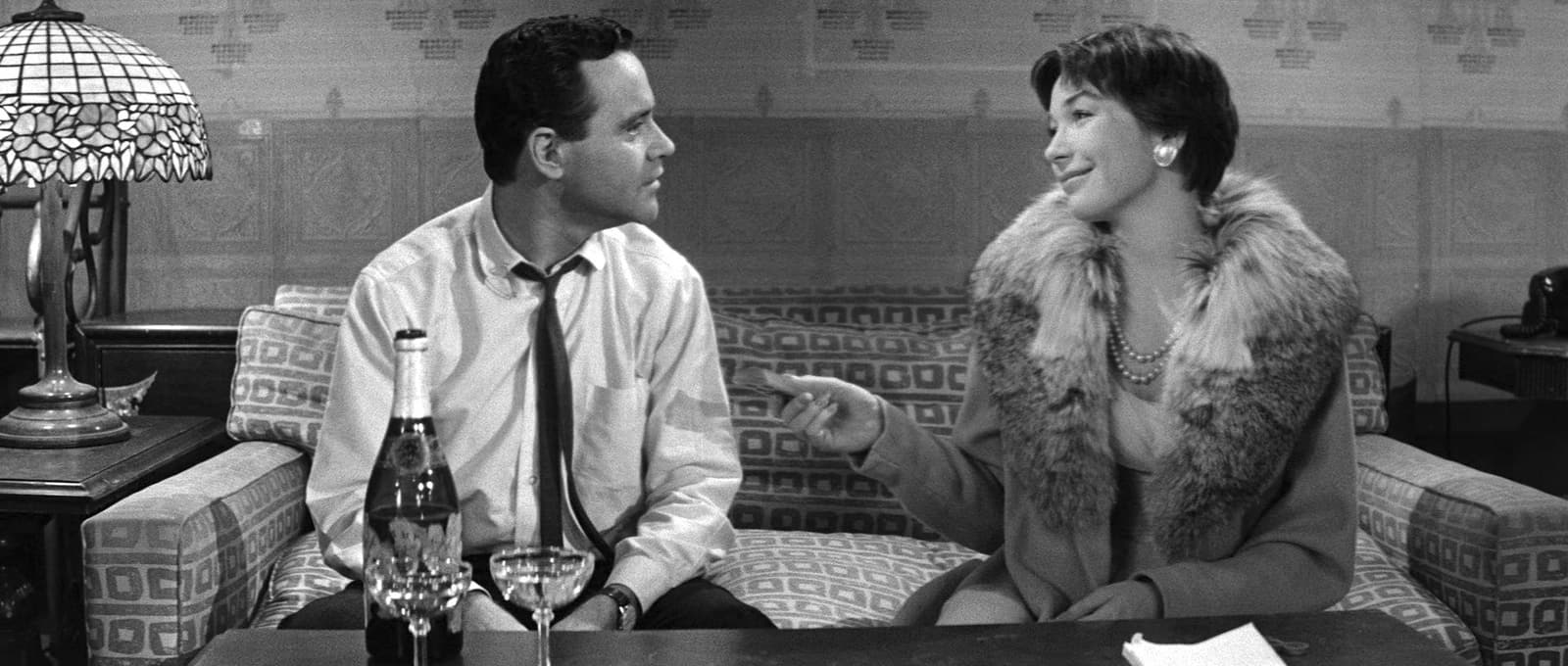
Image context: the lead image is a real trailer still of Jack Lemmon and Shirley MacLaine in The Apartment. It belongs here because this essay reads the film through the distance between apparent closeness and the institutional systems that keep dictating who gets time, privacy, and leverage.[5]
The key is the film's real currency
The most memorable prop in the movie is not a martini glass or a desk calendar. It is the apartment key.[2][3] TCM's awards-season essay notes that Wilder thought in "hooks," the bits of business audiences would remember long after other plot mechanics faded, and Jack Lemmon said people kept asking him for "the key" years after the release.[2] That is not an accident of clever screenwriting. The key matters because it converts abstract office ambition into a physical object that can be passed, withheld, delayed, or abused.
Every time Baxter lends out the apartment, the film tightens the link between career mobility and moral compromise.[2][3] A manager needs a room for an affair; Baxter needs favorable attention from that manager; a key changes hands; someone else gets displaced. Wilder's genius is that he never lets this system stay invisible. Timing conflicts, missed dinners, late-night waits in the cold, and frantic cleaning all keep reminding us that the "favor" is not symbolic. It has a cost in minutes, sleep, dignity, and self-respect.
This is why the movie's romance remains so precarious. Baxter's love for Fran Kubelik cannot unfold in a clean private sphere, because the private sphere has already been colonized by office hierarchy.[1][3] Even before he understands that Fran is entangled with Jeff Sheldrake, the personnel manager he is trying to impress, Baxter has already let the corporation occupy the space where sincerity would need to begin.
The elevator is a vertical class system disguised as flirtation
Fran's job matters more than a quick plot summary usually admits. She is the elevator operator, which means she literally moves people up and down the building while remaining structurally stuck near the bottom herself.[1][2] In a film obsessed with rank, this is almost too perfect. Executives rise by pressing buttons and stepping out at the right floor. Fran helps that movement happen, smiles through it, and becomes one more woman the system assumes can be slotted into male advancement.
Wilder and MacLaine never reduce her to a symbol, which is why the role hurts.[2] Fran has wit, fatigue, speed, and a practiced office brightness that already suggests how much emotional labor the building has trained into her. When Sheldrake exploits her, the relationship is not just a private betrayal. It is a management relationship revealing its real content. The boss who can move careers also assumes he can manage a woman's hope on the side.
That is where the elevator and the apartment connect. One organizes vertical corporate mobility in public daylight; the other absorbs the private mess that mobility produces after hours. Fran moves bodies through the office tower. Baxter's apartment receives the consequences.
Baxter's desk proves the office is designed to erase individuality first, reward conformity second
The film's famous office floor remains one of the sharpest images of white-collar dehumanization in American movies.[1][3] The Library of Congress essay places The Apartment directly in the postwar conversation about "organization men," corporate loyalty, and the making of a worker who is useful precisely because he is replaceable.[3] Baxter begins at Desk 861 in Ordinary Policy, Premium Accounting Division, Section W, a location that sounds less like a career identity than a filing instruction.[3]
The office does not merely look large. It is built to make ambition feel both absurd and irresistible. The rows of desks stretch so far that individuality starts to disappear into pattern.[1][3] Baxter becomes visible to his superiors not by breaking that pattern but by serving it more efficiently than others do. He is rewarded for making the machine more comfortable for the men above him.
That is why The Apartment never flatters upward mobility as self-making. It treats promotion as borrowed vocabulary. A better office, executive washroom privileges, a name on the door: these are signs that the institution has temporarily changed its posture toward Baxter, not proof that he has become whole.[3] The more he is rewarded, the thinner his own life becomes. Advancement here does not enlarge the self. It rents it out.
The apartment is not freedom. It is overflow space for other people's power.
The title sounds as if the movie will revolve around one private room, one refuge, one compact urban world of bachelor loneliness and possible love. Wilder gives us that room, then empties it of sovereignty almost immediately.[1][2][3] Baxter's apartment is supposed to be the place where he can stop performing for the office. Instead it becomes the place where office performance continues under softer lighting.
That reversal is what makes the overdose sequence so devastating. Wilder's balancing of comedy and despair is famous, and rightly so.[2] But formally the scene matters because the apartment finally receives the full emotional bill for the arrangement that had seemed merely humiliating and inconvenient before. The room that had functioned as executive spillover space becomes the place where a woman's abandoned hope nearly turns fatal.
From that point on, Baxter can no longer pretend he is participating in a harmless exchange of favors. The room itself has become accusatory. The key is now attached to a human cost he can no longer rationalize away.
The broken compact mirror deepens this logic. Like the key, it is a small object that carries an entire social structure inside it.[3] Once Baxter recognizes it, the movie's emotional geometry snaps into focus: the woman he loves has been living inside the same system of borrowed time and managed deception that has been lifting his career.
The ending works because Baxter stops treating success as access
The film's moral turn is often summarized through the word "mensch," and the summary holds because Wilder gives the idea material weight.[3] Baxter's late decision is not an abstract ethical awakening floating above the plot. It is a rejection of the system's terms. He discovers that career access without self-respect is only another form of dependency. To resign is to stop translating every relationship into upward usefulness.
This is also why the ending between Baxter and Fran remains so moving. It is tender, but Wilder refuses to over-certify it.[1][2] They do not step into some clean future guaranteed by romantic destiny. They reach one another after the machinery of office desire has done real damage, and the famous final line works because the film has finally earned a room where conversation no longer has to serve promotion first.
In that sense, The Apartment is not a simple love story with satirical decoration. It is a study of how institutions leak into flirtation, housing, scheduling, sex, and self-image until even affection starts sounding like office procedure. Baxter and Fran matter because they are the first people in the film who try, however imperfectly, to step outside that grammar.
Why the film still bites
The period facts remain impressive. TCM notes that the film more than doubled its reported $3 million budget by the end of 1960, drew ten Academy Award nominations, and won five Oscars including Best Picture, Best Director, and Best Screenplay.[2] The Library of Congress later selected it for the National Film Registry.[3] BFI still describes it as a then-risqué romantic comedy set amid "corporate New York's sea of sexual deception," which remains an unusually compact summary of its tonal daring.[1]
But statistics are only the surface explanation for its durability. The deeper reason is that The Apartment understands something structural about modern work: institutions rarely seize private life by direct command. They do it by rewarding small accommodations until the accommodations become a way of life. A loaned key, a delayed dinner, an elevator ride, a promotion that feels flattering for five minutes and hollow for five years. Wilder saw that this was already comedy material in 1960. He also saw that it was tragedy waiting a floor above.
Return to the film now and its brilliance feels less nostalgic than diagnostic. It asks a question that corporate culture still struggles to answer: if success depends on letting the institution price your private life, what exactly have you been promoted into?
Sources
- BFI, The Apartment (1960) film page.
- Turner Classic Movies, "Awards Season: The Apartment (1960)."
- Kyle Westphal, "The Apartment," National Film Registry essay, Library of Congress.
- The Criterion Collection, "Billy Wilder's The Apartment."
- Wikimedia Commons, "File:The apartment trailer 1.JPG."