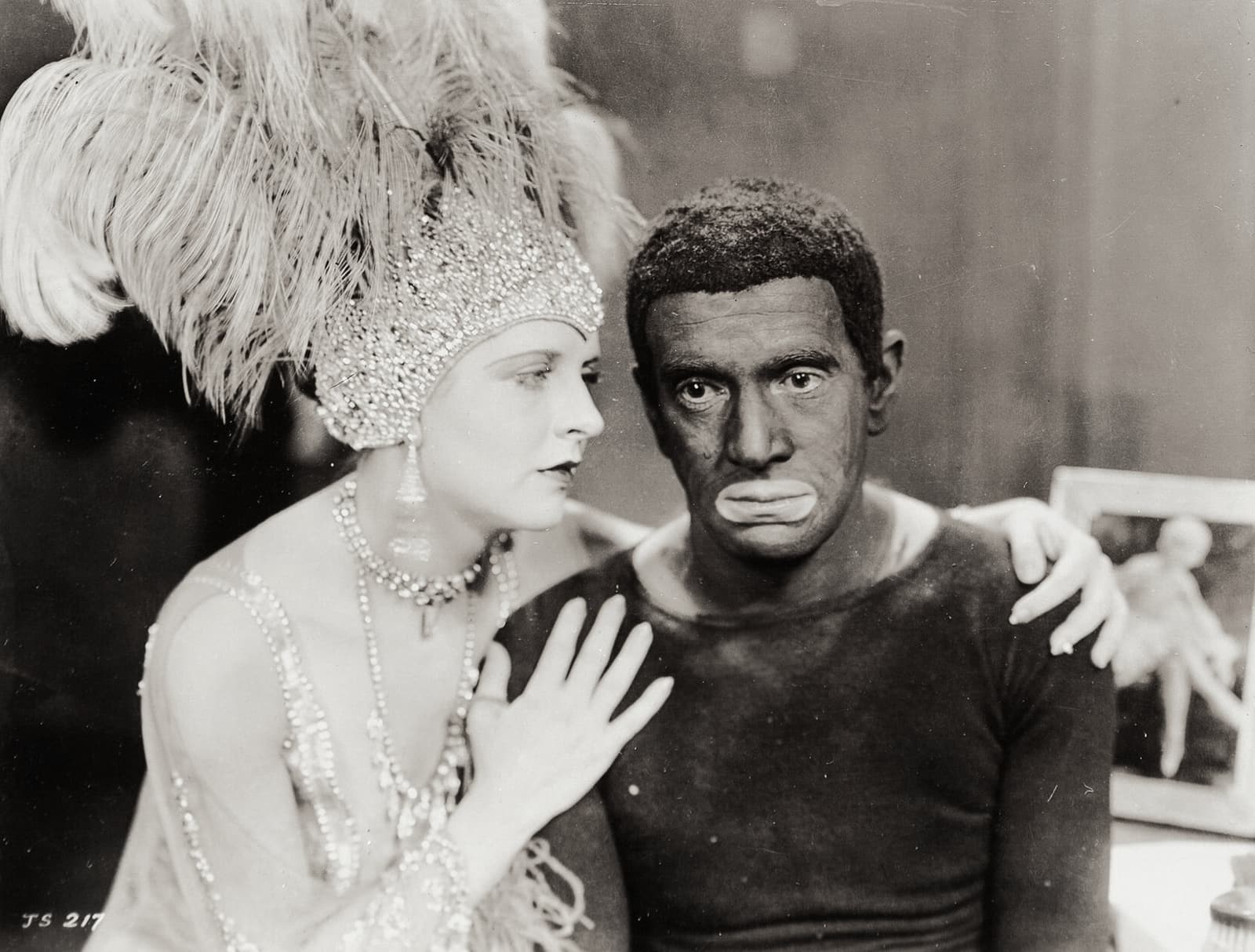
The easiest way to misread The Jazz Singer is to call it the first talking picture and stop there. That phrase is tidy, but the film itself is not tidy. Alan Crosland's 1927 Warner Bros. feature is mostly silent in structure, built around synchronized music and effects, with only short passages of spoken dialogue. Its real importance is industrial rather than purely formal: it made synchronized sound feel less like a demonstration and more like a deadline.[2][3]
That distinction matters because Hollywood had already seen sound experiments, shorts, recorded scores, and competing systems. Vitaphone did not arrive in a vacuum. What changed with The Jazz Singer was the alignment of technology, star performance, theatrical novelty, and corporate pressure. A sound-on-disc system that might have stayed an expensive specialty suddenly looked like a way to sell a different kind of moviegoing and to reposition Warner Bros. inside a studio economy that was still dominated by bigger rivals.[2][4]
The film's breakthrough is also morally difficult to handle cleanly. Jolson's performance history and the film's blackface scenes remain inseparable from its place in American entertainment. AFI's record includes racial impersonation among the film's subjects, and later commentary has treated Jolson's blackface not as an incidental blemish but as part of how the film stages assimilation, ethnic performance, and racial stereotype.[3][5][6] A serious industry history has to keep both facts in view: The Jazz Singer accelerated the sound era, and it did so through performance conventions that now demand direct naming.
Vitaphone solved one problem and created another
Vitaphone was a sound-on-disc system: the picture ran on film while synchronized audio played from separate discs. Britannica describes it as a sophisticated system associated with Western Electric and Warner Bros., and that wording gets at the point. It was impressive enough to sell as modernity, but it was not the future standard that optical sound-on-film would become.[4] The system's value in 1927 was transitional. It could carry music, songs, effects, and selected speech into theaters before the industry had fully settled on the next durable norm.
The practical burden was real. Ron Hutchinson's Library of Congress essay notes that early projectionists had to contend with many Vitaphone discs for The Jazz Singer, later reduced to a smaller number, and that the movie premiered in only two theaters on October 6, 1927.[2] That is not the profile of a technology already ready for ordinary mass circulation. It is the profile of a format whose promise was racing ahead of its logistics.
Yet the logistics did not cancel the promise. They sharpened it. Every successful engagement told exhibitors that sound was not merely an engineering curiosity; it could change ticket demand. Every added theater made the question more urgent: whether to invest in wiring, equipment, training, and a new kind of programming before competitors did. The synchronized voice was not just an aesthetic event. It was a capital-allocation signal.
The film worked because it was only partly a talkie
One reason The Jazz Singer could break the market is that it did not ask audiences to abandon silent-film grammar all at once. AFI records that the film begins as a silent picture with background music, then shifts into synchronized song and speech at carefully charged moments.[3] That structure made the new technology legible. Viewers were not dropped into a fully redesigned medium. They were watching familiar melodrama until sound punctured the surface.
The famous cafe interruption and the parlor scene with Jolson and Eugenie Besserer are important for exactly that reason. The Library of Congress essay emphasizes that the parlor exchange blends music, talk, and Jolson's star personality, while also noting that the film contained only a small amount of actual dialogue.[2] The effect was not continuity of speech. It was rupture. Sound entered as presence, not wallpaper.
That is why the movie's mixed reception did not prevent its business effect. Some critics found Jolson excessive, and contemporary viewers were not all immediately writing manifestos about a new art form.[2] But novelty does not need unanimous critical elegance to reset an industry. The film showed that a few strategically placed sound passages could make an otherwise conventional melodrama feel like an event. That was enough.
Warner Bros. turned a hit into a timetable
The strongest evidence of the film's significance is what happened after it made money. Hutchinson's essay gives the business chain plainly: the film cost hundreds of thousands of dollars, earned millions by 1931, helped push Warner Bros. expansion, and was followed by studio commitments to synchronized Vitaphone accompaniment on future features.[2] The point is not just that The Jazz Singer succeeded. The point is that success converted sound from optional experiment into studio policy.
That conversion is what makes the film an industry-technology story rather than a single-film legend. A new medium does not arrive when a machine functions in a laboratory. It arrives when enough institutions begin reorganizing around the machine. Warner Bros. had to think about production planning, theater acquisition, equipment installation, music publishing, performer contracts, and marketing language. Exhibitors had to decide whether a wired theater was a premium advantage or a defensive necessity. Rivals had to judge whether waiting was prudence or surrender.
The timetable was brutal. The Library of Congress essay frames the transformation as one of the most rapid reinventions of a major industry, with silent pictures effectively overtaken by the end of 1929.[2] That does not mean every silent artist became obsolete overnight or that silent-film form suddenly lost value. It means the commercial center moved. Once audiences associated sound with modern moviegoing, silence became harder to sell as the default rather than as an artistic choice.
The star was part of the apparatus
Vitaphone needed Jolson because the machine alone could not carry the event. MoMA's collection note gets close to the film's odd rhythm when it describes it as essentially silent but suddenly alive in the ad-libbed moments with Jolson at the piano.[5] The phrasing matters. Sound had to appear attached to a body that audiences already understood as theatrical excess: a singer who leaned forward, addressed the room, and treated performance as direct contact.
That is also why the publicity still is more than decoration. McAvoy and Jolson are not demonstrating a microphone or a disc turntable. They are selling a human arrangement: intimacy, courtship, stage ambition, and the sense that personality might now cross the screen with its voice intact.[1] Early sound needed technical synchronization, but it also needed a reason for audiences to care that synchronization had happened. Jolson's persona supplied that reason.
The problem is that the same persona carried the burden of blackface minstrelsy. Britannica's film entry notes that Jolson's blackface has long been studied in relation to stereotypes and ethnic assimilation, while the Jim Crow Museum essay places the performance inside a larger career and cultural argument about race, popularity, and contradiction.[6][7] The film's sound breakthrough cannot be purified away from that history. Its modernity traveled through an old stage convention that made racial impersonation part of the spectacle.
The legacy is a breakpoint, not a blueprint
Seen from a distance, The Jazz Singer looks like a door opening: before it, silent cinema; after it, talking pictures. Up close, it looks more like a hinge. It is a part-talkie, built with a transitional sound-on-disc system, dependent on a vaudeville star, uneven as drama, commercially explosive, and historically compromised. It did not provide the final technical blueprint for sound cinema. It provided proof that the industry could not delay the transition much longer.[2][3][4]
That is the more useful lesson for film technology. The winning artifact is not always the cleanest version of the future. Sometimes it is the artifact that makes the future unavoidable. Vitaphone sound-on-disc would be surpassed, and The Jazz Singer would remain aesthetically awkward beside many late silent masterpieces and early sound films that learned subtler techniques. But the market heard enough. The system, the star, and the partial voice made the cost of waiting suddenly visible.
The film's importance therefore sits in a double register. It is a milestone in synchronized sound, and it is a warning against milestone thinking. No single movie "invented" sound cinema by itself. The Jazz Singer mattered because it forced a network to move: studios, theaters, performers, technicians, critics, and audiences all had to re-price the future of the medium. After that, silence was no longer the industry's natural condition. It was a choice made under new pressure.
Sources
- Wikimedia Commons, "File:McAvoyJolsonJazzSinger.jpg" (Warner Bros. 1927 publicity photo for The Jazz Singer, featuring May McAvoy and Al Jolson).
- Ron Hutchinson, "The Jazz Singer," Library of Congress National Film Registry essay (Vitaphone Project context, premiere details, dialogue count, box office, and Warner Bros. transition).
- AFI Catalog, "The Jazz Singer" (1927; production companies, story history, sound-sequence notes, synopsis, and subject metadata).
- Encyclopaedia Britannica, "Vitaphone" (sound-on-disc system, Warner Bros. adoption, and relation to The Jazz Singer).
- Museum of Modern Art, "Alan Crosland. The Jazz Singer. 1927" (collection record and short description of the film's partly silent structure and Jolson's dialogue moments).
- Encyclopaedia Britannica, "The Jazz Singer" (film overview, synchronized dialogue significance, Academy recognition, and blackface/assimilation context).
- Jim Crow Museum, "Al Jolson: A Megastar Long Buried Under a Layer of Blackface" (context for Jolson's public persona, blackface performance, and debates around The Jazz Singer).