Charles Burnett's Killer of Sheep can sound, in summary, like a simple social-realist film about a slaughterhouse worker named Stan. That description is accurate and too small. The film is not built like a problem drama in which one job explains one man. It is built like a neighborhood weather system. Work, dust, concrete, children, music, errands, marriage, and fatigue keep moving through one another until plot becomes less important than pressure.[1][2]
The UCLA Film & Television Archive frames the production history as part of the meaning: Burnett began shooting the 16mm film on spare weekends in 1972, completed it piecemeal, saw it gain festival attention in the early 1980s, entered the National Film Registry in 1990, and then watched it wait years for music-rights clearance before wider commercial circulation.[1] That delayed afterlife fits the film's form. Killer of Sheep is about what accumulates slowly: unpaid bills, awkward tenderness, children learning the street by touch, and a man whose labor has thinned his capacity to be present at home.
Watts without an establishing speech
Burnett does not introduce Watts as a sociological case file. He lets the neighborhood assemble from fragments. Children jump across rooftops, throw rocks, climb fences, sit on ledges, and turn vacant space into temporary game boards. Adults move through cramped rooms, doorways, stores, back lots, and cars that do not always cooperate. The camera does not announce that these images are "about" postindustrial decline. It lets ordinary texture carry the argument.
That restraint matters because the film's politics are not detached from style. UCLA's program note describes Stan's slaughterhouse job as wearing him down, alienating him from his family, and becoming an unspoken metaphor for economic malaise in South Los Angeles.[1] The key word is "unspoken." Burnett's strongest images do not behave like explanatory captions. A sheep carcass hanging in the workplace, a child balanced above concrete, a husband unable to answer his wife's emotional reach: each image is precise enough to need no lecture, but open enough to keep meaning from hardening into a slogan.
This is why the film still feels fresh. It refuses the false clarity of a single cause. Stan is exhausted by work, but the film does not pretend that changing one job would instantly repair every wound. Poverty, masculine shame, neighborhood humor, racialized labor history, music, friendship, parenting, and tenderness all remain in the frame. The film's ethics are in that refusal to simplify.
Work enters the home before Stan does
Stan's job at the slaughterhouse is central, but Burnett does not use it as a melodramatic machine. The workplace scenes have a harsh physical charge: hanging bodies, repetitive cutting, industrial order, and the strange intimacy of touching dead weight all day. Yet the more devastating effect is indirect. Work enters Stan's body, then enters the home through silence.
The Criterion Channel synopsis calls the film a portrait of a slaughterhouse worker whose demanding job and everyday pressures fray his family life, but it also emphasizes Burnett's poetic and humane eye for working-class Black Los Angeles.[2] That balance is crucial. Stan is neither heroic victim nor moral failure. He is a man whose emotional range has been narrowed by conditions that the film makes visible but does not reduce to a lesson.
The marriage scenes are painful because they are quiet. Stan's wife wants contact, not a speech. The room is close, the bed is close, the distance between them is not. Burnett films domestic space as a test of remaining energy. After a day of killing and carrying, Stan has too little left for touch, too little for reassurance, sometimes too little for anger to become articulate. Work has not simply tired him. It has made responsiveness expensive.
That is the film's central close-reading problem: the slaughterhouse is not a symbol pasted onto the story. It is a rhythm that changes what ordinary gestures can bear. A glance, a pause, a refusal to dance, a conversation that dies before it starts: these are the film's real dramatic turns.
Children make the neighborhood legible
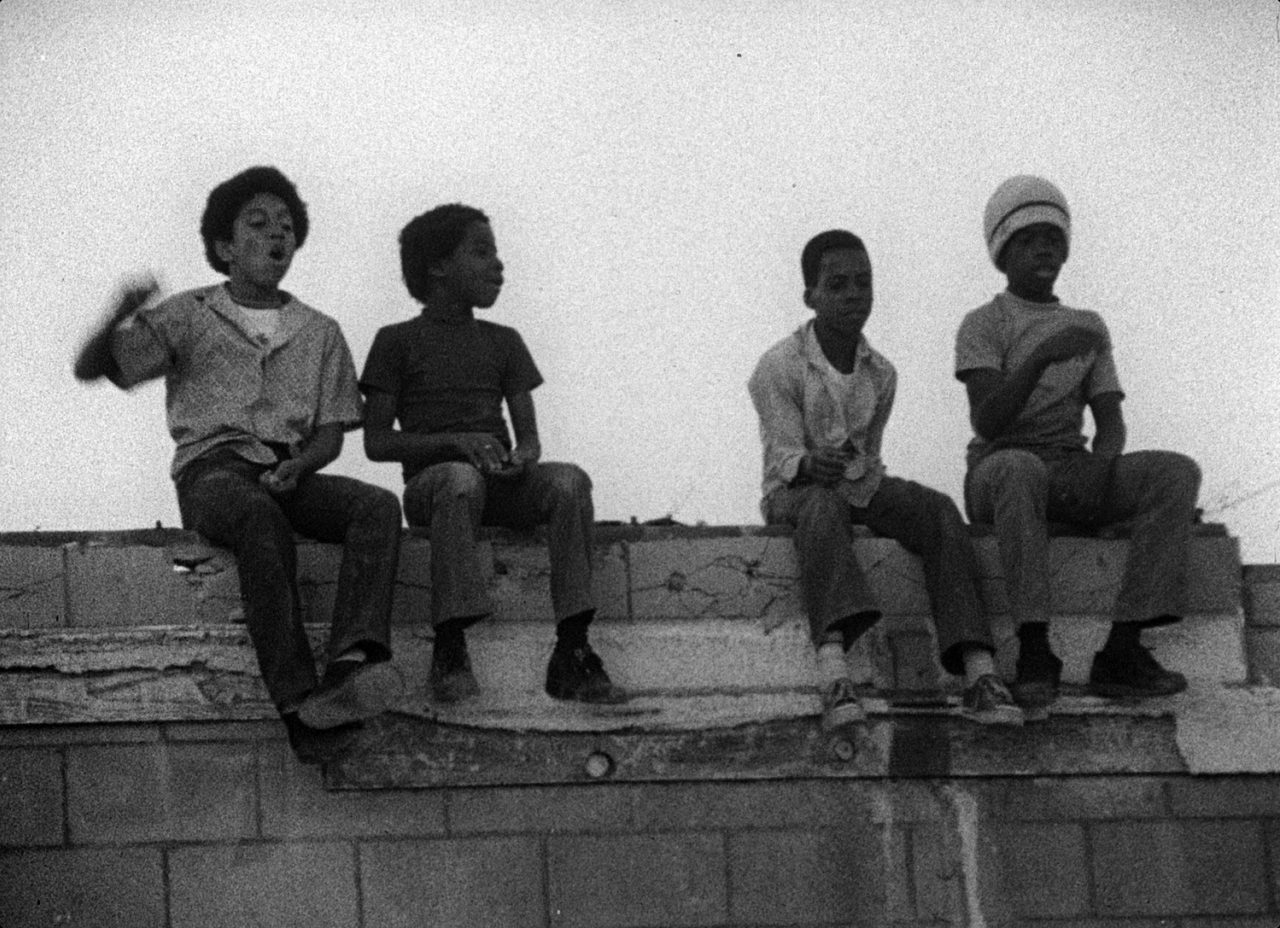
The children in Killer of Sheep are not decorative evidence of innocence. They are the film's sharpest readers of space. The UCLA still used as this article's image shows children sitting on a concrete ledge, and that posture captures Burnett's method: the child body is both precarious and at home, exposed to danger yet fluent in the neighborhood's surfaces.[1]
Burnett repeatedly gives children's play a density equal to adult labor. Their games are funny, rough, inventive, and sometimes alarming. They treat the built environment as a set of challenges: roofs, alleys, dirt lots, walls, and ledges become routes and stages. This is not sentimental childhood. It is apprenticeship. The children are learning balance, risk, loyalty, boredom, courage, and the physics of hard surfaces before the adult world has fully named those lessons.
That is why their scenes do not interrupt Stan's story. They widen it. Stan's exhaustion is one present-tense outcome of a world the children are already mapping with their bodies. The film lets the viewer feel continuity without forcing destiny. A boy on a ledge is not automatically a future Stan, but he is living inside the same material conditions: limited money, improvised pleasure, neighborhood intimacy, and public space that offers freedom and danger in the same gesture.
Blues structure without plot machinery
The movie's music is famous partly because it kept the film from wide distribution for years. UCLA notes that rights clearance delayed commercial circulation until after the film's 2000 restoration and later release.[1] That history is more than trivia because the music is not ornamental. Blues, soul, and classical selections help shape the film's movement from vignette to vignette.
The Milestone Films page, built around the film's later home-video life and restoration visibility, emphasizes how Burnett's long-overlooked work became available to new audiences after years of preservation, rights, and distribution hurdles.[3] The same release history helps explain why Killer of Sheep now feels less like a recovered curiosity than a missing grammar for American independent cinema. Its music-led fragments make narrative out of recurrence rather than escalation.
Instead of driving toward a conventional climax, the film returns to moods: fatigue, play, stalled desire, absurd humor, bodily work, small hope, sudden beauty. The music lets those moods connect without forcing them into a neat chain of causes. A song can make an ordinary room ache. A shift in sound can make a street scene feel like memory while it is still happening. Burnett's soundtrack does not tell the viewer what to feel; it thickens the air until feeling becomes unavoidable.
Why the film's incompleteness is its form
Some films feel fragmentary because they are underbuilt. Killer of Sheep feels fragmentary because Burnett understands that Stan's life is not organized around viewer satisfaction. The American Film Institute's catalog record fixes the production basics, including Burnett as writer-director, the late-1970s completion context, cast, and release history.[4] Those facts matter because they place the film inside independent production rather than studio polish. Its looseness is not a defect to be corrected by a tighter plot. It is the shape of lives that are constantly interrupted by work, money, children, favors, repairs, and fatigue.
The film's famous car episode is a perfect example. In a conventional story, the attempt to get and use a motor would become a clean step toward escape or humiliation. Burnett lets it become something stranger: a comic, frustrating, practical errand that briefly gathers male friendship, hope, mechanical failure, and the absurdity of trying to change a life with one fragile object. The scene matters because it does not solve anything. It shows how people keep trying anyway.
That refusal of neat payoff is the film's dignity. Stan does not receive a redemptive speech. His family is not converted into a moral diagram. Watts is not flattened into despair. The film leaves room for grace without pretending grace is enough.
A landmark that still resists the label
TCM's release-history essay notes the film's passage from hard-to-see reputation to National Film Registry recognition, UCLA restoration, and Milestone's campaign to clear the music-rights problem that had kept it from ordinary circulation.[5] But the label "landmark" can make the film sound settled, as if its value belongs mainly to canon history. Burnett's movie resists that museum quiet. It remains restless because its images keep asking how cinema can honor lives that do not present themselves as clean stories.
That is the close-reading answer: Killer of Sheep matters because it makes work atmospheric. The slaughterhouse is not only where Stan goes. It is a pressure that follows him into touch, speech, sleep, and fatherhood. Watts is not only where the story is set. It is the active texture through which children test gravity, adults test endurance, and music keeps unfinished feeling in circulation.
The result is a film of extraordinary tenderness without comfort. Burnett watches people closely enough to find beauty, and honestly enough not to make beauty solve the terms of living. A child on concrete, a man in a slaughterhouse, a woman waiting for touch, a song crossing a room: the film lets each fragment stay small and then, by accumulation, makes it enormous.[1][2][5]
Sources
- UCLA Film & Television Archive, "Killer of Sheep" page in the L.A. Rebellion collection, including production, restoration, National Film Registry, image, and contextual notes.
- The Criterion Channel, "Killer of Sheep" film page, with synopsis, credits, runtime, and streaming context.
- Milestone Films, "Killer of Sheep" product and restoration-distribution page, including home-video context and release notes.
- AFI Catalog, "Killer of Sheep" film record, with credits, release history, and production metadata.
- TCM, "Killer of Sheep" article, covering the film's hard-to-see reputation, UCLA restoration, music-rights clearance, and National Film Registry status.