Duck Soup is sometimes treated as the Marx Brothers' cleanest political statement, and that is true only if "statement" is allowed to mean something fast, unstable, and happily destructive. Leo McCarey's 1933 comedy sends Freedonia and Sylvania toward war with Groucho Marx's Rufus T. Firefly in office, Chico and Harpo working as spies, Zeppo in his last Marx Brothers film role, and Margaret Dumont preserving ceremonial seriousness while the room collapses around her.[1][2][3] But the film's force does not come from a neat thesis about one government, one party, or one historical villain. It comes from showing how authority can be performed badly and still be recognized as authority.
That is why the movie still feels sharp. Duck Soup does not argue that politics becomes absurd when ridiculous people enter it. It argues something harder: political ceremony is already close enough to theater that a vaudeville team can expose its joints by taking the ritual literally, speeding it up, and refusing to respect the pauses where dignity is supposed to gather.[2][4] Cabinet meetings, diplomatic etiquette, patriotic songs, military costumes, courtroom-like accusations, and war mobilization all become routines. The state does not vanish. It turns into a machine for cueing entrances, insults, reversals, and group numbers.
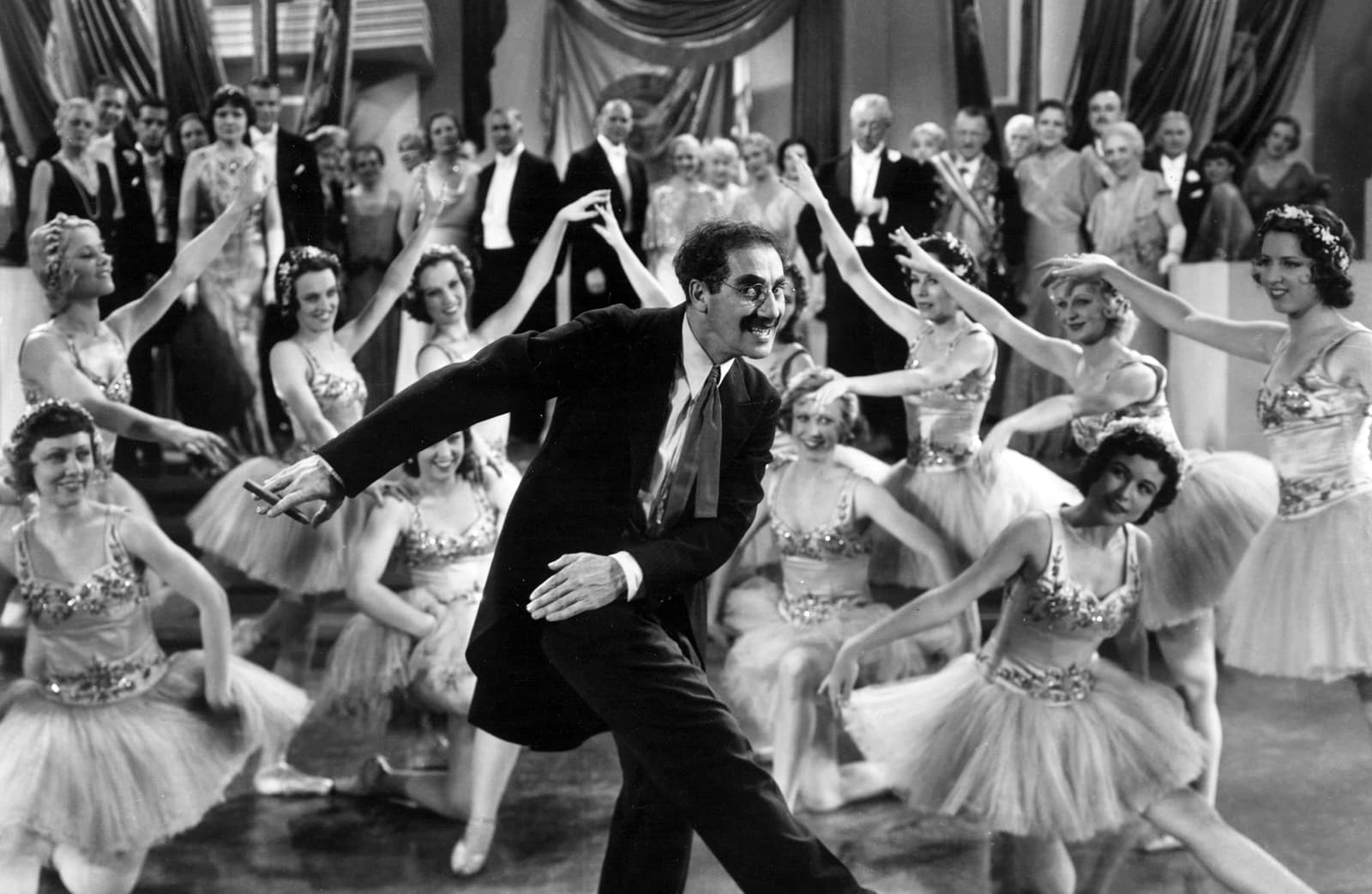
Image context: the lead image uses a 1933 publicity still of Groucho in character as Firefly, preserved on Wikimedia Commons.[5] It is a real film-related photographic still rather than a poster, diagram, or generated visual. The image is useful because Firefly's body is already the argument: a leader made out of greasepaint, uniform detail, cigar angle, and refusal to stop performing.
The joke starts by removing the safety rails
TCM's production account makes one structural point especially useful: Duck Soup drops several familiar Marx Brothers comforts. There is no Harpo harp solo, no Chico piano solo, and no Zeppo romantic subplot, elements that had given earlier Paramount films gentler pauses and parallel tracks.[2] Their absence matters. The film feels more dangerous because it has less cushioning. Instead of stopping to admire virtuosity or rescue the plot with conventional romance, it keeps feeding almost every sequence back into the central pressure: Freedonia is being governed by comic impulse.
That compression gives the film its strange velocity. BFI describes the premise as two small countries pushed toward war through bad feeling, spying, and personal insults.[1] The word "personal" is important. In Duck Soup, diplomacy is not a sober system occasionally disrupted by temperament. Temperament is the system. Firefly turns statecraft into grievance management, flirtation, and verbal one-upmanship. Trentino's schemes matter less as geopolitics than as social irritation. Mrs. Teasdale's wealth and respectability give the government a base, but her dignity only makes the surrounding anarchy more visible.[1][2]
The result is not realism, even as Depression-era government anxiety sits behind the film's release context.[2][4] It is a comic anatomy of public form. A country needs a leader; Firefly appears. A leader needs ceremony; ceremony becomes entrance music and costume. Diplomacy needs negotiation; negotiation becomes insult rhythm. War needs mobilization; mobilization becomes a production number. Each institution keeps its outline just long enough for the Marxes to climb inside and operate it wrong.
Firefly is funny because he treats office as permission
Groucho's Firefly is not merely incompetent. Incompetence would be too slow. He is radically opportunistic about the rules around him. If a title gives him access to a room, he uses the room as a stage. If a national crisis gives him an audience, he uses the crisis as material. If a woman of standing treats him seriously, he turns that seriousness into a prop and tests how long it will hold.[2][3]
That distinction is why Duck Soup does not date as easily as many topical satires. TCM notes that later critics read the film's anarchic politics and war ending as a critique of fascism and nationalism, while also warning against making the movie too programmatic.[2] That caution is right. Firefly is not a coded portrait of one dictator. He is more like a stress test for political theatricality itself. The office grants him gravity, and the comedy comes from watching gravity fail to discipline him.
Margaret Dumont is essential to that failure. TCM's account emphasizes how seriously she plays Mrs. Teasdale, calling her the calm center that makes the surrounding madness more effective.[2] That is not a side note about performance style. It is the film's operating condition. If everyone were winking, the satire would deflate. Dumont supplies the world in which status, manners, and patriotic feeling are supposed to mean something. Groucho then proves that a sufficiently agile performer can borrow those meanings without believing in them for a second.
The mirror scene is a political gag, not only a comic set piece
The famous mirror routine is often remembered as pure physical comedy, and it certainly works at that level.[2] Harpo, disguised as Firefly, must mimic Groucho so precisely that the absence of the mirror becomes the joke. The sequence is nearly wordless, which makes it feel atypical in a Groucho-centered film, but it belongs to the essay's political center. It turns leadership into reproducible surface.
For a few minutes, identity is not an inner truth but a set of gestures that can be copied: posture, timing, stride, cigar handling, facial angle, the rhythm of hesitation and recovery. That is funny because Harpo is trapped in a technical problem. It is sharper because Firefly himself is already a technical problem. What makes a leader legible? A uniform? A mustache? A room's willingness to accept the performance? The mirror routine strips the answer down to behavior and timing.
The scene also clarifies why the film's anarchy is more cinematic than merely theatrical. TCM argues that Duck Soup gave the brothers their best and last opportunity to be outrageous while also making their comedy more cinematic and less stage-bound than parts of the earlier films.[2] The mirror routine proves the point. It depends on framing, duration, spatial alignment, and the viewer's awareness of what cannot be present in the room. Vaudeville gives the film its bodies and timing; cinema makes the impossible mirror plausible enough to become a machine.
War arrives as a costume department with a chorus
The war finale is where Duck Soup becomes most openly savage. Freedonia's military crisis does not build toward solemn sacrifice. It breaks into songs, costume changes, shifting uniforms, and increasingly unstable patriotic display.[1][2][4] The point is not that war has become unreal. It is that public reality has become too easy to dress up.
The Library of Congress National Film Registry essay treats Duck Soup as an enduring work of comic anti-authority, and the film's preservation history confirms that later viewers found more in it than a failed 1933 release could initially reveal.[4] That delayed recognition makes sense. The movie's war logic looks reckless until the viewer sees how precisely it collapses military seriousness into show-business procedure. A uniform can be swapped. A song can accelerate commitment. A leader can insult his way into conflict and then stand inside patriotic spectacle as if spectacle itself were justification.
This is why the ending's aggression does not feel like a normal comic climax. It refuses the comfort of a restored order. TCM notes that the film disappointed some contemporary viewers and critics, then later became widely admired for its anarchic strain and political bite.[2] The same movement is built into the finale. A conventional comedy might resolve confusion by restoring marriage, property, or proper rank. Duck Soup resolves by exposing resolution as another gag. The state has moved from ceremony to bombardment without ever passing through reason.
The film lasts because it does not explain the joke to death
AFI's Movie Club note points to the film's durable canon position: it appears on AFI's major American-film lists and ranks high among American screen comedies.[3] That reputation is not just reverence for the Marx Brothers as personalities. It reflects how cleanly Duck Soup converts their comic method into a whole world. The movie is short, fast, and almost suspiciously lean. There is little sentimental ballast, and the plot is strong enough to organize the chaos without becoming strong enough to restrain it.[1][2]
That balance is the reason the film remains useful as political cinema. It does not offer a policy diagnosis. It offers a form diagnosis. It shows how easily official life can depend on costumes, entrances, songs, insults, repetition, and the social labor of people willing to pretend the performance is still dignified. The comedy is not a vacation from politics. It is politics stripped to timing.
So the best way to read Duck Soup is not as a prediction, allegory, or one-note antiwar message. It is a theme essay performed at machine speed. Government becomes vaudeville when public forms keep operating after their meanings have emptied out. Firefly's great talent is not that he destroys Freedonia from outside. It is that he recognizes, faster than anyone else, that the office is already full of cues.
Sources
- British Film Institute, "Duck Soup (1933)" film page, with credits, premise, running time, and Sight and Sound poll context.
- Mark Frankel, "Duck Soup (1933)," Turner Classic Movies, March 24, 2005, covering production context, reception, McCarey, Margaret Dumont, the mirror scene, and later critical reputation.
- American Film Institute, "DUCK SOUP (1933) - AFI Movie Club," October 2, 2025, noting the four Marx brothers, Freedonia premise, Zeppo's final straight-man role, and AFI list placement.
- William Wolf, "Duck Soup," Library of Congress National Film Registry essay, covering the film's comic anti-authority afterlife and preservation significance.
- Wikimedia Commons, "File:Groucho Marx in Duck Soup film still.jpg," 1933 publicity still used for the article image.